They have reacted — but not with a broad-based sell-off.
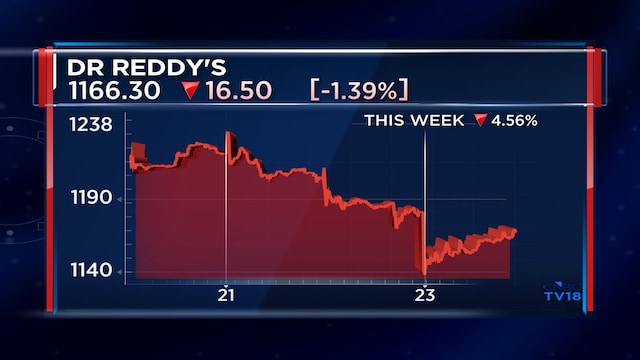
Dr Reddy’s Laboratories has fallen 4.56% over the past week, while Zydus Lifesciences, Cipla, Glenmark Pharma and Aurobindo Pharma have also declined. Sun Pharma, however, has gained 1.24%.
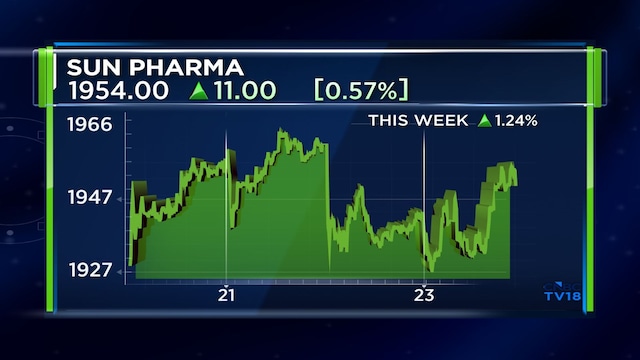
The uneven reaction suggests that investors are taking the tariff threat seriously, but are not yet pricing in the worst-case scenario.
Under the timeline announced by Trump, generic drugs will face no tariffs for two years. The tariff is then proposed to rise to 100% from August 1, 2028, and to 200% from August 1, 2029.
So, why aren’t Indian pharma stocks panicking yet?
The answer lies in four factors: the tariffs are not immediate, moving generic manufacturing to the US is economically difficult, Indian drugmakers already have a significant US manufacturing footprint and the entire tariff burden may not necessarily be absorbed by pharmaceutical companies.
The tariffs are still two years away
The first reason is timing.
Under the timeline announced by Trump, generic drug imports will not face tariffs for two years. That gives pharmaceutical companies time to assess their options, including expanding manufacturing in the US, changing supply chains and deciding which products can be economically made locally.
The industry is also waiting for greater clarity on the final tariff structure and the outcome of India-US trade negotiations.
“The two-year implementation window provides companies an opportunity to adapt their supply chains,” Anuj Sethi, Senior Director at Crisil Ratings, said.
Sethi also pointed out that the final tariff structure and the outcome of trade negotiations are still evolving.
For investors, this means the proposed tariffs are not an immediate earnings shock. Companies have time to respond before the policy takes effect.
Can generic drug manufacturing really move to the US?
The second and perhaps most important reason is the economics of generic drug manufacturing.
Manufacturing a drug in India can cost 30% to 50% less than in the US. That cost advantage has been a key reason why India has become a major supplier of generic medicines to the American market.
A move to the US could therefore significantly increase manufacturing costs.
Priyanka Chigurupati, Executive Director of Granules India, said the company would be prepared to expand its US manufacturing presence if required. However, she said moving large-scale generic production to the US would be extremely difficult because of the cost difference.
“I see that to be close to being impossible at this point purely because of the cost differential,” Chigurupati said.
She added that manufacturing costs could rise by 20% to 25%, making it difficult for companies to pass on the entire increase to customers.
This is the central economic challenge for Trump’s plan.
Generic drugs are already subject to intense competition and constant price erosion. The market also involves multiple dosage forms, strict manufacturing requirements and highly competitive pricing.
Building large-scale domestic capacity in a higher-cost market could therefore make many generic medicines commercially unviable.
In other words, imposing a tariff on imported generics may make imports more expensive, but relocating all production to the US could make the medicines more expensive as well.
That is one reason investors may be reluctant to immediately price in the full impact of a 100% or 200% tariff.
Existing US plants could cushion the impact
Indian drugmakers are also not starting from zero in the US.
Aurobindo Pharma, Dr Reddy’s Laboratories, Lupin, Cipla, Zydus Lifesciences, Sun Pharma and Glenmark all have a presence in the US.
Granules India, for instance, already operates two US facilities and is setting up a third.
This gives companies with existing US assets a potential advantage. They can expand existing facilities or shift selected products to local manufacturing instead of building an entire US supply chain from scratch.
Indian pharmaceutical companies have also invested around $20 billion in the US across manufacturing, research and supply chains, according to the Indian Pharmaceutical Alliance.
IPA Secretary General Sudarshan Jain said companies would continue to evaluate future investments based on the commercial viability of individual products rather than policy announcements alone.
Some medicines, particularly high-value or specialised products, may make economic sense to manufacture in the US. Low-cost, commoditised generics may not.
That distinction could become increasingly important for investors.
Who ultimately pays for the tariff?
The third factor is the possibility of cost pass-through.
The US is heavily dependent on imported generic medicines, with Indian manufacturers supplying around 40% of its generic drug demand.
This creates the possibility that some of the tariff-related cost could be passed through the supply chain rather than being absorbed entirely by Indian manufacturers.
That does not mean pharmaceutical companies will be able to pass on the full tariff. The ability to do so will vary by product and will depend on competition, pricing pressure and the importance of the medicine.
But investors are also unlikely to assume that a 100% or 200% tariff will automatically translate into an equivalent hit to company margins.
The extent to which costs can be passed on will ultimately depend on the economics of individual products.
The final policy is still uncertain
The market is also waiting for answers to several important questions.
Will the tariff apply equally to all generic medicines? Will essential drugs be exempt? Will companies receive credit for existing US investments? How will products manufactured partly in the US be treated?
The answers could materially change the impact on individual companies.
The industry is also engaging with US authorities on issues including the identification of essential medicines and product categories that could be manufactured competitively in the US.
For now, the tariff announcement is therefore being treated as a policy risk rather than a fully defined earnings event.
Which Indian pharma companies could be better placed?
The impact is unlikely to be uniform across Indian pharma.
Companies with existing US manufacturing facilities, the ability to expand local capacity and a portfolio of complex or specialised products could be better placed.
The same could be true for companies with products in areas such as oncology, complex delivery systems and biosimilars, where the economics of local production may be stronger.
Companies that remain heavily dependent on manufacturing in India for highly commoditised generic products could face greater pressure if tariffs are ultimately implemented in their proposed form.
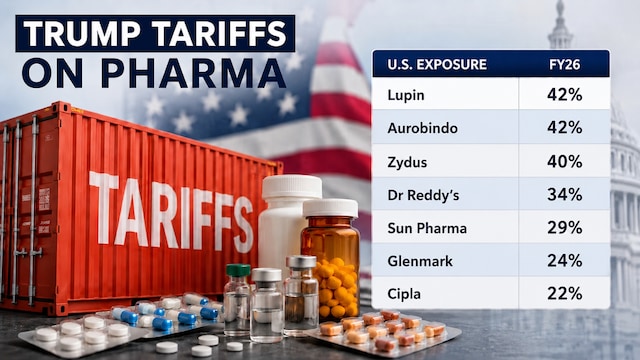
However, revenue exposure to the US should not be confused with tariff exposure.
A company may generate a large share of its revenue from the US but manufacture some of those products locally. Another company may have a lower overall US exposure but export a larger proportion of its products from India.
The actual impact will therefore depend on product-level manufacturing and supply-chain exposure.
The long-term shift beyond traditional generics
The Indian pharmaceutical industry is also gradually investing more in original drug discovery, clinical development and innovation.
According to Priyanka Aggarwal, India and South East Asia Leader, Healthcare Practice at Boston Consulting Group, patent filings by Indian pharmaceutical companies have increased fourfold over the past decade.
She also pointed to the emergence of more than 10 original assets and molecules discovered by Indian companies.
“Over the last few years, we feel that there is an inflection point now where Indian companies are also investing significantly in innovation,” Aggarwal said.
This shift will not solve the immediate tariff problem. But over time, a move towards complex drugs, proprietary medicines, biosimilars and innovative therapies could reduce the industry’s dependence on low-margin, price-sensitive generic exports.
The market is reacting — just not to the worst-case scenario yet
The stock market’s reaction has been cautious and uneven.
| Company | Weekly Stock Movement (%) |
| Dr Reddy’s Laboratories | -4.56 |
| Zydus Lifesciences | -3.79 |
| Cipla | -2.25 |
| Glenmark Pharma | -1.34 |
| Aurobindo Pharma | -0.43 |
| Sun Pharma | 1.24 |
The differing performances suggest that investors are not treating the tariff threat as an identical risk across the sector.
The market appears to be weighing the risks against several mitigating factors: the two-year implementation window, the difficulty of relocating low-cost generic manufacturing to the US, the existing manufacturing footprint of Indian companies, the possibility of passing on some costs and the uncertainty over the final policy.
The biggest risk for Indian pharma is therefore not necessarily the tariff announcement itself. It is what happens if the proposed policy survives in its most aggressive form and companies are unable to pass on the resulting costs.
For now, investors appear to be waiting for more clarity before pricing in that worst-case scenario.
That explains why Indian pharma stocks have reacted to Trump’s tariff threat — but have not panicked yet.