
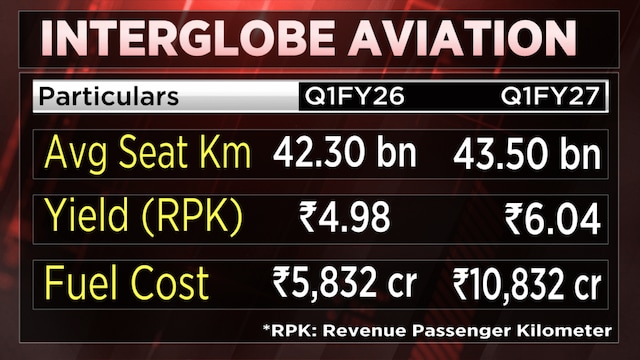
While the airline has guided for higher passenger revenue per available seat kilometre (PRASK), he believes much of that increase will largely offset rising fuel and foreign exchange costs rather than lift margins.
“If the fuel prices and the FX inflation subside and yield continues to remain sticky with a double-digit kind of a capacity growth, the profit could magnify,” Joshi said, drawing parallels with the post-pandemic period when stronger pricing power led to a sharp improvement in airline profitability.
He explained that yield is the fare paid by a passenger to travel one kilometre and serves as a measure of an airline’s pricing power. Despite higher ticket prices, IndiGo has not seen any meaningful demand destruction, suggesting passengers continue to absorb fare increases and supporting the airline’s long-term earnings outlook.
Watch the full conversation here

On reports of the Adani Group entering the airline business, Joshi said the company’s clarification that it has no plans to enter the business-to-consumer (B2C) airline segment should temporarily ease concerns. However, he cautioned that the issue is still evolving. “This is a very evolving situation. It has a policy element attached to it,” he said, adding that cross-holding between airport operators and airlines is not permitted in India.
Catch all the latest updates from the stock market here