
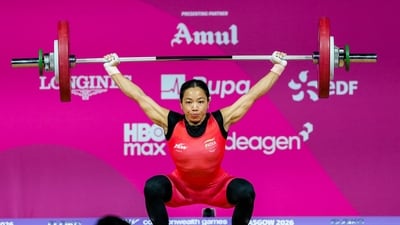
Mirabai Chanu returned to Glasgow 12 years after the city first introduced her to the Commonwealth Games and left with a medal of a different colour – and a career that now looks increasingly difficult to compare with anyone else in Indian weightlifting.
The 31-year-old won the women’s 48kg gold on Sunday with a total of 190kg, lifting 85kg in the snatch and 105kg in the clean and jerk. The number itself was some distance below her career best, but Chanu did not need anything close to that. Nigeria’s Ruth Nyong finished second with 168kg, leaving a staggering 22kg between gold and silver. Chanu also became the first woman in Commonwealth Games history to win three weightlifting gold medals.
There is another number that perhaps says even more about her career: 170kg. That was Chanu’s total when she competed in the same 48kg category, in the same city, at Glasgow 2014. Then, a 19-year-old, she finished second behind compatriot Sanjita Chanu, who lifted 173kg. Twelve years later, Mirabai returned to Glasgow, lifting 20kg more. She went from finishing three kilograms behind the champion to finishing 22kg ahead of her nearest challenger.
For most athletes, 12 years is enough time to contain an entire international career. For Chanu, it separates her first Commonwealth medal from her latest one.
Fifteen went to Glasgow in 2014. Only Mirabai came back
India selected 15 weightlifters for the 2014 Commonwealth Games. The list contained established names alongside the teenage Mirabai. Compare that squad with India’s weightlifting contingent in Glasgow in 2026, and only one name appears on both lists: Chanu.
Longevity alone, however, does not make her exceptional. Athletes can extend careers while gradually slipping away from the very highest level. What separates Chanu is that the decline has barely arrived in the numbers.
When she became world champion in 2017, Chanu lifted a combined 194kg in the 48kg category. A year later, she raised her total to 196kg while winning Commonwealth Games gold at Gold Coast.
At the Tokyo Olympics, competing at 49kg, she produced 202kg to take silver behind China’s Hou Zhihui. Her 115kg clean and jerk was an Olympic record at the time, while she had entered Tokyo as the world-record holder in that lift after completing 119kg at the Asian Championships.
Paris, three years later, was widely treated as a missed opportunity because Chanu finished fourth. But remove the medal colours and look at the barbell: she totalled 199kg. Her output had fallen by only three kilograms from the performance that won her an Olympic silver three years earlier.
Chanu’s results have fluctuated. She has battled injuries, endured the disastrous no-total outing at Rio 2016 and missed the Paris podium. Her physical capability, however, has never suffered the prolonged collapse that usually signals the end of an elite career.
In fact, the opposite happened this year. At the National Championships in February, aged 31, Chanu lifted 89kg in the snatch and 116kg in the clean and jerk for 205kg, setting national records in all three measures in the 48kg category. It was 11kg more than the total with which she became world champion nine years earlier.
Also Read: India’s Commonwealth Games 2026 schedule for July 27: Check full list of events and timings
Still fighting the world’s best at 31
Commonwealth dominance alone cannot establish where a lifter stands globally because several of the sport’s strongest nations are outside the competition. Chanu’s case does not depend on Commonwealth results alone.
At the 2025 World Championships, she lifted 199kg to take silver in the 48kg category. North Korea’s Ri Song Gum won with 213kg, while Thailand’s Thanyathon Sukcharoen took bronze with 198kg. Chanu, born in August 1994, was the oldest of the three medallists.
Eight years separated Chanu’s 2017 world title and that 2025 world silver. Her totals were 194kg and 199kg. That is perhaps the clearest answer to whether her performances have faded with age. More than eight years after becoming world champion, Chanu was not only still competing at the World Championships. She was lifting more and standing on the podium again.
Her Olympic record provides another measure of that consistency. Karnam Malleswari won India’s first Olympic weightlifting medal with bronze at Sydney 2000, while Kunjarani Devi finished fourth at Athens 2004. Chanu followed her silver at Tokyo with fourth place in Paris, making her the only Indian weightlifter to finish inside the Olympic top four on two occasions. Even Paris, therefore, was evidence of longevity disguised as disappointment.
A clean career amid Indian weightlifting’s doping problem
There is another reason Chanu stands apart, and it has become particularly relevant at these Commonwealth Games. Indian weightlifting arrived in Glasgow after its maximum athlete quota was reduced from 16 to 11 because of five anti-doping rule violations recorded during the qualification period.
It is an uncomfortable problem that has repeatedly followed Indian weightlifting. Against that backdrop, Chanu’s record carries additional weight. There is no publicly recorded anti-doping sanction attached to her senior international career, despite more than a decade spent competing at the highest level. That matters particularly in a sport where progress is measured so brutally and visibly in kilograms.
Chanu’s career has instead been built through gradual improvement, technical refinement, repeated recoveries from injury and an ability to remain competitive through one Olympic cycle after another. The numbers underline just how unusual that journey has been.
At Glasgow 2014, she lifted 170kg. When she became world champion in 2017, it was 194kg. Her Tokyo Olympic silver came with 202kg. At 31, she lifted 199kg for World Championship silver before pushing her total to 205kg at the Nationals in 2026.
There has been no smooth, uninterrupted rise. Elite sport rarely allows one. But there has also been no prolonged decline. And that is perhaps what separates Mirabai Chanu most clearly from the generations around her. In 2014, she was one of 15 Indian weightlifters arriving in Glasgow, a teenager lifting 170kg and standing on the second step of the podium. Twelve years later, every one of those teammates has disappeared from India’s Commonwealth Games squad. Chanu is still there.
She is lifting more than she did when she became world champion. She was a World Championships silver medallist at 31. She has finished inside the top four at consecutive Olympics. Her latest Commonwealth victory came by 22kg. And after silver in Glasgow in 2014, followed by gold medals in 2018, 2022 and now 2026, she has become the first woman to win three Commonwealth Games weightlifting titles.
Mirabai Chanu has not simply lasted longer than most. More than a decade after her first major international breakthrough, she remains one of the standards against which everyone else in Indian weightlifting is measured.