
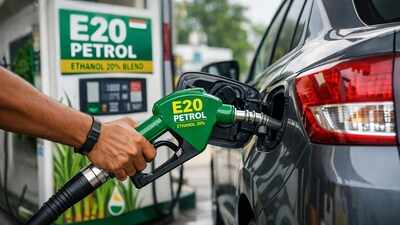
Seeking to dispel concerns about the impact of E20 petrol on vehicles, the Ministry of Petroleum & Natural Gas has released a list of seven claims which it has rejected. From mileage and engine failure to compatibility, the Ministry of Petroleum & Natural Gas has sought to dispel “misleading claims”.Meanwhile, Road Transport and Highways Minister Nitin Gadkari has said that petrol blended with 20% ethanol (E20) may lower fuel efficiency by 2-6%, depending on the type and age of the vehicle.In a written reply to the Lok Sabha, Gadkari said engine durability tests conducted both on dynamometers and under real-world driving conditions have not recorded any failures linked to the use of E20 fuel. He added that, compared with E10 petrol, E20 offers better acceleration, improved ride quality and around 30% lower carbon emissions.The minister said the impact of E20 on BS-III, BS-IV and BS-VI petrol-powered two-wheelers and four-wheelers was evaluated through a joint study carried out by the Automotive Research Association of India (ARAI), the Society of Indian Automobile Manufacturers (SIAM) and Indian Oil Corporation Ltd (IOCL).We take a look at the 7-point clarification issued by the Ministry of Petroleum & Natural Gas on E20 petrol and its impact:
Claim 1: Vehicles manufactured before 2023 cannot run on E20 petrol
The government has said that vehicles that have been manufactured before 2023 can safely use E20 petrol. The release cites more than 3.5 years of E15+ use and over 2.5 years of E19-E20. Vehicles that have been using ethanol blended petrol for some years now show no verified evidence of widespread engine failures or vehicle breakdowns.
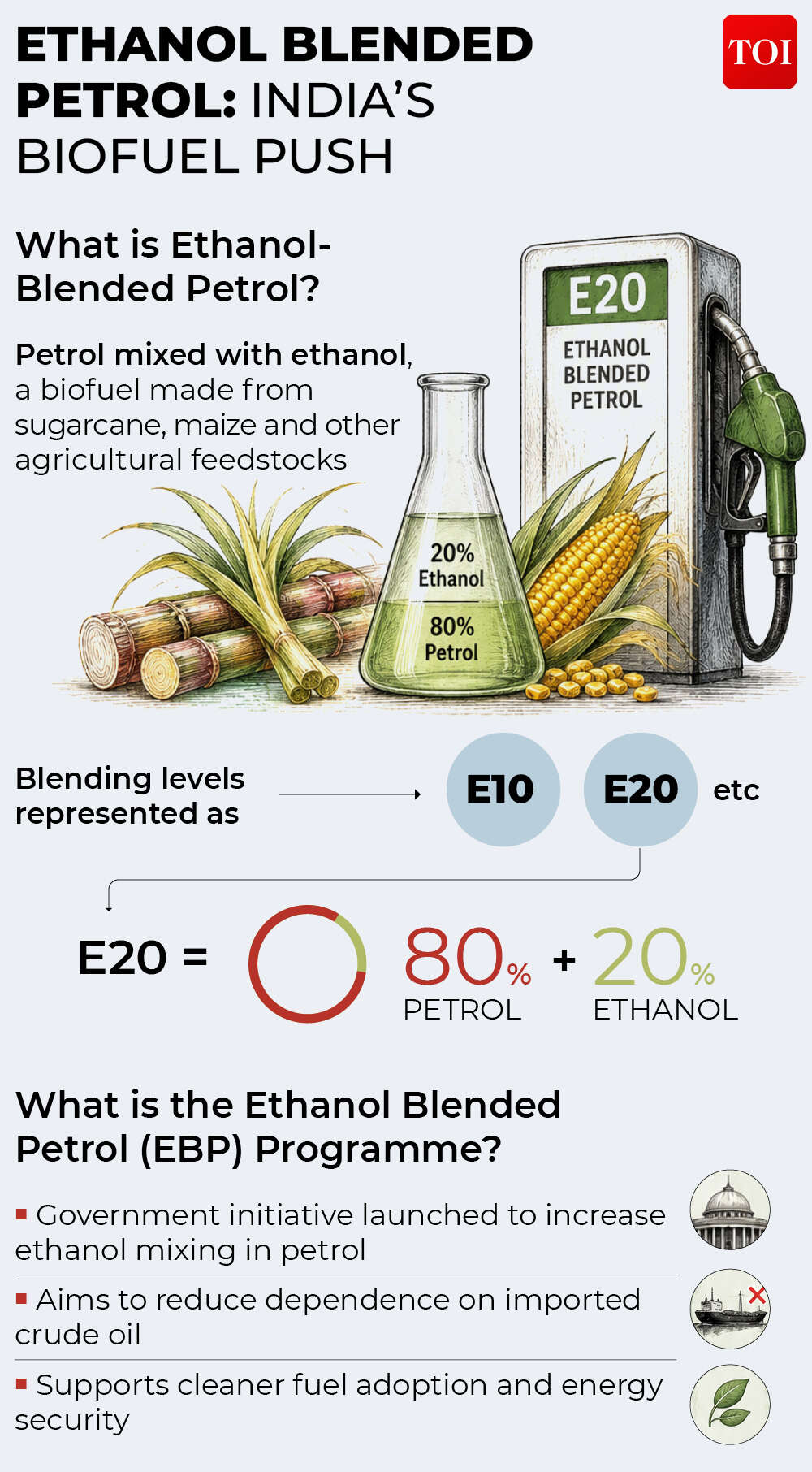
What is Ethanol blended petrol?
The assessment is based on over 25 years of phased implementation, extensive testing and real-world data, including service records from 2.84 crore vehicles in FY2025-26, of which 1.5 crore were not originally E20-compatible, as well as data from another 1.4 crore E20-operated vehicles, all of which found no E20-related corrosion, abnormal wear or reduction in component life.
Claim 2: 30 crore vehicles will become unusable
The government has clarified that petrol blended with more than 15% ethanol (E15+) has been in widespread use for over three and a half years, while E19-E20 fuel has been available for more than two and a half years.During this period:
- More than 20 crore two-wheelers and over 3 crore petrol cars have been running on these fuels.
- There has been no verified evidence of widespread engine failure or vehicle breakdown linked to ethanol blending.
“If E20 really rendered vehicles unusable, India would have witnessed millions of breakdowns, warranty claims and service campaigns. Nothing of that sort has occurred,” the release said.
Claim 3: E20 not desirable by automobile manufacturers
On July 4, 2026, the Ministry of Petroleum & Natural Gas, together with the Ministry of Heavy Industries and the Ministry of Road Transport & Highways, held a joint press conference in which senior representatives from Toyota Kirloskar, Maruti Suzuki, Hero MotoCorp, Hyundai Motor India, TVS Motor Company and Bajaj Auto addressed concerns related to E20 fuel. The companies presented a unified position in support of the programme.Toyota said that the E20 was introduced only after rigorous testing under internationally recognised UNECE standards. Maruti Suzuki, citing service data from 2.84 crore vehicles in FY2025-26, including over 1.5 crore older vehicles, reported no E20-related corrosion, abnormal wear or reduction in component life, adding that the impact on fuel efficiency is generally limited to 3-3.5%. Hero MotoCorp also said its service data showed no higher incidence of damage in vehicles using E20, while the companies collectively reiterated their commitment to the programme and to addressing consumer concerns transparently.
Claim 4: Older vehicles are at risk
A leading automobile manufacturer serviced 2.84 crore vehicles during FY2025-26, including nearly 1.5 crore vehicles that were not originally certified as E20-compatible.According to the company’s service data:
- No abnormal corrosion linked to E20 fuel was observed.
- No abnormal wear was reported.
- No reduction in component life was attributed to E20 usage.
A leading two-wheeler manufacturer has reported similar findings from its field experience. In addition, another automobile manufacturer tracked 1.4 crore vehicles operating on E20 over an extended period and found no evidence of ethanol-induced corrosion.
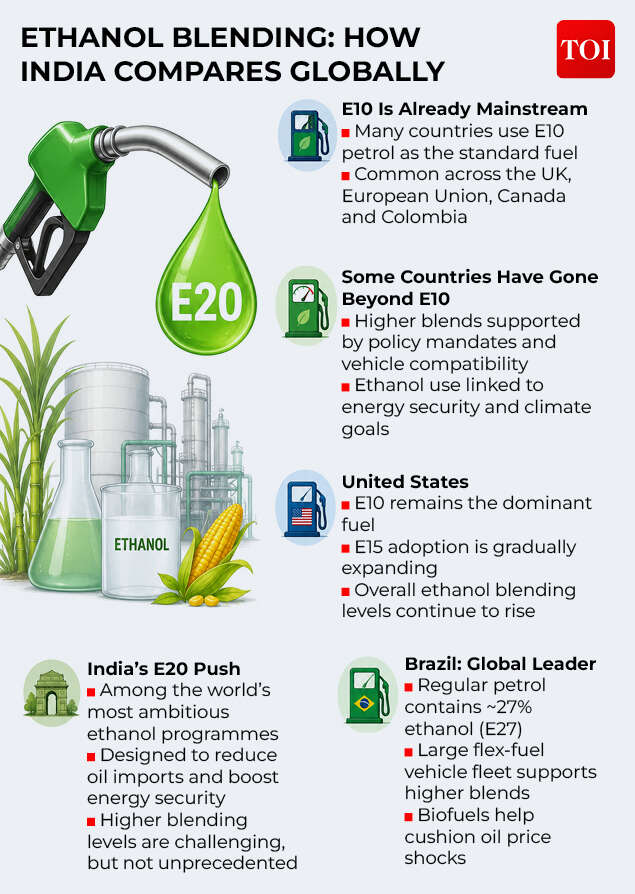
Ethanol blending: How India compares globally
Claim 5: Mileage will completely go down
The release cited government studies and data from automobile manufacturers that consistently indicate that fuel efficiency is influenced by several factors, including:
- Driving behaviour
- Traffic conditions
- Vehicle maintenance
- Tyre pressure
- Air-conditioner usage
For some older vehicles originally designed for E10 fuel, any reduction in fuel economy is generally limited to around 3-5%, rather than the much higher figures being circulated, the release said.At the same time the release claimed that, E20 fuel offers several performance advantages, including:
- A higher octane rating and improved anti-knock properties.
- Cleaner combustion and smoother engine operation.
- Better acceleration and overall driving performance.
Claim 6: Manufacturers are being forced to support E20.
The government said that if automobile manufacturers had not been satisfied with the scientific validation of E20 fuel, they would neither have:
- Certified vehicles as E20-compatible.
- Continued to honour warranty commitments for those vehicles.
Manufacturers continue to provide warranty coverage for vehicles using specification-compliant E20 fuel because they are confident in the extensive testing and validation carried out before the fuel was introduced.
Claim 7: Automobile companies are under government pressure to hide the truth about E20.
In its clarification, the Ministry of Petroleum & Natural Gas said:
- India’s automobile manufacturers are independent, publicly listed companies with legal and regulatory responsibilities towards their customers.
- Concealing widespread vehicle defects would expose them to warranty claims, product liability, regulatory action and significant reputational damage.
- Manufacturers continue to honour warranties for E20-compatible vehicles, something they would not do if they believed E20 fuel was causing widespread engine damage. Their warranty decisions are based on engineering validation and real-world operating experience, not political considerations.