
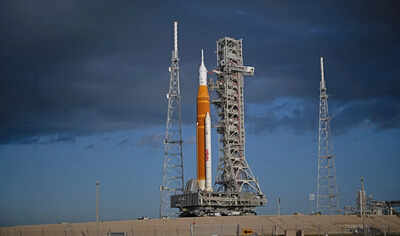
With only a week left until liftoff, the anticipation is building for the upcoming NASA mission, dubbed Artemis II, which is designed to send humans on a journey around the Moon for the first time in over half a century. With a target launch window of no earlier than 1 April 2026, this mission is a landmark event in space travel. After years of testing, delays, and development, the US space agency is now poised for a liftoff that will determine the course of humanity’s future beyond our home planet. It is not just a mission, but a bold leap towards space travel, the Moon, and even Mars.
Artemis II launch April 2026: What to expect
The launch window is scheduled to open on the 1st of April, 2026, although the exact date will be subject to the weather and the level of preparedness of the mission. The mission is expected to take about 10 days, during which the crew of four astronauts will embark on a voyage around the Moon and back to Earth. This mission will be the first crewed mission to the Moon since the Apollo 17 mission in 1972, making it historic as it ventures into deep space.
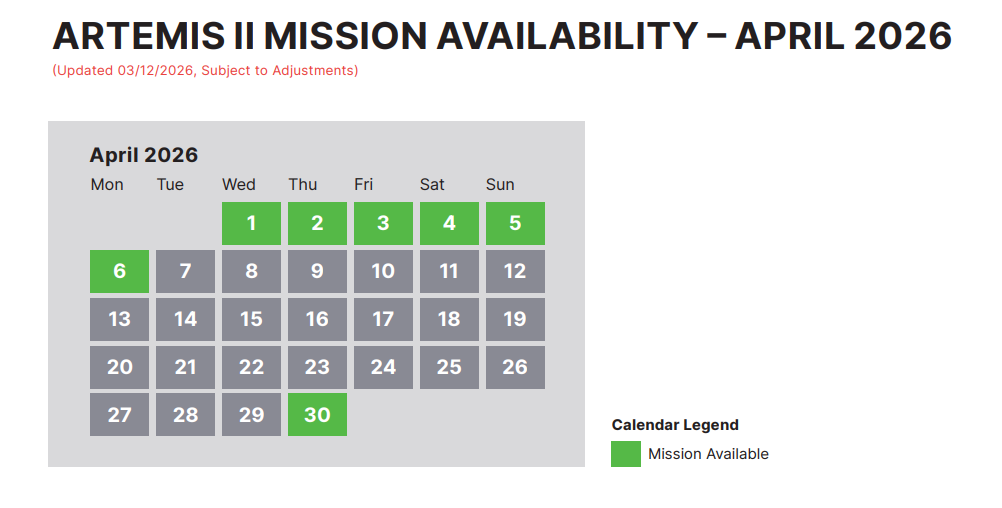
Image: NASA
According to NASA, the launch will be conducted at the Kennedy Space Center’s Launch Complex 39B, where NASA’s most powerful rocket to date, the Space Launch System (SLS), will be used.
Artemis II mission details: Crew, rocket and spacecraft
At the heart of the mission is a combination of cutting-edge technology and international collaboration. The crew includes:
- Reid Wiseman (Commander)
- Victor Glover (Pilot)
- Christina Koch (Mission Specialist)
- Jeremy Hansen (Canadian Space Agency)
This mission is unique as Glover will be the first person of color, Koch will be the first woman, and Hansen will be the first person from outside America to travel to the Moon. The astronauts will travel to space aboard the Orion spacecraft, which can sustain human life beyond space, carried by the powerful SLS rocket.
Why Artemis II matters for future Moon missions
Artemis II is not just a symbolic return, it is a critical test mission. NASA aims to evaluate systems essential for long-duration human spaceflight, including:
- Life support systems
- Deep space navigation
- Radiation exposure handling
This mission makes history because Glover will be the first person of color, Koch will be the first woman, and Hansen will be the first person from outside America to venture towards the Moon. These astronauts will travel in the Orion spacecraft, which can support life in deep space, carried by the powerful SLS rocket.
Final preparations: Countdown to launch
In recent weeks, NASA engineers have completed critical repairs, including fixing a problem with the helium system, which has allowed the rocket to return to the launch pad for final checks.The rollout of the rocket itself is a slow and precise process, taking almost four miles at less than 1 mile per hour, emphasizing the magnitude of the mission. At the same time, NASA is closely watching environmental factors, including solar radiation, for the safety of the astronauts.
A new era of space exploration begins
As the countdown enters its final days, Artemis II is no longer just a mission but a symbol of renewed human ambition. Whether it is testing out new and highly advanced spacecraft or making a way for a base on the moon and beyond to explore Mars, this launch could potentially be the beginning of a new era of space history.April 2026, it may not just be a rocket taking off into space but potentially a new giant leap for mankind.