
India has had none of Korea’s AI infrastructure-related exuberance. Its benchmark index has been among the world’s worst performing this year. Yet retail investors are racking up debt to buy at stretched valuations. Fully digital stock purchases have made it simple — perhaps a bit too simple — for investors to access credit and for brokers to push it. Besides, with inflation expectations for the near future at above 9%, it makes little sense for savers to leave money in a deposit account earning 6%.
According to the latest data from the National Stock Exchange, the so-called Margin Trading Facility book has ballooned to 1.38 trillion rupees ($14 billion). That may not sound like much when compared with the $5 trillion market capitalisation of stocks listed on the country’s biggest bourse. It’s also about half of Korea’s peak margin overhang.
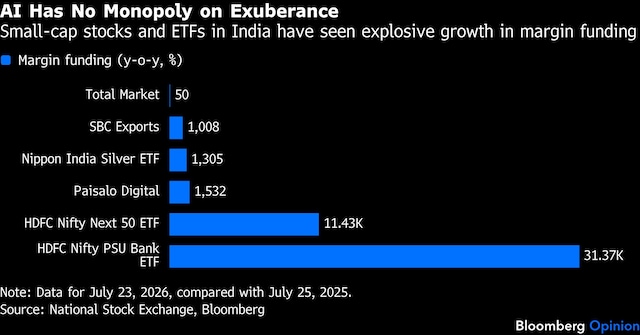
More concerning, however, is the 50% jump in investor debt from a year earlier. New-age digital brokers are aggressively competing with their more traditional rivals to scale their client-funding portfolios. Retail and high-net-worth investors are absorbing these funds at record rates. The buildup is starting to look scary.
Korea has at least started tightening monetary policy to prevent the economy from overheating from better-than-expected growth in exports, investment, and consumption. Higher borrowing costs should help with the ongoing unwinding of margin debt. India has so far avoided raising interest rates, though sooner or later a falling rupee and elevated energy prices will test policymakers’ resolve.
That’s when the leverage sitting in retail portfolios might get tested.
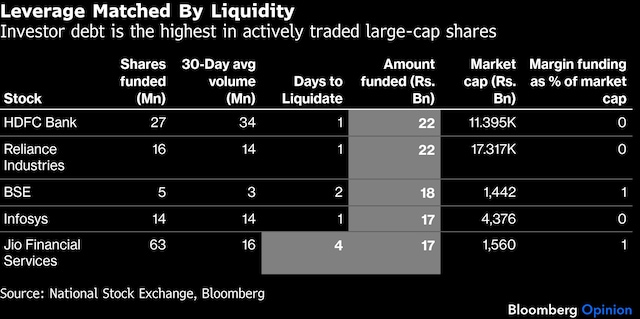
The problem is as much about quality as quantity. A dive into the NSE leverage data for more than 2,000 stocks and exchange-traded funds suggests that a disproportionate amount of margin debt has bypassed large-cap blue chips.
Unlike in Korea, where speculative buying is concentrated in Samsung Electronics Co. and SK Hynix Inc., in India the fervour is dispersed across penny stocks peddled by finfluencers. A couple of clicks on a smartphone app not only completes the purchase, but also executes a collateral agreement. Brokers charge 9% to 18% annual interest, and they want to reduce the rates further, according to a recent Reuters article.
The fear of missing out on the next “multi-bagger” seems to be the psychological driver here.
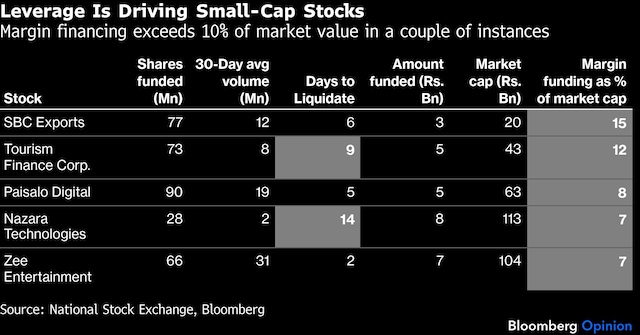
The same can’t be said of SBC Exports Ltd., which sells carpets and supplies manpower. Its shares have more than doubled over the past year. Investors who have borrowed to buy the stock account for nearly 15% of its market capitalisation.
There are many such shares, including Zee Entertainment Enterprises Ltd., a punter’s favourite even though the television network has lost 80% of its value over the past nine years amid governance scandals and regulatory scrutiny.
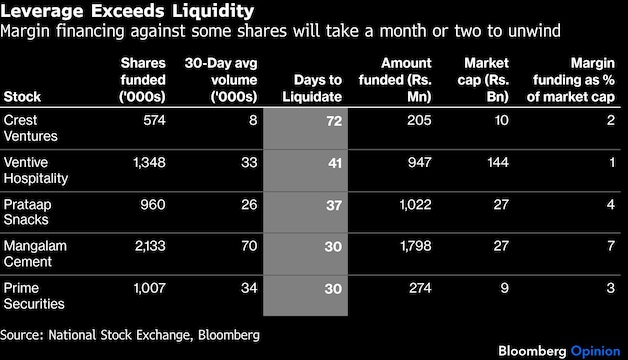
A different group of stocks is held with more debt than the value that changes hands on a daily basis. Were these illiquid stocks to head for a serious correction, brokers would issue margin calls.
If retail traders fail to come up with hard cash, the brokers’ automated risk management systems would execute a forced liquidation, dumping the shares onto the market. These mid- and small-cap shares, which have no ready buyers on a regular day, might enter into freefall.
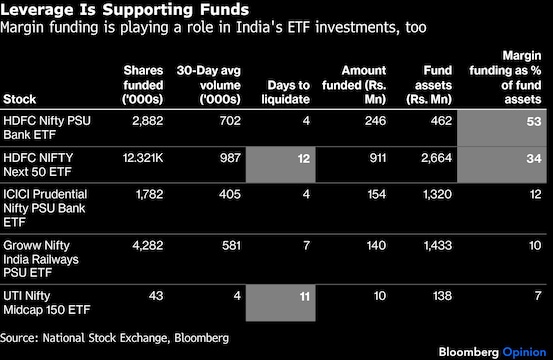
This brings us back to the similarities and differences between the two Asian markets. India, too, has leverage in ETFs, though it isn’t coded into the product like it is in Korea. The margin financing riding the nation’s craze for precious metals has witnessed a 15-fold surge from a year earlier. For some stocks-focused ETFs, borrowed money accounts for 30% to 50% of the fund size.
With the exposure spread across thousands of tiny, collateralised, short-duration loans, delinquencies may pose negligible risk to the brokers. But if they start dumping these investment vehicles, the shock waves might spread across the market amid a surge in household debt — another feature that India shares with Korea.
There are differences as well. South Korea’s leverage boom is rooted in global euphoria surrounding AI hardware, semiconductors, and technological leadership. Even with that bubble deflating under the weight of central bank actions and overcrowded trades, the worldwide shortage of memory chips remains a powerful driver behind lofty expectations.
In India, margin debt is inflating not because of an explosive corporate growth narrative, but because retail traders are borrowing money to support stocks that global investors are walking away from.
In Korea, the regulator erred by being too permissive with single-stock leveraged ETFs. By contrast, the Securities and Exchange Board of India has acted decisively to protect small investors from index options after most lost their shirts while large whales made a killing. (The regulator is embroiled in a closely watched legal tussle with Jane Street Group LLC, which it has accused of systematic price manipulation. The market maker has denied the allegations.)
But as Reuters pointed out, younger traders who were selling options before SEBI’s stricter rules are now borrowing to play the cash market. The margin-funding business at Groww, a popular digital broker, has swelled 10-fold over seven quarters to around 38 billion rupees. Angel One Ltd.’s client-funding book, a “fast-emerging growth opportunity,” according to a recent presentation, is even bigger at 71 billion rupees.
That’s why the central bank, too, needs to pay attention. With hostilities in the Middle East refusing to end, there is little chance that energy import costs will go back down soon. Add the risk to food supplies from deficient monsoon rains, and there’s a serious danger that interest rates — when they go up — may have to stay higher for longer to tame inflation and steady the weakening rupee. If allowed to keep growing unchecked, the inevitable unraveling of margin funding may end up looking much harsher than an orderly market correction.
Also Read: OpenAI wasn’t alone: Anthropic says its AI models also breached real-world systems