
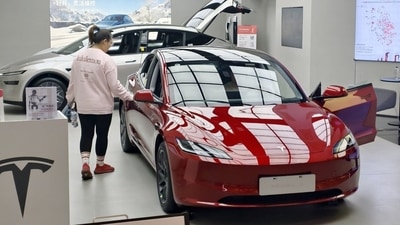
Elon Musk designed Tesla’s China business to be easily separated from its U.S. business because of geopolitical tensions. It might also come in handy if he proceeds with a SpaceX merger.
Musk in recent years instructed Tesla executives to organize the company with a “laser” between its U.S. and China businesses, according to people familiar with the planning. He wanted to ensure that in the event of geopolitical strife between the two countries, at least the U.S. half of Tesla would survive.
Now, some Tesla executives have been told to prepare for a separation of the China business ahead of a potential merger, a person familiar with those talks said. And Tesla advisers have discussed possible options for a separation, including a spinoff, sale or closure, another person said.
Any of those moves could have a profound impact on Tesla, whose Chinese operation transformed it into a consistently profitable global mass-market electric vehicle leader—and potentially impact its valuation if a SpaceX merger were to happen.
It is unclear how quickly Tesla could spin out or sell the China business, and it is possible that its plans could change.
Musk, who is chief executive of both Tesla and SpaceX, has talked up the crossover potential between both companies in recent months as he reorganizes them around artificial-intelligence projects. Investors and analysts have embraced the idea of a merger following a record-setting IPO for SpaceX, which raised $86 billion for the company in June.
“Obviously we can’t talk about, you know, combining companies and that kind of thing on earnings calls,” Musk told investors last week. “It is got to be done with the appropriate process.”
Musk was particularly concerned about Tesla’s dependence on China for battery cells and feared its access to semiconductors could be jeopardized if Beijing invaded Taiwan, the people familiar with the planning said. The goal was to be ready for 2026 or 2027 in anticipation of a war, they said.
Separating Tesla’s China operations—including an electric-vehicle factory there—would address potential conflicts arising from SpaceX’s work as a major U.S. defense contractor. Such a deal would aim to create a firewall between Tesla’s Chinese subsidiary and its U.S. business.
SpaceX faces significant restrictions due to its dealings with the U.S. government. The company is a major national-security defense contractor, with business lines that include launching top-secret satellites and operating internet services in war zones like Ukraine.
Sales to the U.S. government made up 20.9% of its business in 2025. That business is highly regulated, with the company restricted by export controls and, for some programs, classified government activities.
Executives have also discussed creating a separate sales entity to handle exports from Tesla’s Shanghai plant, one of the people said.
Tesla could create separate office systems and bar China-based employees’ direct access to other company units, the person said. While Tesla China already has some autonomy, employees more or less work together around the globe and the top executive in China, Tom Zhu, oversees all of Tesla’s global automotive business.
A potential merger between SpaceX and Tesla would likely trigger intense scrutiny from Beijing, given that a major U.S. defense contractor would control Tesla’s factories in China and the factories’ know-how and supply chain could be repurposed for the U.S. military, according to people familiar with the matter. Another concern for Beijing is that a deal could put data of China’s roughly two million Tesla owners in the hands of an American defense company, they said.
In the event of a merger, Beijing would likely seek Tesla’s commitment and business guardrails to prevent the influence of SpaceX on Tesla China and illicit diffusion of dual-use goods such as rare-earth materials from Tesla China to SpaceX, the people said.
Tesla has two major factories in Shanghai. They make electric cars and batteries that are sold in China and exported to various markets around the world, but not to the U.S. China is Tesla’s second-largest market after the U.S., making up around 18% of sales in the first half of 2026. Unlike many other Western competitors, Tesla’s automaking operation there isn’t part of a Chinese joint venture.
During the first Trump administration, Tesla launched an initiative called Project Carbon to relocate its Chinese suppliers to Mexico, a decision that went beyond concern over tariffs from the U.S. on Chinese goods, according to people involved in those plans.
Musk was particularly concerned about Tesla’s dependence on China for lithium iron phosphate, or LFP, battery cells, as well as its reliance on chips from Taiwan Semiconductor Manufacturing, the world’s biggest contract chip maker, which faces the threat of war between the island and Beijing, the people said.
In 2025, the EV maker decided that it would stop using China-based suppliers by 2027 in its U.S. factories, in part because of U.S. tariffs and government incentives for local production, The Wall Street Journal reported.
Mergers involving multinationals typically require regulatory approval across multiple jurisdictions, though most reviews focus primarily on antitrust concerns. In 2018, Qualcomm terminated its proposed purchase of Dutch chip maker NXP Semiconductors after failing to obtain clearance from China.
It is common for companies in the U.S. to have contingency plans for their China businesses and a number of U.S. companies have already spun out their China arms into independent companies. Starbucks recently sold a majority stake in its China business. In 2016, Yum Brands, owner of Pizza Hut and KFC, spun off its China unit and sold stakes to local investors.
Write to Becky Peterson at becky.peterson@wsj.com and Raffaele Huang at raffaele.huang@wsj.com