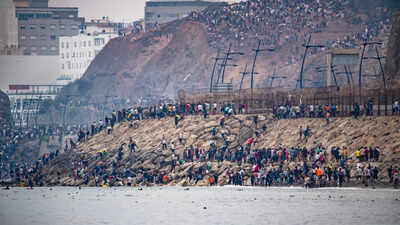
Ceuta came into focus after around 60,000 migrants crossed the border from Morocco into the Spanish enclave on North Africa’s Mediterranean coast, across the Strait of Gibraltar, triggering a major humanitarian crisis in which 67 people were killed during the rush and ensuing tensions.Within hours, however, more than 48,000 migrants returned to Morocco, many citing harsh conditions inside Ceuta, according to the Spanish government.In response, Madrid has installed a 500-metre sea barrier along part of Ceuta’s coastline in a bid to prevent another mass influx.The sudden influx has raised a key question: What triggered the unprecedented crossing?
Moroccan border controls appeared to loosen
One of the most widely discussed explanations is the apparent relaxation of Moroccan border enforcement.According to AFP, a Spanish journalist, who specialises in migration in North Africa, said Moroccan security forces had been “sitting on their hands” as thousands approached Ceuta.“To reach the breakwater that marks the border between Ceuta and Morocco, there are cordons of police and auxiliary forces, and it’s obvious they’ve been allowed through,” he said.The New York Times reported that several migrants said Moroccan police officers had waved them through, allowing crowds to overwhelm Spain’s border. Migration researcher Lorenzo Gabrielli told the newspaper, “It is impossible for nearly 50,000 people to cross the border between Morocco and Spain in a single day without Morocco having a hand in it.”However, there was no conclusive evidence that Rabat had deliberately engineered the crisis.
Social media fuelled hopes of entering Europe
Several reports pointed to viral social media posts as a major catalyst. Reuters reported that many migrants decided to make the journey after watching videos showing thousands successfully entering Ceuta. Those heading back told Reuters they had initially been drawn by viral social-media videos and messages from friends suggesting that the heavily guarded border could be breached.AP cited Myriam Cherti, a senior researcher at the university of oxford’s centre on migration, policy and society, as saying online posts carried practical guidance on how to cross the border and what migrants should say once inside Spain.Meanwhile, Spanish prime minister Pedro Sánchez blamed human trafficking networks for spreading misleading information about migrants’ chances of remaining in Spain.
A Spanish court ruling may have acted as a pull factor
Another explanation centres on a recent Spanish Supreme Court ruling. The court ruled on July 8 that migrants arriving by sea could not be returned immediately without due process.“Without a doubt, the July 8 ruling… has played a role,” the Spanish journlaist said, according to AFP, “but that doesn’t explain the level of mobilization”, he added.While the ruling did not legalise irregular entry or guarantee migrants could stay in Spain, reports about the judgment spread widely on Moroccan social media, encouraging more people to attempt the crossing.
Economic hardship remains the strongest driver
Behind the immediate triggers lies a deeper economic reality. Many migrants interviewed by multiple media agencies said they were driven by unemployment, low wages and the lack of opportunities at home. Morocco has struggled with sluggish economic growth, prolonged drought, rising living costs and high youth unemployment, leaving many young people convinced that they have little chance of building a future in the country.“Spain gives you the chance to make your future, not like Morocco,” 21-year-old Abdulah Buji told AP.“Spain gives you the chance to make your future, not like Morocco,” 21-year-old Abdulah Buji told AP, adding, “I am a talented boy. I just want a chance.”Buji also said, “I’ve spent perhaps 14 years studying, but there’s nothing at home, and I’d have to work 12-hour shifts for a meager wage.”Reuters quoted another migrant, Brahim, who said he had crossed after seeing videos online.“We came to make progress, not to be fooled,” he said…I thought I’d build a better future there. But I was surprised in Ceuta.” After arriving, he said he survived for three days on water because he could not afford food. “Ceuta was like a prison — nothing to do there. Everything was closed,” another returnee told Reuters.
Spain’s migration policies also came under scrutiny
Spain’s relatively liberal migration policies have also become part of the debate.According to AFP, some analysts believe the Spanish government’s more open approach to regularising undocumented workers may have encouraged migrants.The New York Times reported that Spain’s conservative and far-right opponents argued prime minister Pedro Sánchez’s immigration policies had made the country more attractive to migrants. Sánchez rejected that claim, instead blaming smugglers and misinformation surrounding the court ruling.
Diplomatic tensions between Spain and Morocco
AFP reported that Morocco has long claimed sovereignty over Ceuta and Melilla and has previously used migration as leverage during periods of political tension.The influx dwarfed the last major migration crisis in Ceuta in May 2021, when around 12,000 migrants crossed from Morocco over two days after Moroccan authorities loosened border controls during a diplomatic dispute with Spain.