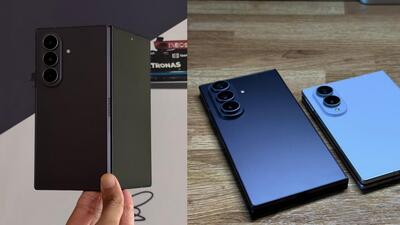
Continuity is a mostly a good thing. Samsung thinks so, and I concur. While the Galaxy Z Fold8 Ultra moniker succeeds the Galaxy Z Fold7, with the Samsung Galaxy Z Fold8 naming going to the impressive passport-like foldable, the new ‘Ultra’ in the naming doesn’t necessarily signify a change of direction. There are of course generational improvements as Samsung builds on the radical refresh of the last year’s incredibly impressive Galaxy Z Fold7 foldable. The display hides the crease better, Samsung’s insistence on a better ultra-wide camera is apparent, and the higher capacity silicon-carbide battery (with faster charging speeds) is certainly good news.
The Samsung Galaxy Z Fold8 Ultra prices in India start at ₹1,99,999 for the 12GB + 256GB combination, and you’ll part with ₹2,19,999 for 12GB + 512GB and ₹2,59,999 for 16GB + 1TB specs. That’s a fair penny to pay for a smartphone in this day and age, and a fair generational inflation dictated by a combination of component pricing and perception to that reality. Top notch hardware, as is always the case with Samsung and Qualcomm’s collaboration for the former’s flagship phones year after year, and a genuine layering of software improvements including some refined Galaxy AI features, which should feel wholesome for buyers.
Display real estate hasn’t changed, and continues to be the 8-inch flexible OLED and a 6.5-inch cover screen. But look closely, and you’ll notice that the foldable screen doesn’t have a visible crease anymore. I’ve said it time and again in all these years, that phone makers and display tech will find a way to eliminate the cream (which to be fair, wasn’t a problem then either). Samsung has now reached upon a method in which a titanium layer now sits beneath the OLED panel, adding to the polymer film. The new tech is supposed to be 20 times mechanically more stiff, with the film bonded to this plate. Regular usage, and sensible viewing, will not elicit any hints of the crease. But if you intend to be funny, and press down hard on the middle of the screen, there may be a subtle hint of it (though I’d ask what you achieved by pushing tech robustness unnecessarily).
The key change is that Samsung has increased the foldable screen’s resolution to 2504 x 2256 pixels (up from 2185 x 1968 pixels). Samsung also says this now touches a peak display brightness of 3000 nits, whereas the predecessor topped out at a still fairly high 2600 nits. The advantage is incremental, unless you’re outdoors in a proper summer’s afternoon, at which point every nit of improvement makes a world of difference. The good thing is that with last year’s foldable, Samsung made the cover screen very usable and while there are no underlying changes to report there, that utility continues as is.
There is design continuity between last year’s phone and the Galaxy Z Fold8 Ultra, which is great considering that was a significant upgrade of the overall contours and silhouette (something rivals are still struggling to match up to). On the performance front, the Qualcomm Snapdragon 8 Elite Gen 5 presents that generational leap that anyone spending top money for this phone, would demand. We’ve already seen this chip in the Galaxy S26 Ultra with similar memory and storage combinations, and that parity will give a fair sense of the experience too.
Samsung has bumped up the charging capabilities, with 45-watt wired charging and 20-watt peak wireless charge speeds. That is a significant step up from last year’s foldable, which peaked at 25 watts and 15 watts, respectively. The drawback of this svelte design is there are no magnets integrated, which means you’ll need a compatible case to make this Qi2 ready to make the most of the wireless charging. The increase to a 5,000mAh Si/C battery architecture does mean there is more runtime to be had.
As for more parity between flagships, the Galaxy Z Fold8 Ultra now also has the same camera troika at the back at the Galaxy S26 Ultra. That means a 200-megapixel primary wide camera, a 10-megapixel telephoto and a 50-megapixel ultra wide instead of the 12-megapixel sensor that did duties last year. The improvement in the ultrawide stems from Samsung’s insistence on that aspect of photography being important, something I’d also pointed out on the Galaxy Z Fold8 analysis. I differ slightly, and would opt for a better telephoto any day, given the choice.
Samsung’s algorithm approach leans a bit more heavily towards using AI for image processing, perhaps a bit more than some other phone makers. That isn’t necessarily a problem, because the underlying hardware does its bit to send a lot of information for the algorithms to work with. Sometimes you may notice two photos taken in quick sequence exhibit completely different tonality of the sky, but for the most part, the troika of details, colour and contrast comes through without any foibles.
With time, you will notice utility of Gemini’s Automated Tasks feature as well as Galaxy AI’s Nudge Now, which will suggest actions via pop-ups at the correct time and depending on context. Utility will vary depending on how you find it stepping up for your requirements. But this in a way underlines what Samsung has tried to do with the Galaxy Z Fold8 Ultra upgrade as a whole. After last year’s big step, this year was always going to be about refinement and necessary changes. That’s exactly what has happened. The fact that the Galaxy Z Fold8 Ultra is significantly more expensive isn’t entirely in Samsung’s hands (and I’m sure they’ve tried to cushion the impact as much as possible). But that makes any buying decision even more considered. That’s just a sign of the times we live in.