

Even as investors become more risk savvy and financial literacy brings investment avenues like stocks, mutual funds, bonds closer, the humble fixed deposit continues to hold importance in portfolios. And this ‘safe haven’ of its own kind, is back in focus at a time when globally interest rates are going up, Indian stock markets are down from their peaks, and gold has fallen as well!The Reserve Bank of India (RBI) kept the key benchmark policy rate – repo rate – unchanged at 5.25% in its monetary policy review on Wednesday. The neutral stance and the stated resilience of the Indian economy also signalled that the RBI will be cautious in opting for a rate hike, unless inflation spirals out of control.What does this mean for your FD investments? In the current scenario of geopolitical uncertainty, is it wise to opt for the good old FD as a shield against headwinds? Is it the right time to invest in FDs? We ask experts:
Fixed deposits: Best time to get in?
Experts say that instead of timing the interest rate cycle, fixed deposits should be opted for based on goals and cash flow. But, if you are looking at fresh investments in FDs, higher interest rates may be a good lure.Adhil Shetty, CEO of BankBazaar.com expects deposit rates to remain broadly stable in the near term with the repo rate being kept unchanged.Public sector banks are currently offering around 6.6% to 6.8% on popular one to three-year FDs, while private banks are offering roughly 6.4% to 7.0% for similar tenures.
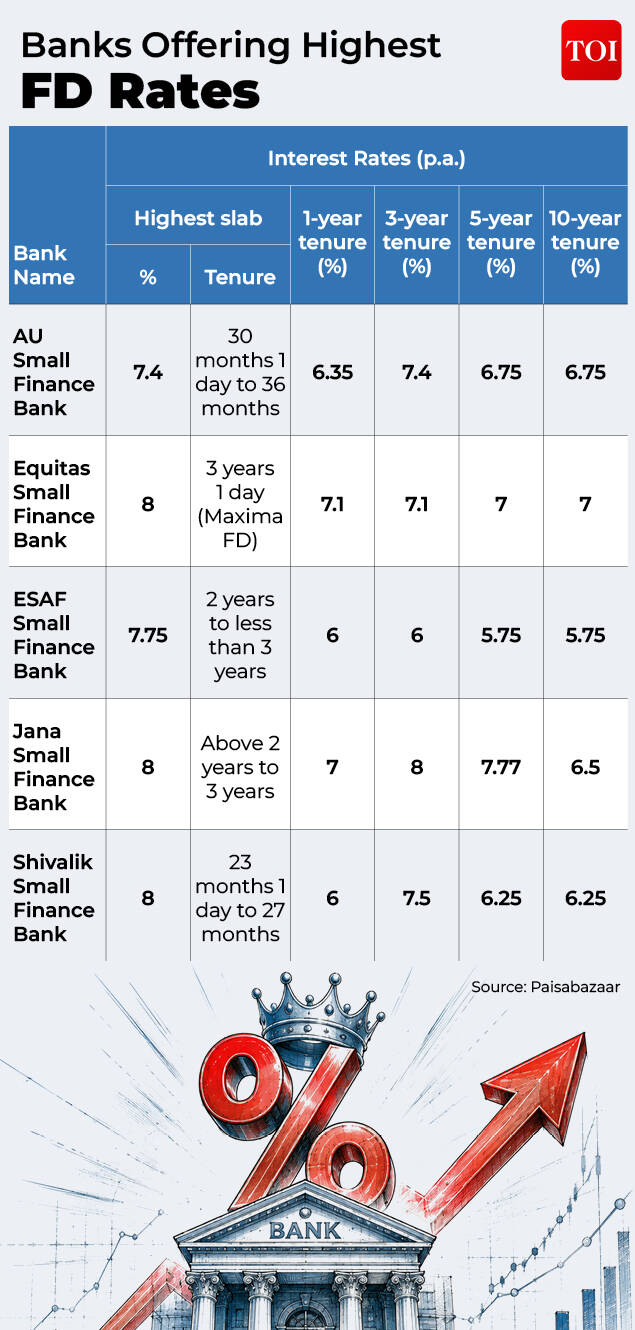
Banks offering Highest FD Rates Right Now
“Rather than trying to time the interest rate cycle, investors should align FD investments with their cash flow needs and investment horizon. If you have surplus funds earmarked for short to medium-term goals, this is a reasonable time to lock in at least a part of your corpus while retaining some flexibility through staggered investments,” Adhil Shetty says.Santosh Agarwal, CEO of Paisabazaar recommends that depositors should continue with their existing FDs till their maturity dates.“However, they can close their deposits prematurely if the FD rates currently being offered are significantly higher than the rates of their existing FDs, even after accounting for the premature withdrawal penalty,” she tells TOI.In case of fresh deposits, Santosh Agarwal recommends locking in higher rates, especially if those are offered for longer tenures.“For higher yields, consider booking fixed deposits in Small Finance Banks (SFBs) as they usually offer higher interest rates than public and private sector banks. Like all scheduled banks, deposits with SFBs too are insured for up to Rs 5 lakh per depositor per bank. While locking into higher rates, especially for longer tenures, can be beneficial, investors should choose the tenure based on their investment horizon and liquidity requirements rather than at interest rates alone,” she adds.
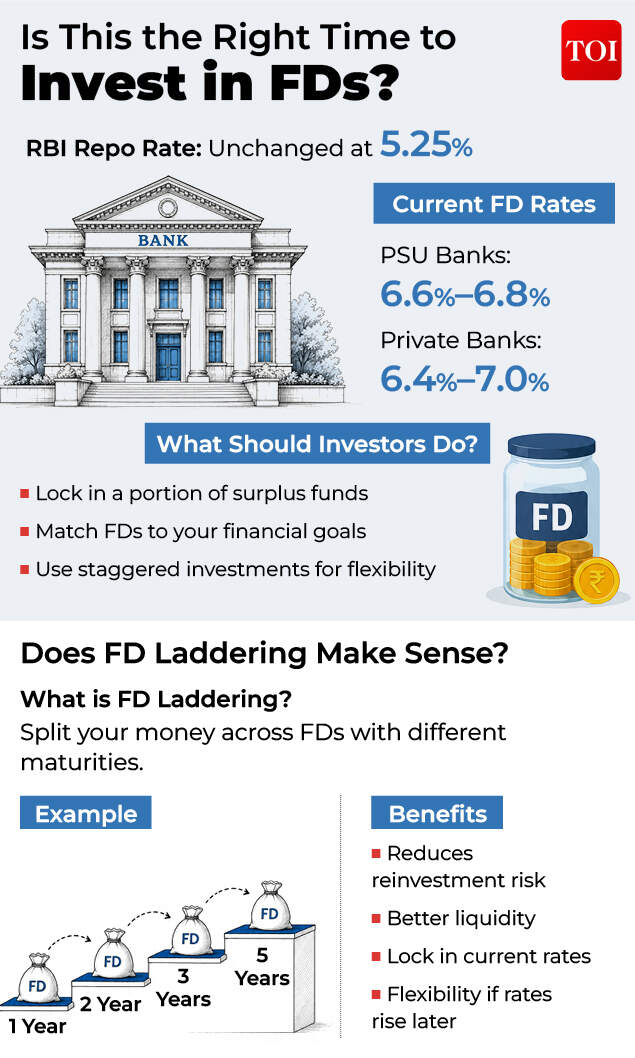
Is it the right time to invest in FDs?
Financial experts also pitch for fixed deposits laddering which is essentially the strategy to split your money across multiple FDs with different maturity periods. This helps meet different financial goals across years.According to Rohit Shah, Founder & CEO, GYR Financial Planners, laddering helps a conservative investor lock in relatively higher rates across maturities while smoothing reinvestment risk.“It works best when built around your own cashflow needs – a rung maturing exactly when you’ll need the money. What doesn’t work is laddering purely to time rate movements; that’s speculation dressed up as strategy,” he tells TOI.Laddering also reduces reinvestment risk because a portion of the portfolio matures periodically and can be reinvested at prevailing rates. It also improves liquidity without compromising the stability that FDs offer.“With banks continuing to offer competitive rates across one to three-year tenures, laddering allows investors to lock in prevailing rates while retaining the flexibility to benefit if interest rates move higher in the future,” says Adhil Shetty.
Pros and cons of FD investments
While fixed deposits are the go-to investment option for conservative investors, and even those looking for guaranteed returns, they do come with their set of drawbacks. FDs are taxable and hence any return you earn on your investment should be considered on a post-tax basis.Inflation is another factor to consider, since compared to other investment avenues like stock market, mutual funds, gold, and bonds, fixed deposits offer lower returns which when adjusted to inflation don’t shine. Experts say that FDs should not replace long-term investments such as equity for wealth creation.Rohit Shah explains with an example: Take a 7% FD: for someone in the 30% tax bracket it falls to roughly 4.9% after tax, and once you subtract 5–6% inflation, the real return is close to zero or negative.“FundsIndia’s analysis has repeatedly shown post-tax FD returns sitting below inflation, especially for higher tax slabs. To be fair, FDs remain genuinely capital-protected – insured up to Rs 5 lakh per bank under DICGC – so they preserve capital well. They just don’t grow it,” he says.Whether FDs offer positive real returns depends on both inflation and the investor’s tax bracket. “Current FD rates of around 6.5% to 7.0% are above the RBI’s projected inflation of 5% for FY27. However, because FD interest is fully taxable, investors in higher tax brackets may see significantly lower post-tax real returns. Investors should therefore compare post-tax returns with expected inflation rather than rely on the headline interest rate alone,” says Adhil Shetty.This does not take away the role of FDs as wealth conservator and hedge in times of volatility.Rohit Shah believes that there are three types of investors who should opt for FDs: those who are underweight on fixed income and need to rebalance; those with goals falling due in the next one to three years, where capital safety outweighs returns; and conservative, fixed-income-oriented investors sitting on surplus who value certainty over growth.Retirees, conservative investors and those building an emergency fund may particularly benefit from the current interest rate environment. In case of senior citizens certain tax benefits for fixed deposits make them an appealing bet.
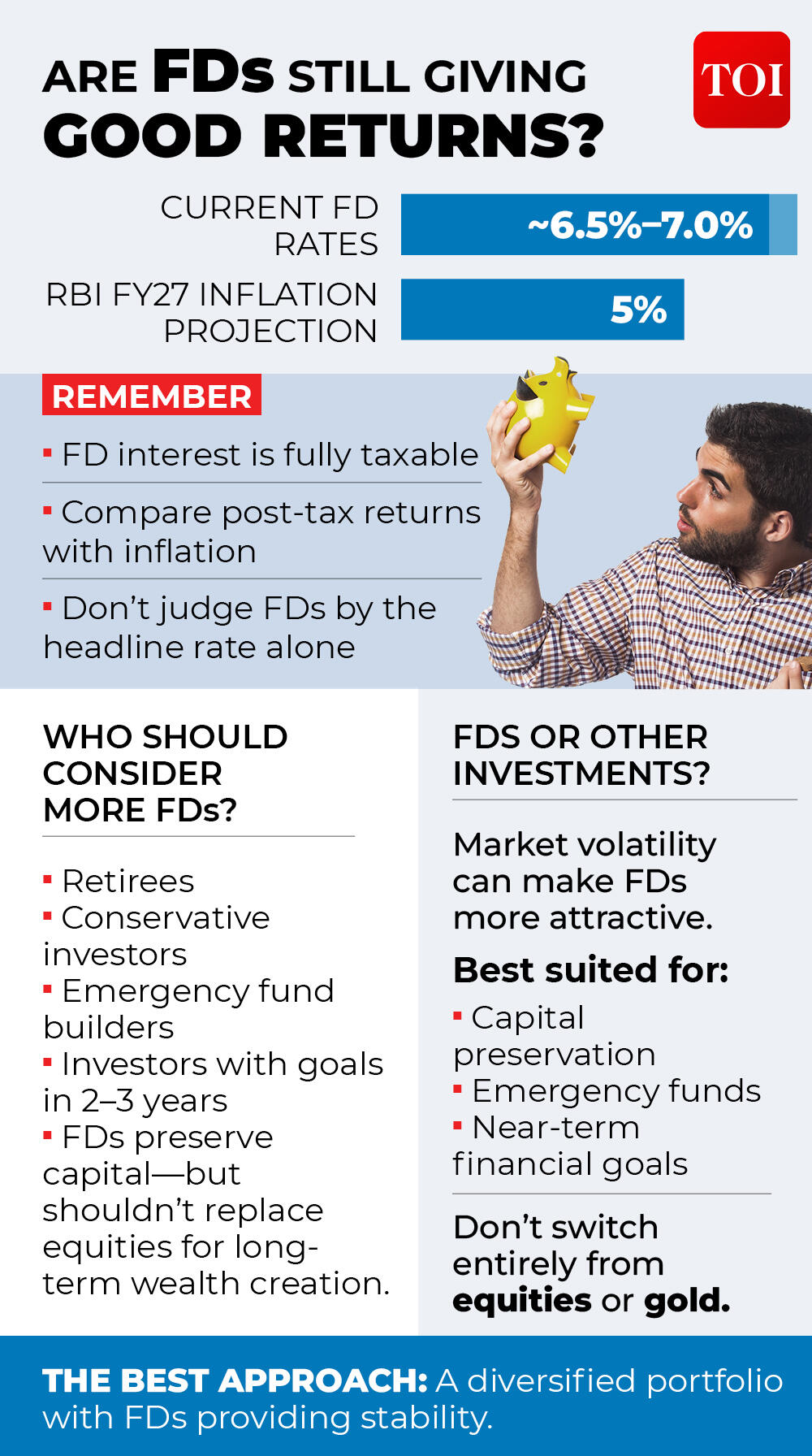
Are FDs still giving good returns?
In fact, periods of market volatility often increase the appeal of predictable returns, and bank fixed deposits continue to serve that purpose well.“FDs are particularly suitable for capital preservation, emergency funds and near-term financial goals,” says Adhil Shetty.However, he believes that the decision should not be driven solely by short-term movements in equity or gold.“Investors with longer investment horizons should continue to maintain a diversified portfolio across asset classes rather than shift entirely into fixed deposits. Each asset class serves a different purpose, and FDs are best viewed as the stability component of a well-balanced financial plan,” he concludes.(Disclaimer: Recommendations and views on the stock market, or any other asset classes or personal finance management tips given by experts and analysts are their own. These opinions do not represent the views of The Times of India.)