
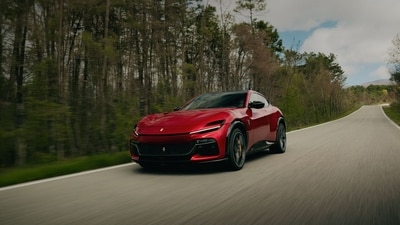
Opening thoughts. I must state some facts upfront: this edition of Wired Wisdom will be more about automobiles than our usual personal tech conversations, because a few things happened this past week that deserve discussion. Here’s one: Ferrari says their order books are completely filled through 2027, and the earliest the next car order from a deep pocketed buyer will be processed, is in 2028. And believe me, the typical Ferrari customer is likely to be very patient and will wait for the car they really want.
Any misconceptions that the Sir Jony Ive designed Ferrari Luce would have turned off rich people from potentially buying a Ferrari, have been truly unfounded.
For Ferrari this is a moment of transition (a true transition, not the kind Indian cricket team coach Gautam Gambhir claims every time the team loses a match; which is often these days). The Ferrari Amalfi, 849 Testarossa (and the Spider), and 296 GTB and GTS are being gradually introduced, while some of the popular ones including the 296 GTS, Roma Spider, and SF90 XX Stradale and SF90 XX Spider are retiring.
Production of the F80 flagship is believed to be ramping up. The Ferrari 12Cilindri and the 12Cilindri Spider have been joined by the Ferrari 12Cilindri Manuale. And not to forget one of my favourite designs, the Ferrari Purosangue. In H1 2026, Ferrari shipped 6,802 vehicles.
EDITOR’S MARGIN
MARUTI’S STRATEGY
A massive few days for Maruti Suzuki India. There is a new version of one of their bestselling cars, the Brezza, and that’s more than a cursory mid-cycle refresh. And in synchronicity, the automaker has reported its best ever monthly domestic sales. In July 2026, the carmaker’s domestic sales tipped 200,123 units, up from 140,570 in the same month last year.
- The compact and midsize cars including the Baleno, Dzire, Swift and remnants of the Ciaz inventory made up for 90,822 units (top from 65,840 in July 2025).
- The generally popular utility vehicles (higher ground clearance and SUV-esque footprint tend to attract families) including the relatively recent Victoris, Grand Vitara, Brezza, Ertiga, the XL6 as well as the Invicto, Jimny and eVitara, collectively made up for 78,851 units (also up from 52,773 units year on year).
- In India’s car buying paradigm, I am honestly surprised that the mini segment that holds the Alto and the S-Presso made up for 12,634 units—so much for price sensitivity assumptions, and a lot of weightage to increasingly aspirational car buying (though this number too is up from 6,822 year on year).
An incredibly popular car in Maruti Suzuki’s India’s portfolio is the Brezza compact SUV. First launched 10 years ago (as the Vitara Brezza; the Vitara prefix was dropped in 2022), the car hit the monumental 10 lakh cumulative sales mark in December 2023—and crossed the 15 lakh sales mark in July. In fact, in its 10th year, the vehicle retains a 31% share of its segment, competing with the Hyundai Venue and the Kia Sonnet. You could argue that with so many of these cars on the road, there’s very little unique about driving it anymore. To that point, I do not believe most Maruti Suzuki buyers really get bothered by that—in fact, practicality, utility and peace of mind ownership are key criteria.
The Brezza now has a new iteration, and this is technically its third generation in all this time, and second broad refresh. That’s also one of the reasons Maruti Suzuki cars hold resale value better than most other rivals, which generationally tend to change much more (the older models feel even more dated as a result).
Key new additions are a 1.0-litre 3-cyliner Boosterjet turbo engine that will sit alongside the familiar K15C 1.5-litre naturally aspirated 4-cylinder petrol engine, 6-speed manual transmission on both engine options, 5-star safety rating, a larger 10.1-inch infotainment screen on higher spec variants with Alexa and connected car tech such as Suzuki Connect and slightly redone (read, grown-up) interiors. The 1-litre engine allows Maruti Suzuki to draw on GST benefits (due to cubic capacity tiers), and therefore an inarguably great value pricing that starts at ₹7,39,900 (ex-showroom). The K15C engine options, due to 1.5-litre capacity attracting higher GST, are a bit more expensive in comparison. Great that the automaker has given buyers both options—and it’s a nice reversal from usual trend, where turbo engines tend to be more expensive due to higher performance potential.
I’ve not driven the Boosterjet engine in the state of tune the Brezza specifically gets, but this should be exciting to drive—109 mechanical horsepower and 170nm (Newton-meter) of torque. Maruti Suzuki claims this will deliver a fuel efficiency of around 20.47km/l, which is unheard of in turbo genres (though yours truly regularly pulls higher mileage figures from Hyundai’s 1.5L Turbo GDi engine with 6MT).
Finally, I am absolutely certain that Maruti Suzuki will be criticised for their version of passive, warning focused driver assistance systems—blind view monitoring on the external rearview mirrors for cars and other motor vehicles in adjacent lanes, rear cross traffic alert when reversing out of a parking spot, and exit warning as you are about to open the door to crossing vehicles or pedestrians. People would want more ADAS that steps in automatically, such as lane hold or automatic braking. But I prefer to be warned and take steps on my own. Personal preferences.
THE LATEST, ON NEURAL DISPATCH
XIAOMI KUNLUN PLATFORM
Xiaomi in China has added two SkyNomad Series vehicles to its EV portfolio. The Xiaomi SkyNomad N90 Max Flagship 7-Seater Extended-Range SUV and the SkyNomad N70 Max 5-Seat AWD Extended-Range SUV now sit alongside their EV sedans and SUVs.
These are, as to be expected, loading with tech including extensive personalisation options, smart electric doors that can open by voice and touch, a 360-degree anti-collision system uses AI to detect obstacles near open doors and can actively resist opening or sound a warning, over 140 aerodynamic optimisations, including a standard active grille across the range that helps the SkyNomad N90 Max achieve a drag coefficient of 0.255, and zero gravity seats.
On the tech front, the series runs on the Snapdragon 8 Gen 3 platform and includes the Nvidia Thor-U chip delivering 700 TOPS of computing power for Xiaomi’s HAD (High-Assistance Driving) system, complete with forward-facing dual LiDARs and 4D millimeter-wave radar.
But I’m quite interested in the new Kunlun platform that Xiaomi has underpinned the SkyNomad vehicles with. The company says this has been approached as a three-axis structure.
- The X-axis focused on front cabin integration to free up interior space, including five-in-one EREV system, integrated water-cooling module, integrated refrigerant module, mid-mounted HVAC unit, and a PTC-compressor two-in-one compress the front cabin length to just 1,265 mm.
- The Y-axis is all about the third-row wheel-arc optimisation—here, Xiaomi says springs and shock absorbers are separated into a split layout, releasing 15 mm of wheel-arch height for the third row compared to traditional large SUVs. This helps accommodate a 3,080 mm wheelbase on the N90 Max (2,950 mm on the N70 Max) and allows for up to 900 mm of seat adjustment range for the second and third rows.
- Then there’s the Z-axis, which is about eliminating the step-up perception between the second and third rows in most SUVs; here, rear electric drive unit integration and rear suspension has been redesigned with a highly integrated rear coaxial electric drive that frees 145 mm of vertical space, an integrated-linkage independent suspension that uses an H-arm structure where the air spring sits inside the arm, lowering the floor by another 37 mm, and the large battery pack that’s been redesigned with the battery pack control module relocated inside to reduce floor thickness by 180 mm and therefore delivering a completely flat second-row floor.