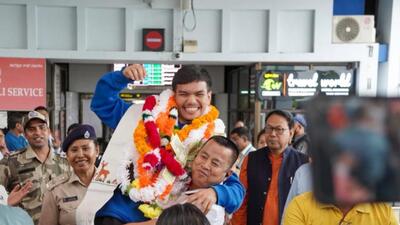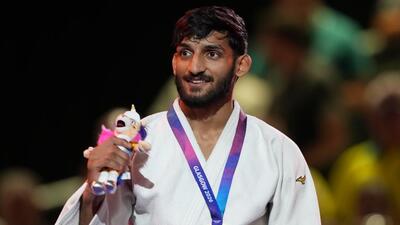
Mumbai: For someone who won his first international medal at the Commonwealth Games (CWG), Harsh Singh was somewhat startled by the reception at the Delhi airport upon his return from Glasgow a couple of days ago. Being showered with garlands and sweets, and hoisted aloft on the shoulders of well-wishers is not something the soft-spoken judoka is used to.
Did he like it or was he a touch overwhelmed?
“Mujhe medal laana pasand hai (I like winning medals),” Singh said. “After that, whatever comes along, I am okay with it.”
That medal was a gold, the first by an Indian male judoka at the CWG coming minutes after Asmita Dey had broken Indian judo’s gold drought at the Games.
For a sport that isn’t exactly mainstream in India, this was a moment of glory for judo. And one of the two protagonists behind it can already feel a difference in visibility and perception. Relatives and people in Singh’s Delhi neighbourhood, who previously knew little about judo, are now considering putting their own children into the sport.
“Earlier, the youth didn’t want to take up this sport,” Singh told HT. “There were no returns from it, no opportunities, no scope. Kids would switch from judo to wrestling or kabaddi. They saw nothing in judo — where the players are, what they are achieving. Now if they see Indians winning medals in events like this, they will be aware of the sport and have some hope that there is a future in it.”
Singh’s own hopes from the CWG were to get on the podium. The debutant “did not expect gold”, which he won after beating Australia’s two-time Olympian and 2022 CWG bronze medallist Joshua Katz in the -60kg final.
“But I had trained for it,” the 23-year-old quickly added. “India had medals in this category before, but not gold. I thought that if I were to go, I wanted to try and return home with that.”
For almost a year from 2024 to 2025, Singh feared he wouldn’t be able to get there.
In August 2024, Singh suffered tears to the anterior cruciate ligament (ACL) and meniscus in his right knee during a training session at his base, the Inspire Institute of Sport (IIS). The doctor suggested surgery, but Singh shrugged it off.
“My heart wasn’t ready to accept that I will have to have a major surgery and be out of action for a year,” he said.
A month-and-a-half later, when his knees got “locked” while doing squats in the gym, Singh realised he couldn’t carry on like that. “It would have hampered my game and my career,” he said.
The next day, he underwent surgery. For the next couple of months, he needed the support of a walker even as he gradually started movement in his knee. The next year, he completed rehab in March and returned to competition at the national ranking event in October.
“My weight had increased to 72kg, and I had to give trials in 60kg. To bring that down again was very difficult,” he said. “Early in that phase, I had a lot of negative thoughts and fears on how I would recover. But my physios, doctors and coaches kept me positive.”
Singh didn’t always have this kind of support system. Growing up in a modest household in Delhi, he would do judo for fun. But when it turned more serious, which included longer travel hours to Palam for training, he didn’t often have the means.
“Things like supplements and equipment were expensive. I couldn’t afford it all by myself. My seniors would chip in and help me in whatever capacity,” Singh said.
“It was only after I won some medals at the National Games, and then got selected in IIS, that I could focus fully on the sport without having to worry about things.”
A Havildar in the Army, Singh has ensured his father no longer has to work. As for his own career, he reckons he is only getting started.
“To be honest, I feel like this is just the first step for me,” he said of the CWG gold. “This is my first international medal, and it gives me hope that I can win more.”