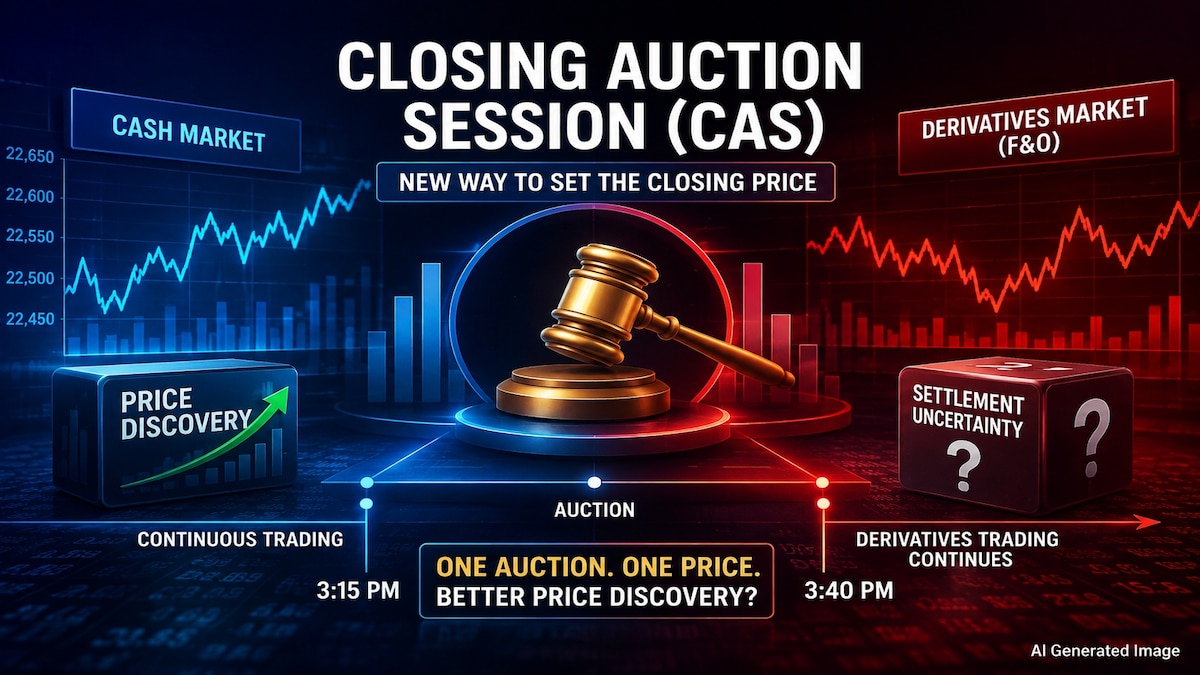
However, market participant Rajesh Baheti argued that linking futures and options (F&O) settlement to the auction-based closing price has introduced significant uncertainty, describing it as a “coin toss”.
Speaking to CNBC-TV18, Narayan said the move to introduce CAS followed extensive consultations and research after representations from global passive funds, which highlighted tracking errors during index rebalancing and pointed out that India was an outlier among major markets in not having an auction-based closing mechanism.
“The passive players in the FPI community are quite large,” Narayan said, adding that they accounted for nearly 30% of foreign portfolio investors’ equity assets under management and inflows. He noted that active global funds were also interested because many of them are benchmarked to the same indices.
Also read: SEBI to stay course on CAS framework, urges brokers to boost retail participation
Narayan said another key objective of the reform was to minimise basis risk between the cash and derivatives markets.
“I don’t think de-linking the F&O settlement from the CAS makes sense,” he said. “Ideally, I want genuine market participants… to face as little basis risk as possible. Ideally, that basis should be zero.”
Baheti, Managing Director of Crosseas Capital Services Pvt Ltd, took a sharply different view, arguing that the issue is not the auction mechanism itself but its linkage with F&O settlement.
He said the volume participating in the closing auction remains too small compared with the size of the derivatives market.
“Earlier, we had 10-15% of the market’s trading volume determining the F&O settlement. Now that’s down to about 2% on the NSE and probably around 0.2% on the BSE,” Baheti said.
He argued that the uncertainty surrounding the final settlement price has already affected derivatives trading.
“It’s a coin toss now,” he said, adding that he has advised traders at his firm to exit positions before 3:15 pm rather than hold them through the auction.
According to Baheti, options premiums have risen sharply because traders no longer know where the final settlement price will be discovered.
“Options are priced according to risk. If the risk increases, option premiums increase,” he said.
Baheti also questioned whether the current auction volumes are sufficient to determine settlement in a derivatives market that is many times larger than the underlying cash market.
Responding to concerns that the auction mechanism could make market manipulation easier, Narayan said the real issue was low participation rather than the auction format itself.
“Low volumes remain the issue,” he said. “The issue is not really about manipulation. I think that can be adequately dealt with by the exchanges and SEBI.”
According to Narayan, surveillance becomes easier under an auction-based system because regulators need to monitor activity only during a single auction window, making it simpler to identify spoofing, frequent order modifications and attempts to influence the closing price.
He acknowledged that the first few trading sessions under CAS had produced sizeable differences between the 3:15 pm market level and the final settlement price, but said those gaps should narrow as participation increases.
“I would like to see much higher volumes going through the CAS, and I think that will happen over time,” he said.
Narayan also urged broker platforms to display indicative auction prices and order imbalances more prominently so that arbitrageurs and other market participants can respond quickly to pricing dislocations.
“If there are issues with certain broker front ends, they need to be fixed,” he said, adding that active mutual funds, proprietary traders and portfolio managers should monitor the auction “like hawks” because it presents trading opportunities.
Venkatachalam Shunmugam, Partner at MCQube, struck a more balanced note, saying the initial volatility appears to be a temporary adjustment rather than a structural flaw.
“I think it will be quite volatile initially. However, I believe that over a period of time it should settle down,” he said, describing the current phase as “teething problems”.
Shunmugam said exchanges should focus on attracting more liquidity providers to the auction while increasing awareness among traders about how the mechanism works. A broader and more diverse order book, he said, would help keep the final closing price closer to the 3:15 pm reference level.
On calls from some market participants to separate F&O settlement from the auction, Shunmugam said he did not expect regulators to reverse course.
“I don’t think so because the closing price is the price that should be used for every settlement,” he said. “What we need is a price that is collectively discovered in a fair and transparent manner, and that is what the CAS provides.”
India introduced the Closing Auction Session for F&O stocks to replace the earlier system under which the official closing price was based on the volume-weighted average price during the final 30 minutes of continuous trading.
Under the new framework, continuous trading ends at 3:15 pm, followed by an auction that determines a single equilibrium closing price, while derivatives trading continues until 3:40 pm.
The reform aims to improve price discovery, provide better execution for passive and benchmark-linked funds, and align India’s market structure with practices followed by major global exchanges.
However, the first few sessions have also exposed operational challenges, including limited auction participation, inadequate visibility of indicative prices on some broker platforms and heightened volatility in expiring derivatives contracts.
Watch accompanying video for entire conversation.