A wildfire that swept through the high-altitude alpine zone of Africa’s Rwenzori Mountains in 2012 has been identified as the first large-scale fire to strike the region in at least 12,000 years, according to a study published in Nature. By analysing ancient lake sediment cores (cylindrical samples of layered mud from the lake bed), researchers reconstructed the mountains’ fire history and discovered that the 2012 blaze left an unprecedented charcoal signature, more than 100 times greater than anything recorded in the previous 12 millennia. The findings suggest that climate change and growing human influence are exposing one of Africa’s most unique mountain ecosystems to a threat it had largely escaped throughout the Holocene.
Lake sediments preserved a 12,000-year record of fire
The research team collected sediment cores from two lakes in the Rwenzori Mountains, which straddle the border between Uganda and the Democratic Republic of the Congo. One core came from Lake Kopello, located in the alpine zone at around 13,000 feet (about 4,000 metres), while the other was collected from Lake Mahoma at roughly 9,000 feet (2,740 metres).Lake sediments act as natural environmental archives. Over thousands of years, pollen, plant waxes, microscopic organisms and charcoal from surrounding landscapes settle layer by layer on the lake floor. By studying these layers, scientists can reconstruct past climates, vegetation changes and wildfire activity.For this study, the researchers focused on charcoal preserved within the sediments because it provides a reliable record of past fires. The Lake Kopello core showed almost no evidence of major fires throughout the past 12,000 years. Then, in the layer corresponding to 2012, the charcoal concentration increased by more than 100-fold, producing a signal unlike anything else in the record.According to the researchers, the enormous charcoal spike demonstrates that the 2012 wildfire was not part of a recurring natural fire cycle but an unprecedented event in the region’s recent geological history.
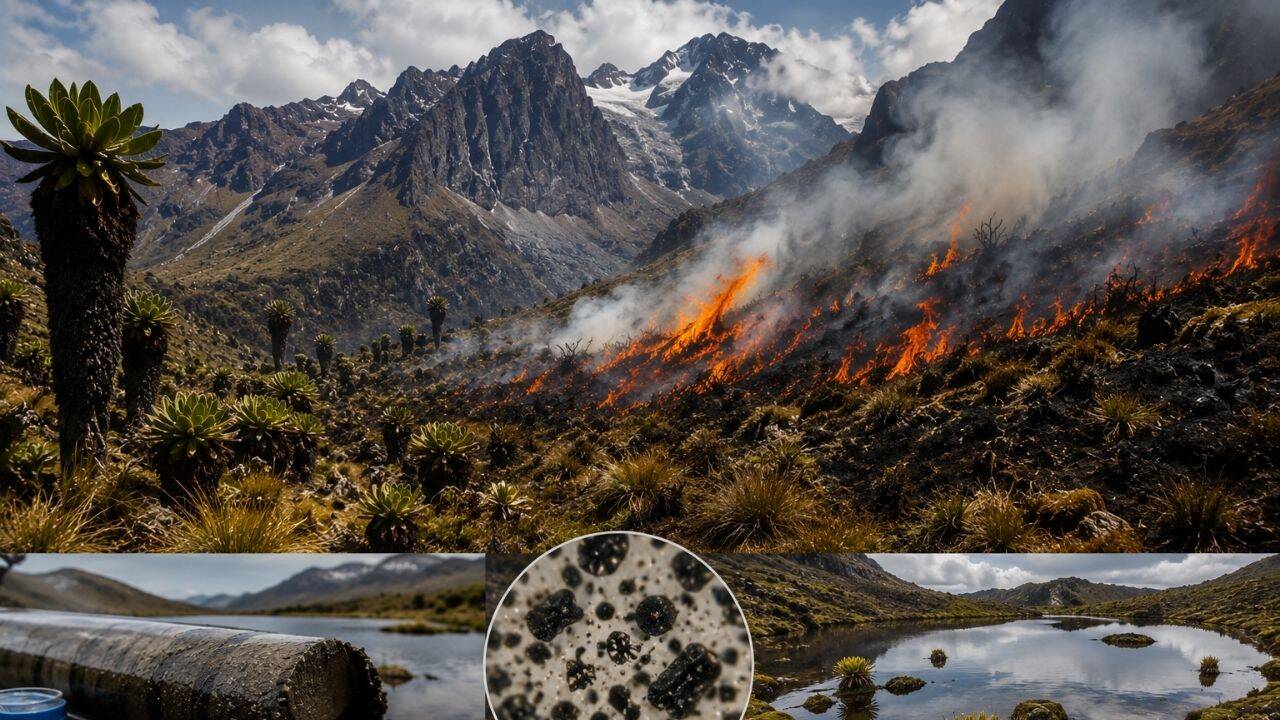
Representative Image (AI-generated)
Why the 2012 wildfire was so unusual
The wildfire burned approximately 42 square kilometres of alpine moorland at elevations above 13,000 feet. Scientists had long assumed that these high-altitude ecosystems were naturally protected from wildfire because they are typically cold, wet and frequently covered by mist.The Rwenzori Mountains, often called the “Mountains of the Moon,” contain rare Afroalpine ecosystems that support many plant and animal species found nowhere else on Earth. These isolated mountain habitats, sometimes referred to as “sky islands,” evolved under conditions where large fires were essentially absent.The study suggests that a combination of warming conditions and human activity may be increasing the likelihood that fires can ignite and spread in landscapes that historically remained too wet to burn. Researchers note that similar recent fires have also been recorded on Mount Kenya and Mount Kilimanjaro, indicating that fire may be emerging as a growing threat across Africa’s highest mountain ecosystems.
Lower slopes reveal earlier human influence
While the alpine zone remained virtually fire-free until 2012, the sediment cores from the lower-elevation Lake Mahoma told a different story. The researchers found that charcoal began appearing regularly about 2,000 years ago. This increase closely matches archaeological evidence indicating intensified human activity in the region during the same period.The sediment record also documented major ecological changes following the appearance of fire. Pollen from deciduous rainforest trees declined, while pollen from bamboo and grasses became more common, suggesting that repeated burning permanently altered the surrounding mountain forests.Although the exact cause cannot be confirmed, the timing indicates that human activities likely contributed to the increasing frequency of fires at lower elevations. In contrast, the alpine ecosystem remained largely protected until the unprecedented 2012 wildfire.
A warning for vulnerable mountain ecosystems
According to the researchers, the findings highlight how rapidly climate change can alter ecosystems that have remained stable for thousands of years. Unlike many fire-adapted landscapes, the Rwenzori alpine vegetation evolved without regular wildfires, making it particularly vulnerable when fires do occur.The consequences extend beyond biodiversity. Following the 2012 fire, nearby communities experienced destructive flooding because the burned vegetation could no longer absorb rainfall and stabilise the slopes, allowing water and debris to rush downstream.The researchers conclude that preventing future ignitions should become a conservation priority for the Rwenzori Mountains and other Afroalpine “sky islands.” As warming temperatures continue to reshape high-elevation environments, landscapes that remained largely untouched by wildfire throughout the Holocene may face increasing risk in the decades ahead.