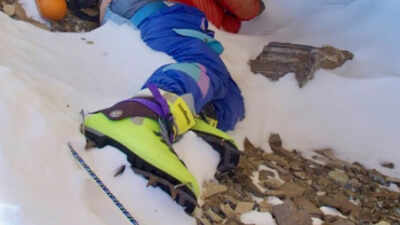
The body of an Indian climber believed to have become the mountaineering world’s infamous “Green Boots” could finally be brought down from Mount Everest, three decades after he died while descending from the summit.India is preparing a high-altitude recovery mission to retrieve the remains of Dorje Morup, an Indo-Tibetan Border Police (ITBP) personnel who died on Mount Everest in 1996, according to a detailed report by the BBC.Morup’s body has remained frozen at about 8,500 metres on the northern side of Everest for nearly 30 years. The remains became known among climbers as “Green Boots” because of the distinctive bright green mountaineering boots visible on the body.The ITBP is now looking for a specialist team capable of undertaking the difficult recovery operation. The force hopes to bring the remains back to India by September, after which DNA testing would be carried out to establish Morup’s identity conclusively, the BBC reported.If the identification is confirmed, his remains will be returned to his family in Ladakh.
The climber behind the ‘Green Boots ’ mystery
Morup was 48 when he joined a six-member ITBP expedition that attempted to climb Everest from the Chinese side in 1996. The expedition was seeking to become the first Indian team to reach the summit from that route.Three members of the expedition eventually turned back because of a snowstorm, while Morup and fellow climbers Tsewang Smanla and Tsewang Paljor continued towards the summit.All three reached the top, but disaster struck as they attempted to descend.A blizzard hit the mountain and killed the three climbers. Their bodies were left on Everest, as recovering bodies from the mountain is itself an extremely dangerous undertaking.For years, the body now known as “Green Boots” was assumed to belong to Paljor. However, surviving members of the 1996 expedition, along with information about the climbers’ final radio communications and the location of the body, have led authorities to believe that it was actually Morup.An ITBP official told BBC that Morup’s clothing and climbing equipment had also helped authorities identify the remains in recent years.The body has since become one of the most recognisable markers on the route to Everest’s summit, passed by climbers making their way through the mountain’s notorious “death zone”.For Morup’s family in Ladakh, the operation could finally resolve a mystery that has lasted three decades.
Share your thoughts in the comments
Be respectful · TOI community guidelines
His wife, Konchak Yangskit, told the BBC that she struggled to accept his death because she had never seen his body.Morup had told her before leaving for the expedition that he would return home after making the country proud. He had also asked her to look after their children and come to the airport to receive him when he returned.His son, Punchok Dorjai, told the BBC that the family plans to hold a funeral near Martyrs Park in Leh if the remains are confirmed as his.He also said the family intends to keep the green boots that gave Morup’s remains their enduring identity on Everest.