NEW DELHI: The Indian women’s hockey team is heading towards a critical juncture, defined by two major tournaments positioned agonisingly close together.
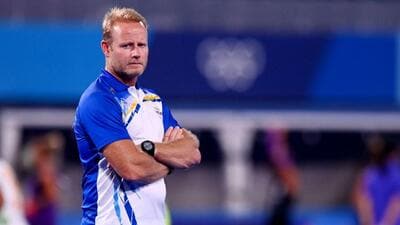
For chief coach Sjoerd Marijne, the World Cup (August 15-30) and Asian Games (September 19-October 4) represent a symbiotic pathway towards the ultimate target. While the World Cup offers a stage against the global elite, the Asian Games victory carries the golden ticket — direct qualification for the 2028 LA Olympics.
Navigating this double-header requires not just tactical precision but vision as well. Marijne is acutely aware of the balancing act his squad must perform. Asked about the priority, the Dutchman refused to diminish the prestige of either, viewing them as interconnected stepping stones.
“I rate both tournaments really high,” Marijne tells HT. “But with the Asian Games, you can qualify for the Olympics and that is our big goal — being a medallist at the 2028 Olympics. That is the dream goal. Can we reach it? We don’t know, but we are hunting for it. And the major step is to qualify.”
The pragmatic approach does not relegate the World Cup to a preparatory exercise. Competing at the tournament demands absolute focus, and for Marijne these tough matches are what his players need to forge resilience for the Asiad in Japan.
“It doesn’t mean that the World Cup is not important for us, because those matches can help us for Asian Games. You play a World Cup once in four years. You also want to do well. So, for me both are possible because I’ve already experienced it in 2018. We had the same (schedule) and we did really well at both tournaments,” said the 52-year-old.
Marijne joined the setup in January following which he helped the Salima Tete-led team achieve two major targets. India won the World Cup Qualifiers in Hyderabad in March to make the cut for the showpiece event. India then won the Nations Cup in Auckland in June to earn promotion to the elite Pro League.
The chief coach maintains that there is ample time between events to recover, emphasising that “one tournament will help the other”.
Before dreaming of the Asian Games podium, India must survive a difficult World Cup group stage. India have been grouped with Paris Olympics silver medallists China, Rio Olympics champions England and world No.18 South Africa. Only two will progress to the next round robin. Just to qualify for that will be a tough task for the world No.9 outfit.
“It’s a very tough group,” says Marijne. “If you only see the numbers, then against South Africa you need to win as they are lower ranked. The other two are higher ranked.”
Encounters against England and China will serve as the ultimate barometer of progress. India had lost to England in the World Cup Qualifier final. Marijne said that though the team did well there, they could have extracted more out of it. The true test will be against China, the Paris Olympics silver medallists who will also pose the biggest threat at the Asian Games.
“China is, of course, a different story,” says Marijne. “They have been doing really well the last few years. That will be the biggest challenge. And we play them first (August 16). But it’ll give us insight, where we are now against the No.4 of the world. Is the gap really as it was, or has it become smaller, or maybe even bigger? Now, let’s not hope that, of course.”
To ensure that the gap shrinks, Marijne has overseen a cultural overhaul. Before his arrival, the team was marred by turbulence and internal rifts. The transformation into a cohesive unit required stripping away egos and fostering a collective identity. “You need more unity, focus on the team goal, not your individual goal.”
This unity translates into rigorous, task-driven discipline. While the team is working on structured and defensive solidity, Marijne knows the margins are razor thin.
“Defensively stay as structured as we are and be disciplined. In the end, in big tournaments, it’s about converting your chances into goals. We did really well with penalty corners, but we can convert more field chances,” he said.
But the reality of international hockey is that opportunities are fleeting. “Against the higher ranked teams, you’ll not get 10 chances, you’ll get maybe three, and you have to make at least 1-2 of them. You’ll get maybe three PCs, you have to make 1-2 of them. Then you’re going to win those matches,” adds Marijne, who guided the team to fourth place at the 2021 Tokyo Olympics.
The vision is set, internal friction has been replaced by collective ambition, and the World Cup awaits as the furnace where destinies are crafted.