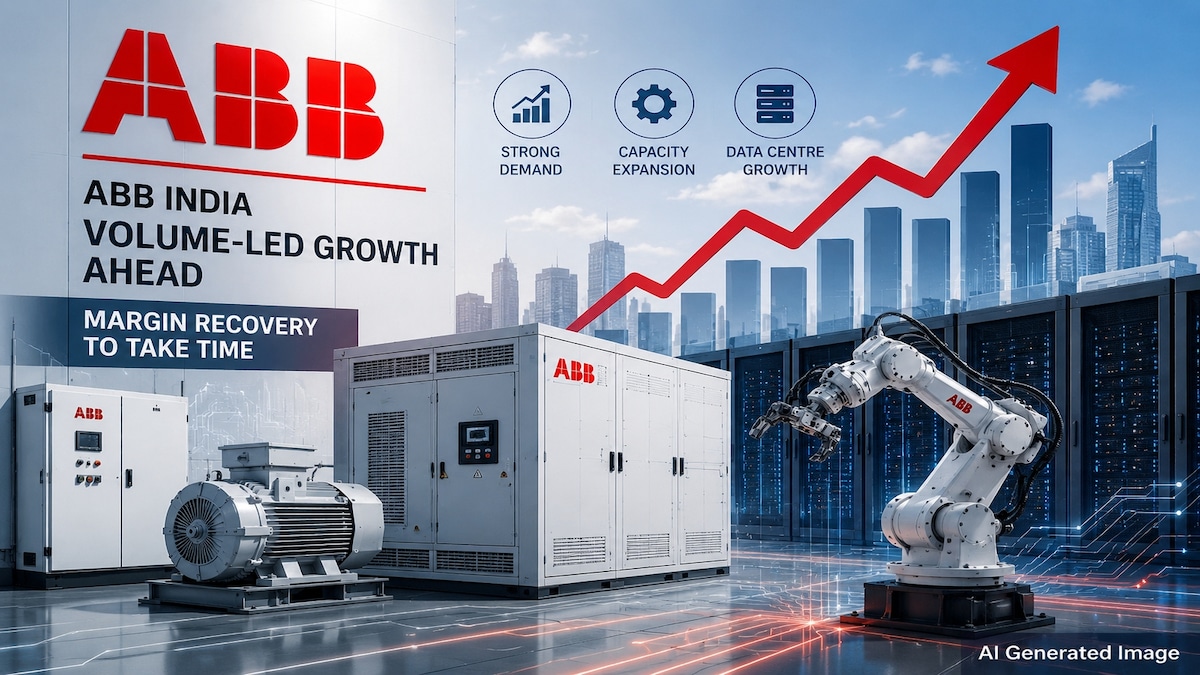
“The next level of expansions will primarily be driven by the volumes. So it will be volume-led growth, and for margin-led growth to take place, it will take some more time,” Sridhar said.
ABB India reported a standalone net profit of ₹362.3 crore for the second quarter of calendar year 2026, up 3% from ₹352 crore in the same period last year.
The company reported its highest-ever second-quarter revenue of ₹3,559 crore, while first-half revenue rose to ₹6,743 crore. Both periods recorded double-digit year-on-year growth.
At the operating level, EBITDA increased 11.4% year-on-year to ₹447.1 crore. However, the EBITDA margin declined to 13% from 14% a year earlier.
Sridhar said the company remained confident of improving margins once market volatility settles, while demand across its businesses continues to remain strong.
Commodity, forex volatility weigh on margins
Sridhar said margin pressure was largely due to higher material costs, particularly commodities, along with foreign exchange volatility.
He said ABB India wanted to return to its earlier margin levels, but the timing would depend on how quickly these external factors ease.
“We are confident that if the volatility sort of settles down, we will be in the right position to go ahead,” he said.
Sridhar added that geopolitical uncertainty remained outside the company’s control, but ABB India’s diversified operations and resilience should help it navigate the current environment.
ABB India order inflows rise 50%
ABB India’s order inflows grew 50% in the quarter, compared with an 81% increase reported by the global ABB Group.
Managing Director and Country Head Sanjeev Sharma said the difference was largely because some products and projects are booked directly by the parent group rather than through the Indian entity.
ABB has a diversified global product portfolio, with some products localised in India and sold directly through ABB India, while other products are supplied into the Indian market through the group’s global portfolio.
“This gap has been narrowing down over a period of time, and I think it will continue to narrow down over a period of time. But it will not be negligible in a few years to come,” Sharma said.
Sridhar said around 30 percentage points of the difference between the group’s order growth and ABB India’s growth came from two opportunities booked at the group level for strategic reasons.
One was an order under a global contract with an Indian customer, while the other related to the marine and ports segment. ABB India is building capabilities in marine and ports, with the group currently supplying the main systems while the Indian business supports services, installation and commissioning.
Data center demand remains strong
Data centers continue to be a key growth segment for ABB India, accounting for around 15-17% of its order book.
Sharma said demand from the segment remained robust and the company had invested in the required portfolio and capacity to cater to future growth.
“We only feel that in terms of our order books, it will be quite strong from the data center market segment in the future,” he said.
He added that data center projects typically have faster decision-making and delivery cycles. Orders in the segment could convert into revenue within five to six months, while conversion could be even quicker for customers that have standardised their systems with ABB.
ABB India plans ₹300-350 crore annual capex
ABB India plans to continue investing ₹300-350 crore annually in organic capacity expansion, Sridhar said.
The company aims to operate its capacities at around 85-90%, leaving 10-15% headroom for organic expansion when required. It also plans to continue its announced capacity investments over the next two to three years.
Sridhar said maintaining spare capacity has helped the company ensure consistent supplies to customers amid strong demand.
ABB India expects strong demand, capacity expansion and growth in emerging segments to support volume growth in the coming periods, even as a recovery in margins remains dependent on easing cost, currency and geopolitical pressures.
This is the slightly edited transcript of the interview.
Q: What could one expect as exit rate for margins in calendar year 2026?
TK Sridhar: I think today the margins have been impacted largely by the material cost increases, especially driven by the commodities, which have seen elevated ranges at this point in time, plus also the foreign exchange volatility as such. So now we are at 12-13% of EBITDA levels. I think we definitely want to move to those levels where we were earlier. The demand is pretty much strong. We have quite exciting emerging segments which are growing.
So I think the next level of expansions will primarily be driven by the volumes, right? So it will be volume-led growth, and for margin-led growth to take place, it will take some more time, is what we see.
And I think we are putting all efforts to make sure that we’re able to cater to the customers and stay resilient at this point in time. And we are confident that if the volatility sort of settles down, we will be in the right position to go ahead.
Q: So yes, it will be more of a volume-led growth versus margin-led growth. It will take some time for the margins. Then maybe calendar 2027 is when we get some certainty on the geopolitical front. That’s when we can start seeing the older margins coming back.
TK Sridhar: So geopolitical uncertainty is something which is beyond our control. I think we are by-and-large resilient organisation to meet this. In the past, we have definitely waded through these types of topics. So we are confident that as these settle down, we would also look at an increasing margin trend.
Q: Mr Sharma, the ABB parent group — we know that there is no direct correlation, but every time the parent group reports their numbers, we see the India order inflow coming in. This time it was 81%, and we saw the impact coming in for ABB India as well, and we saw the run-up. Now, there seems like there’s some gap that is going on, right? And versus your 50%, which is beyond those marine and ports, are there any other verticals where the order is being booked directly by the parent company? What is the gap that we could maybe help viewers understand between both of them?
Sanjeev Sharma: And this is true. I think there is a gap between what is reported by the group and how we see it in our books here in India, for the simple reason that ABB is a very well-diversified product portfolio company, wherein there are portfolios which we have established within the country and wherein we have localised them, and they pass through us to cater to the customers directly.
But then there are certain opportunities which are indirect, wherein the group is able to kind of supply into the market from the global portfolio. This gap has been narrowing down over a period of time, and I think it will continue to narrow down over a period of time. But it will not be negligible in a few years to come.
But as we see the demand for these one-off projects or one-off products, as they consolidate their consistent demand in the market, what we do is we include that part of the ABB India portfolio, localise it, and give it to the wider market.
Q: So you’re seeing this gap that, you know, previously we were seeing, is coming down because in the last few quarters it was almost in line. So this time there’s a one-off that has happened, right, in the order inflows.
TK Sridhar: So I think this time the orders which we saw were definitely 80 percentage, and we grew by 50 percentage. And this 30 percentage gap basically came from two opportunities which were placed on the ABB Group, but for strategic reasons.
One was an order which was under a contract or a global contract placed on an Indian customer. Naturally, it’s more of an order arrangement which happened. It was already an existing contract execution.
The other one is basically for marine and ports, and this is something which we are building capacity and competency in India. It’s a future growth opportunity for us. So while the main systems are provided by the global company, ABB Group company, we support them quite a lot from the services, installation and commissioning of that opportunity in India.
So it’s like any other business. The earlier stage of getting into the market is supported by the group, and then we later on catch up to that. And this has happened in the past, and this is something which marine and ports will also be going through. So it’s a natural transition, is what I see.
Q: Okay, so we are building that capacity, right, and the capability on the marine and ports front. Any other capacity that you all are adding as well to reduce this gap? What are the talks that you’re seeing, and in the near future, how does that investment also move for ABB India? What are you all looking to invest more in terms of capex?
TK Sridhar: So I think in our organic options, we are already on the record on the organic options. I think we do a minimum of ₹300 to ₹350 crore every year, and that will continue.
We always make sure that our capacities are at 85% to 90%, so that we have a headroom of 10-15% to expand organically at any point in time. And this has actually resulted in continuous supply, ensuring continuous supply to the customers.
I think you would have also heard, too, in the recent past when a global CEO was there. So we did announce the capex plans, and that will continue over the next two to three years to construct and make us future-ready.
Q: You know, let’s just focus and talk about a couple of segments, particularly as well. Data centers, around 15% to 17%, you all have said, account for your order book, right? How do you see that scaling up? What is the opportunity and influx that you are getting in terms of inquiries or orders as well?
Sanjeev Sharma: The market as such is quite robust, and we have been reporting it for the last seven years. When we actually started focusing on data centers, we were perhaps among the first who captured that opportunity, and there is a very high level of resilience in this market segment.
And we see in coming years it will only increase going forward, and our portfolio and our capacities are already in place. We have invested in them, and we’ll be able to cater to all the demand that is coming from the data centers.
We only feel that in terms of our order books, it will be quite strong from the data center market segment in the future.
Q: And overall, to the revenues, how would it be contributing overall? What would that share be going forward? Maybe in the next one year for this?
Sanjeev Sharma: So these data centres are typically very fast-moving projects. The decision-making is fast, as well as the demand for deliveries is quite good. So I think the ratio between when the order comes in and when it goes out is pretty good.
So we will see the same kind of books. Like, say, if you have 15% to 17% coming orders which are sitting with us, I think they will convert into revenues in five to six months’ time. I think that’s what we foresee, and there are certain customers who are standardising with us. There, the conversion between orders to delivery will be even faster.