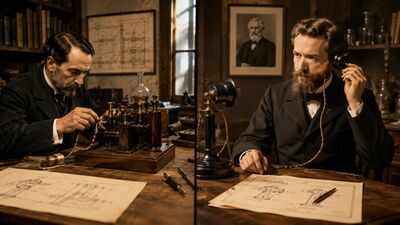
In 1849, Italian-born inventor Antonio Meucci began developing an early voice-transmission device that would later be known as the “teletrofono.” Decades of experimentation, financial hardship and a lapsed patent caveat meant that credit for the telephone ultimately went to Alexander Graham Bell in 1876. Meucci’s story, however, did not end there. Nearly 113 years after his death, the United States Congress formally acknowledged his contribution to the invention of the telephone. This article examines how the Telettrofono came to be, why Meucci was unable to protect it, and how its legacy was eventually recognised.
Who was Antonio Meucci and how did he develop the Telettrofono
Antonio Meucci, a native of Florence, spent much of his working life devising practical inventions rather than pursuing formal scientific research. In the 1830s he built a talking device that allowed communication between a theatre’s stage and its control rooms. After emigrating to Cuba later that decade, he developed a water purification system, a rheumatism treatment and a talking telegraph while working for a local theatre.By 1850, Meucci had settled in Staten Island, New York, where he opened a candle factory and employed several fellow Italian immigrants. It was here, in 1856, that he built a rudimentary transmission device connecting his laboratory to his home, so that he could stay in contact with his wife, whose arthritis had left her largely immobile. This domestic necessity became the basis for the device he would later call the Telettrofono.
How Antonio Meucci’s patent caveat and financial struggles affected the Telettrofono
Meucci demonstrated his invention publicly and continued refining it, eventually producing more than thirty variations. Unable to afford the full cost of a patent, he instead filed a caveat, a cheaper but temporary notice of an impending patent that required annual renewal.According to the official resolution passed by the U.S. House of Representatives in 2002, Meucci was “unable to raise sufficient funds to pay his way through the patent application process, and thus had to settle for a caveat, a one year renewable notice of an impending patent, which was first filed on December 28, 1871.” The same House resolution states that Meucci’s working models were reportedly lost by a laboratory affiliated with Western Union, and that by this stage he was “living on public assistance” and unable to renew the caveat after 1874. The consequences of this lapse were significant. As per the House resolution, had Meucci been able to pay the modest fee needed to maintain the caveat beyond 1874, “no patent could have been issued to Bell.” Meucci’s documentation problems in later court proceedings stemmed largely from the loss of his models, which he maintained had happened “due to Western Union losing his models.”
How Alexander Graham Bell patented the telephone in 1876 and faced a legal battle
Alexander Graham Bell filed his own patent application, titled “Improvements in Telegraphy,” on 14 February 1876 and was granted the patent on 7 March that year. According to National Museums Scotland, Bell recorded his first successful test in his laboratory notebook, later noting that his assistant Watson “declared that he had heard and understood what I said.” Bell went on to found the Bell Telephone Company in 1877 and spent much of the following decade defending the patent in court against rival claimants, Meucci among them.The dispute did not end with Bell’s lifetime dominance of the telephone industry. As per the House resolution, in January 1887 the United States Government moved to annul Bell’s patent on grounds of fraud and misrepresentation, and the Supreme Court found the case viable enough to send for trial. Meucci died in October 1889, and Bell’s patent expired in January 1893, meaning the underlying question of the true inventor was never resolved in court.
Why Antonio Meucci’s role in telephone history was recognised by Congress in 2002
More than a century after Meucci’s death, Congressman Vito Fossella of Staten Island introduced House Resolution 269, which the House of Representatives agreed to on 11 June 2002. The resolution formally recognised Meucci’s life and achievements, and acknowledged his role in the invention of the telephone, without stripping Bell of his historic patent.The recognition has not erased the ambiguity surrounding the telephone’s true origin. France and Germany continue to credit their own contenders for the title, and Bell’s own experiments arose from research into multiple telegraphy rather than a direct copy of Meucci’s work. What the House resolution did establish, however, was that Meucci’s early demonstrations, financial struggles and lost models formed a legitimate and previously overlooked chapter in the history of long-distance voice communication.