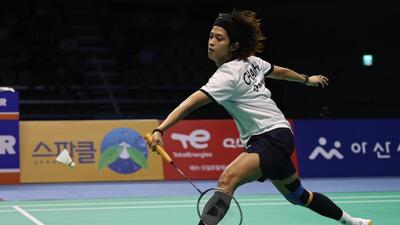
New Delhi: There was nothing but absolute focus in the eyes of Ashmita Chaliha as she stepped on to the main court of the Yi Sun-sin Gymnasium in Asan in what was the 26-year-old’s first final on the BWF World Tour.
It was Sunday at the $250,000 Korea Masters and the left-handed shuttler stood on the verge of history. Ranked No.50 in the world, the Guwahati girl was the underdog. Yet, she carried a quiet, undeniable momentum.
Earlier in the Super 300 tournament, she had stormed through the draw by dismantling top seed Hina Akechi of Japan in the quarter-finals. Now, only China’s fourth seed, Han Qian Xi, stood between her and her first BWF World Tour title. But the Chinese couldn’t oppose Ashmita for long as the Indian shuttler won 14-21, 21-14, 21-14 to become the first Indian to win the Korea Masters.
It was extra special for Ashmita. A comeback would have been the last thing on her mind during the dark phase after suffering a career-threatening knee injury (medial meniscus tear) in the same tournament in August 2024. Surgery was followed by a lengthy rehabilitation phase when rebuilding confidence as well as fitness and skill was all a huge challenge.
“I feel really great and unbelievable. But then I am trying to digest it. Now, I am hungry for more,” Ashmita said, relief and joy evident, as she expressed her gratitude to her Korean coach Park Tae-sang.
The final began with a flash of brilliance. Channelling the rigorous training she had undergone under Park at the National Centre of Excellence in Guwahati, Ashmita came out swinging. Her smashes found the lines and her deft net play pushed her to an early 9-5 lead.
But arenas have their own unseen variables, and the air currents high above the court began to play tricks. The tricky drift caught the shuttle, distorting its flight path. Ashmita struggled to calibrate her shots.
Frustration mounted as a flurry of unforced errors saw her bleed five straight points. The world No.35 seized the momentum, capitalising on the shifting conditions to snatch the opening game.
At the interval, Ashmita walked to the sidelines. There, Park was waiting. Where doubt could have easily crept in, her coach offered a vital injection of energy and tactical clarity.
As the players swapped ends for the second game, Ashmita immediately felt the difference. She was now on the “comfortable” side of the court, shielded from the unpredictable draft that had plagued her earlier.
With the handicap lifted, the Indian unleashed her true game. She dictated the pace, moving Han side to side, snapping winners. Controlling the rallies with newfound authority, she mirrored the scoreline of the first game to force a decider.
The third game was a battle of nerves and endurance. Knowing she had to start on the trickier side of the court, Ashmita dug deep. Her strategy shifted from aggressive shot-making to one of patience. She stayed in the long rallies, waiting for the mid-game interval.
When the interval took place, the players switched sides one last time. Stepping back on to the “good side” of the court, Ashmita knew this was her moment. She turned up the pressure, finding the crucial winners exactly when she needed them. After 53 minutes, a final decisive shot sealed her victory.
As the shuttle hit the floor, disbelief washed over her. All the talent and hard work she had put in over the years bore fruition, the magnitude of her achievement still sinking in.
Ashmita is the fifth Indian player/pair to win a BWF World Tour title this year, after PV Sindhu (Japan Open), Satwiksairaj Rankireddy/Chirag Shetty (Singapore Open), Devika Sihag (Thailand Masters) and Tanvi Sharma (Taipei Open).