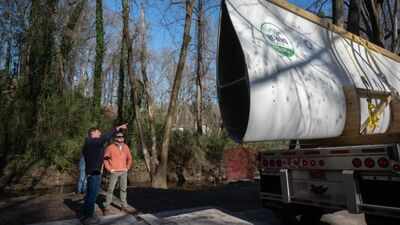
A retired wind turbine blade that once generated electricity at a Colorado wind farm has found an unexpected second life in Atlanta, as a pedestrian bridge. According to the Georgia Tech Research News Center, a 15-metre (about 50-foot) blade weighing roughly 7,000 pounds was transported from Colorado and installed across a creek at Beaverbrook Park in northwest Atlanta. The project has created the first bridge of its kind in the United States, turning a decommissioned piece of renewable-energy infrastructure into a functional part of a public park.
From turbine to bridge
The idea began with a practical problem at Beaverbrook Park. Jud Ready, a principal research engineer at the Georgia Tech Research Institute, had been involved with the park for years. While improvements had added an exercise trail, playgrounds, a gazebo and ball fields, visitors still could not easily walk through the wooded portion because a creek cut across the route.A grant from Park Pride helped with the park’s improvement efforts, but it was not enough to construct a conventional bridge. Ready then learned about research being carried out by his Georgia Tech colleague Russell Gentry, a professor in the School of Architecture and a member of the Re-Wind Network, which investigates ways to give retired wind turbine blades new structural uses.Rather than breaking the blade down into smaller materials, the team kept it largely intact and incorporated it into the bridge. This approach is known as adaptive reuse. The distinction is important because the team was able to preserve the blade’s existing structural capabilities rather than returning the material to its original state.Gentry described the approach as preserving the blade’s structural capabilities instead of reducing it to another raw material. In other words, the object that was originally engineered to withstand enormous forces while rotating high above the ground can continue performing a structural role after its life as a turbine component ends.
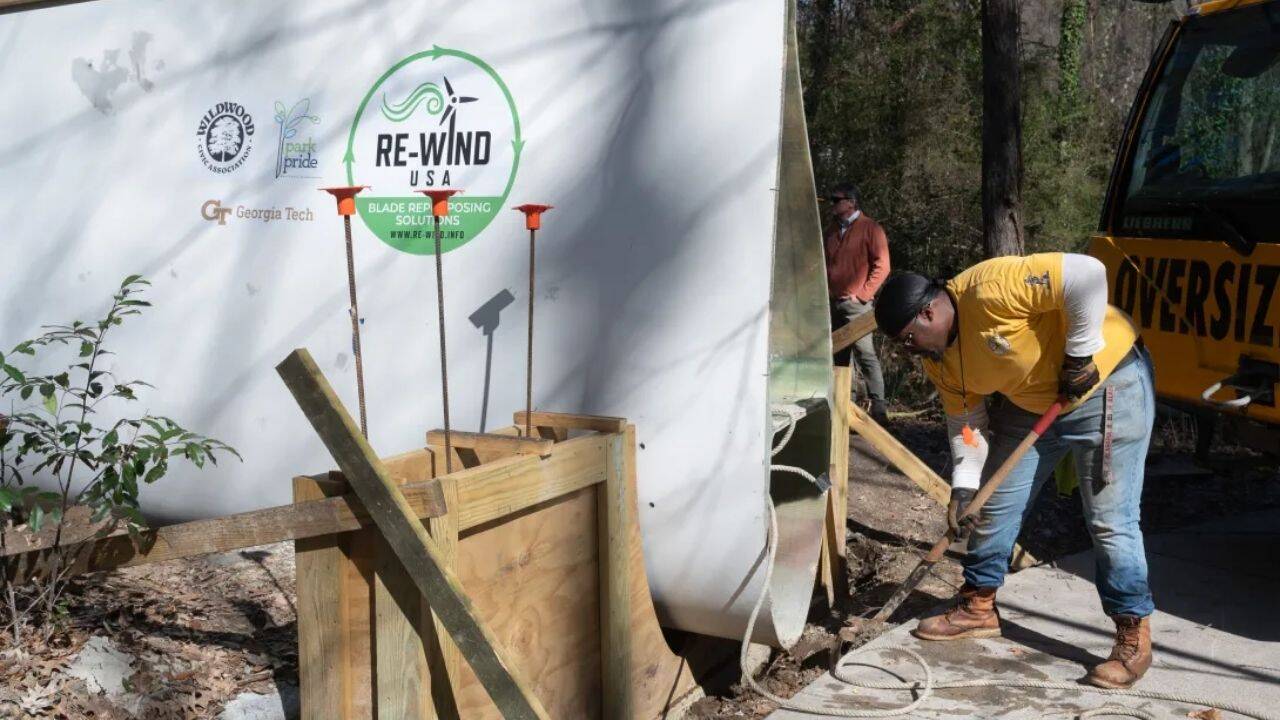
Image Credit: Allison Carter via Georgia Tech Research News Center
A 7,000-pound engineering challenge
Getting the blade to Atlanta was only the beginning. The 15-metre structure weighed approximately 7,000 pounds and had to make the journey from its former home at a Colorado wind farm to a public park in Georgia.The project was supported by funding from the National Science Foundation, the U.S. Department of Energy and wind turbine manufacturer Siemens Gamesa. A team involving Georgia Tech students, researchers and alumni worked on everything from surveying the park to understanding the blade’s unusual geometry and calculating how it would behave as part of a bridge.Designing the structure presented a challenge because conventional building and bridge codes contain limited guidance for using retired turbine blades as structural components. The team therefore had to develop much of the structural system specifically for the project.Architecture graduate Cayleigh Nicholson surveyed the park to determine the bridge’s location, while Sakshi Kakkad developed software to study the blade’s geometry and determine how it could be positioned. Civil engineering student Gabriel Ackall worked on calculating stresses and deflections, helping ensure the structure would meet safety requirements and city regulations.The unusual material also required the researchers to draw on more than half a dozen years of previous wind turbine blade testing and prototyping. Advanced modelling was combined with that research to determine how the retired blade could safely function as a pedestrian bridge.
Giving old blades a second life
Reusing the blades in infrastructure offers another possibility: their existing strength and shape can become part of a new structure. The Beaverbrook bridge also builds on earlier work by the Re-Wind Network. The organisation had already constructed two similar pedestrian bridges in Ireland, making the Atlanta installation its first such bridge in the United States.The bridge was installed in mid-March 2025 by a 16-person crew involving construction workers, an erection company and ironworkers. A local tree company also helped by pruning trees so a crane could safely lift the massive blade into position.What began as a retired component from a Colorado wind farm is now part of Atlanta’s everyday public infrastructure. For people walking through Beaverbrook Park, the structure provides a simple way across a creek. But its larger significance lies in what it represents: a wind turbine blade that has moved beyond electricity generation and taken on a completely different role as a bridge.