
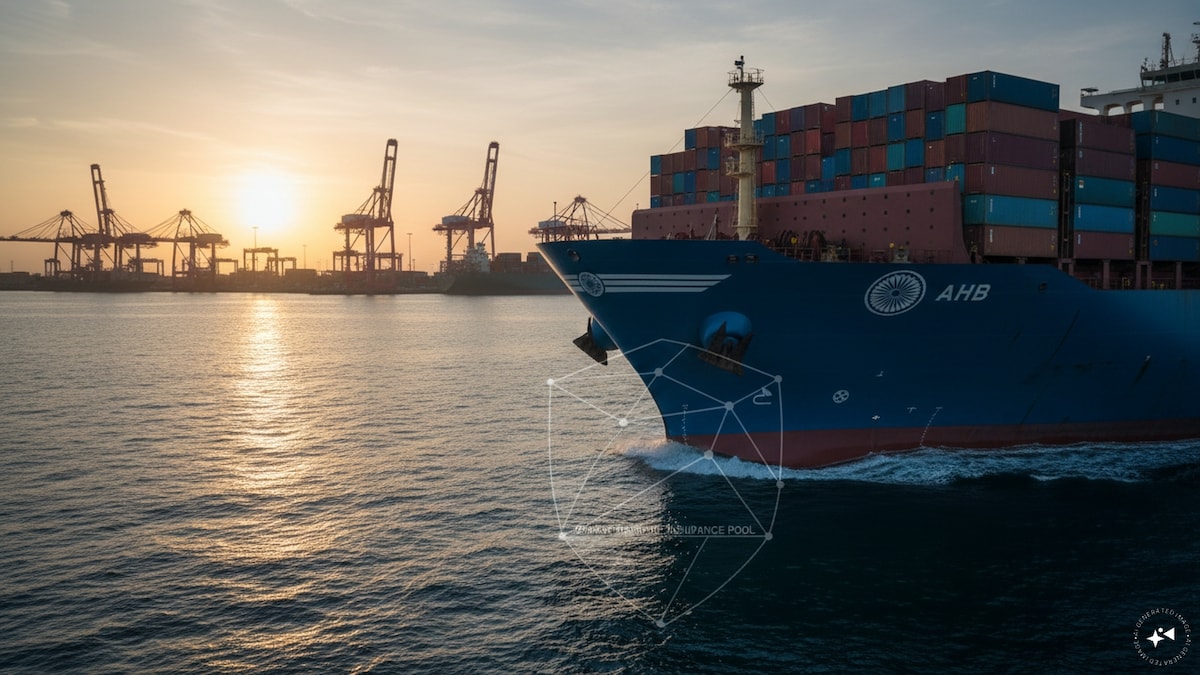
The development marks a broader push to build domestic capacity in specialised marine insurance and reduce dependence on overseas markets, particularly during periods of geopolitical disruption.
What is the BMIP?
The BMIP is a sovereign-backed insurance mechanism established to provide continuity of maritime war-risk cover for Indian-flagged vessels, Indian-controlled vessels and cargoes moving to and from Indian ports.
The Union Cabinet approved the pool in April 2026, with a sovereign guarantee of ₹12,980 crore. The Department of Financial Services operationalised it on May 12.
As of July 29, 1,608 policies covering cargo and hull war risks had been issued under the pool, according to the Ministry of Finance. The government said war-risk premium rates had fallen by around 35-40% from levels seen at the height of the recent West Asia conflict.
Why was the pool created?
Marine insurers can reassess both the availability and pricing of cover when geopolitical risks rise sharply. This can make it more difficult or expensive for shipping companies and cargo owners to secure war-risk protection through international markets.
The BMIP was created to provide an additional domestic source of insurance capacity in such circumstances.
According to Hari Subramaniam, Chief Growth Officer – Marine, Howden Specialty, a division of Howden, a major international insurance group, the pool is intended to provide insurance continuity during geopolitical conflicts or sanctions while also helping develop India’s domestic marine insurance expertise.
What is P&I insurance?
P&I insurance is different from hull and war-risk insurance.
It primarily protects shipowners and operators against third-party liabilities arising from the operation of vessels. These can include crew and cargo liabilities, pollution-related liabilities and wreck-removal costs.
The first P&I policies under the BMIP were bound in July for a tug and two barges owned by Shipping Corporation of India (SCI), Subramaniam said.
The first policy issued by New India Assurance under the pool provides an indemnity limit of up to $1.5 billion through the combined capacity of the pool, according to the Ministry of Finance.
Why does the P&I expansion matter?
P&I is a specialised segment of marine insurance with a significant international market presence. Bringing such capacity under a sovereign-backed domestic framework could broaden the role of the BMIP beyond war-risk insurance.
Subramaniam described the first sovereign-backed P&I policies as an initial step towards building greater domestic marine insurance capability.
The industry’s expectation is that the BMIP could eventually extend P&I cover to ocean-going vessels, with such coverage envisaged by 2027, he said.
What is the challenge ahead?
Having domestic insurance capacity is one part of the equation. International acceptance of the policies is another.
Subramaniam identified the acceptance of BMIP-backed P&I policies at ports worldwide as one of the current challenges.
This is important because vessels operating internationally need their insurance arrangements to be recognised by relevant ports and other stakeholders across jurisdictions.
The effectiveness of the expanded BMIP will therefore depend not only on the capacity it can provide in India, but also on how widely its insurance cover is accepted across international shipping routes.
What does this mean for India?
The BMIP is aimed at strengthening domestic capacity in a specialised segment of the insurance market while providing an additional source of cover during periods of heightened geopolitical risk.
Its initial focus was on cargo and hull war risks. The addition of P&I cover expands the scope to another major category of maritime risk.
For India, the broader objective is to develop domestic expertise and capacity in marine insurance and reduce reliance on overseas markets for specialised coverage, while ensuring continuity of insurance protection for shipping and trade.