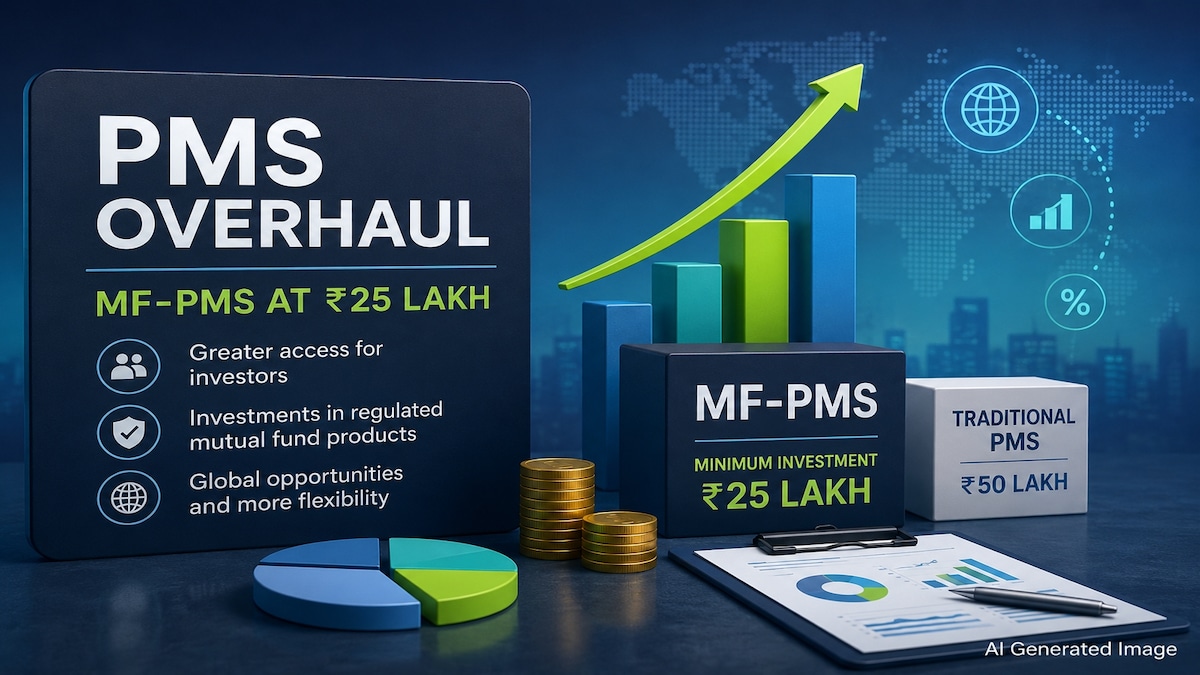
The Securities and Exchange Board of India (SEBI) has proposed a mutual fund-only PMS (MF-PMS) category with a minimum investment threshold of ₹25 lakh, compared with ₹50 lakh for traditional PMS. The regulator has also proposed greater flexibility for portfolio managers to invest in overseas securities and use exchange-traded derivatives.
Experts speaking to CNBC-TV18 said the proposed framework could benefit investors and portfolio managers by combining professional portfolio construction with access to regulated mutual fund products.
DP Singh, Deputy MD and Joint CEO of SBI Mutual Fund, said the MF-PMS structure could provide an additional layer of protection because the underlying investments would remain within regulated mutual fund schemes.
“I think this will increase the PMS in a bigger way,” Singh said, adding that the proposed framework could be a “win-win for everybody”.
MF-PMS could widen access to professional portfolio management
The proposed MF-PMS category could make professional portfolio management more accessible by allowing managers to build portfolios using mutual fund products rather than directly selecting individual stocks, as is typically done in an equity PMS.
Under the proposed framework, an MF-PMS manager could construct and manage a portfolio using products such as direct mutual fund plans, exchange-traded funds (ETFs), index funds and specialised investment funds (SIFs).
Singh said this could become increasingly useful as the number and variety of investment products available to investors continues to grow.
He pointed to the growing number of PMS strategies and said smaller PMS businesses often face a significant compliance burden. Allowing them to manage portfolios through regulated mutual fund products could help ease some of those operational and compliance pressures.
“The end game is that the investor will be benefited, and this will increase the size of PMSs in a big way,” Singh said.
Shobhit Mathur, Co-founder of Ionic Wealth, said the proposed framework addresses a growing challenge for affluent investors: deciding what to invest in as the investment universe becomes more complex.
“The problem is no longer just about how to invest. The problem is also about what to invest,” Mathur said.
According to Mathur, investors today have to choose between traditional mutual funds, ETFs, SIFs, commodity-linked funds and products providing exposure to global markets.
An MF-PMS could act as a wrapper that allows a portfolio manager to select and rebalance these investments based on an investor’s requirements.
PMS performance comes with greater variation
While the proposed framework could broaden access to professional portfolio management, the experts also highlighted the differences in performance across PMS strategies.
Mathur said PMS portfolios, by their nature, are more customised and can take higher risks than standardised mutual fund portfolios. This can result in both higher returns and greater variation between strategies.
Data discussed during the CNBC-TV18 interaction showed that the average three-year return for PMS was around 15%, compared with about 14.2% for mutual funds. However, the best-performing PMS had delivered around 36%, while the worst-performing PMS had delivered about 3%.
Mathur said the wide variation reflects the more customised nature of PMS and reinforces the importance of selecting the right manager.
“PMSs, per se, have done their job well,” he said.
He added that the proposed MF-PMS framework could become particularly relevant as the investment universe expands and investors increasingly seek professional help with asset allocation and product selection.
Direct plans could make MF-PMS attractive
Another potential benefit of the proposed structure is the ability to build portfolios using direct mutual fund plans.
Mathur said HNIs and ultra-HNIs are increasingly inclined towards direct plans because of their lower costs, but they may still require professional help to select and manage those investments.
Under the proposed structure, a portfolio manager could potentially select direct mutual fund schemes for a client and charge a transparent management fee.
SEBI has proposed a management fee of up to 2.5% of assets under management for the MF-PMS category, according to the consultation framework discussed on the programme.
The structure could also create an opportunity for mutual fund distributors and registered investment advisers to expand their businesses, subject to the proposed segregation and regulatory requirements.
Singh said the framework could be particularly beneficial for registered advisers because it could give them a regulated mechanism to charge for portfolio management services.
“This is a big, big boost to their businesses,” he said.
Global stocks and derivatives could widen PMS investment choices
The proposed changes go beyond the creation of an MF-PMS category. SEBI has also proposed expanding the investment universe available to portfolio managers, including allowing investments in overseas securities and providing greater flexibility around exchange-traded derivatives.
Mathur said these changes could help portfolio managers construct more diversified portfolios and use hedging strategies when market conditions warrant.
For HNI investors, exposure to overseas markets, REITs and other asset classes is increasingly becoming part of portfolio construction, he said.
The proposed flexibility could allow portfolio managers to dynamically increase or reduce market exposure and potentially provide investors with a smoother portfolio experience across market cycles.
Singh, however, pointed out that overseas investments through PMS would still be subject to the Liberalised Remittance Scheme (LRS) framework.
He also questioned why similar flexibility should not eventually be extended to mutual funds, given that mutual funds already have limits on overseas investments.
Track record could become more important
As the proposed framework potentially brings more investment products and participants into the PMS ecosystem, both experts stressed the importance of the track record and credibility of portfolio managers.
Singh said investors should focus on the credibility and performance history of the person or firm managing their money.
“Credibility and track record always work,” he said.
Mathur added that PMS has an advantage over some other forms of financial advice because portfolio managers are required to disclose performance, making it easier for investors to compare managers.
He said the proposed framework could therefore bring greater transparency to the wealth-management ecosystem by making performance, fees and track records easier to evaluate.
SEBI’s consultation paper, released on July 23, proposes a broader review of the Portfolio Managers Regulations, 2020, with the MF-PMS category forming one of the key changes under consideration. The proposals are still at the consultation stage and could change before final rules are notified.