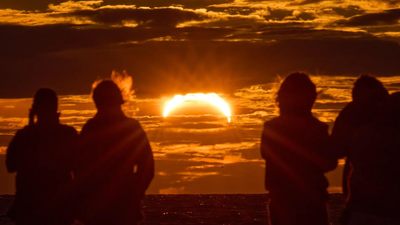
Millions across the UK and Europe turned their eyes to the sky as a rare solar eclipse swept across the region, marking the most dramatic such event in nearly 30 years and turning the evening light noticeably darker in parts of Britain.Those watching from the UK witnessed a partial solar eclipse that peaked shortly after 7.00 pm (local time), with the Moon obscuring more than 90 per cent of the Sun for most viewers.But in parts of Greenland, Iceland and Spain, the Moon completely covered the Sun, plunging the areas into brief darkness as viewers witnessed a rare total solar eclipse.The eclipse’s path of totality began at the northern tip of Siberia, Russia, before curving across the Arctic Ocean and reaching Iceland in the early evening. It then swept south towards the UK, where the partial eclipse began at around 6.00 pm (local time) in northern Scotland and just before 6.20 pm (local time) along England’s south coast.Clear skies across much of central and southern England and Wales offered spectators unobstructed views of the Moon passing across the Sun for about an hour. While cloudier conditions prevailed in northern England, Scotland and Northern Ireland, crowds still gathered at landmarks across the country.Solar eclipse glasses were in high demand and sold out at opticians, hardware shops and even bakeries ahead of the event. Those unable to find them improvised with colanders, cereal boxes and sheets of paper to safely watch the partial eclipse.Meanwhile, spectators across Spain watched in awe as a rare total solar eclipse swept across the country’s north on Wednesday evening, briefly plunging parts of the region into darkness.Spain deployed a large police contingent and established designated viewing areas in rural locations offering some of the best vantage points for the spectacle.In Spain, authorities expected up to six million visitors to flock to mostly rural areas along the eclipse’s path across northern Spain and the Balearic Islands.A total solar eclipse occurs somewhere on Earth roughly every 18 months, but any given location experiences one far less frequently, typically only once every 400 years.A solar eclipse occurs when the Moon passes between the Sun and Earth, blocking some or all of the Sun’s light and casting a shadow on Earth.A total eclipse is possible because of a rare coincidence. The Sun is about 150 million kilometres (93 million miles) from Earth, roughly 400 times farther away than the Moon. But the Moon’s diameter is also about 400 times smaller than the Sun’s, making the two appear almost exactly the same size in the sky.If the Moon were slightly smaller or its orbit were farther from Earth, a total solar eclipse would never occur.