Despite Aravindh Chithambaram’s early ouster, three Indian grandmasters are still participating in the Esports World Cup. But even as Nihal Sarin, Arjun Erigaisi and Pranesh M slipped into the lower bracket, chess great Hikaru Nakamura, fresh from dishing out a belter against Alexey Sarana, was closely following the Indian contingent from the air-conditioned confines of Expo Porte de Versailles on Wednesday. Once he was done, the praise came pouring out as he spoke glowingly about the standard of chess in India.
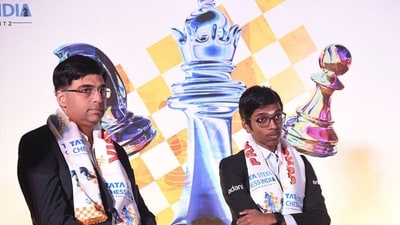
And why should it be any other way? D Gukesh is the youngest-ever world champion. R Praggnanandha’s rise has been second to none. Arjun is India’s No.1-ranked grandmaster, and Nihal became the first Indian to claim the Bullet Chess Championship earlier this year.
And to think that all this wouldn’t have been possible without one Viswanathan Anand leading the way. A huge grin spreads across Nakamura’s face as he begins recalling the greatness of Anand. He was still finding his feet in the big boys’ league when he first faced the Indian legend. Their battles made for compelling ebbs and flows, including the umpteenth memorable battle in the 2015 Armageddon classic of the Zurich Chess Challenge. And hence, for Nakamura, there’s Viswanathan Anand, and then the rest.
‘Anand the Godfather of Indian chess’
“There was only one Indian player from the time I was probably like 6-7 years old, and I started till I was about 30 or around there. So, I mean, it’s a big difference when you have a lot of young guys competing. Of course, they make no mistakes. But I still think Vishy is the best Indian player ever. We’ll see what happens with the new generation, whether they surpass him, but Vishy is sort of the godfather, the one who started it all. Because of the contributions that he’s made, you have Prag, you have Gukesh, Arjun. And who knows who else will break through? Players like Pranesh are here. And I think there are probably around 2600 others that we don’t know about yet,” Nakamura tells The Hindustan Times.
“I think what stands out is their passion and their ability to learn the game. But it’s also because chess is viewed very positively in India. It’s seen as a legitimate path to success. In the United States, if you tell your parents that you want to become a chess player, it’s probably not going to be well-received. In India, it’s different, and I think a lot of that goes back to what Vishy accomplished and the fact that he’s such a recognisable figure there. The future of Indian chess is very bright.
‘Young Indian grandmasters have struggled’
At the same time, Nakamura did seem concerned about the recent struggles of India’s top grandmasters. At the Chess World Cup, only Arjun showed consistency, advancing to the quarterfinals, but he missed out on the Candidates as he couldn’t finish in the top three. After the great highs of 2024 and 2025, 2026 has been something of a lull for Indian chess. But Nakamura doesn’t see it as a red flag.
“I think they’ve struggled a little bit in recent times. When I look at it, Arjun had this bad match against Alireza today, where he blundered, but overall, I feel like he’s been playing a little bit better. I think Prag has been playing very well of late. Gukesh, you know, is another story altogether. That’s for another day. But I think they’re all playing well. They’re going to be there for a long time, and they’re definitely very, very strong. Right now, they’re what, 12th, 13th, 14th in the world? Maybe Arjun and Prag are climbing back up. But at any rate, they’re all extremely strong,” he added.
In December last year, Nakamura became a father and has since, by his own admission, rarely thought about chess. It’s not as if he doesn’t study the game, but at the moment, it’s certainly not his main project. Someone of his stature could easily have taken the EWC unseriously and simply enjoyed the environment – barring the ridiculously hot weather – in Paris. But Nakamura is someone who loves the game, and when he was younger, he played it for the craft. That love for the game is still evident in the way he approaches it today.
“Keeping up the motivation is very difficult because everybody studies you a lot. And the game has reached a stage where you can’t really just show up and play. At least until a few years ago, you could have gotten away with it. For example, I played in this tournament in Miami, USA, about two or three weeks ago. I pretty much just showed up and played. I thought the result was okay, but it wasn’t good. And because of that, I think it’s very difficult to study in the way that I was used to,” he added.