
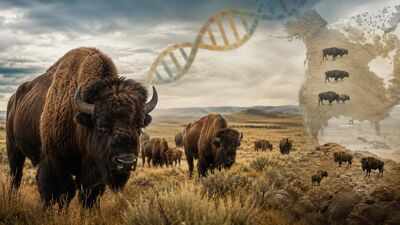
Scientists have pieced together the deepest genetic history of the North American bison ever assembled, using DNA drawn from 115 animals that lived before the species was pushed to near extinction in the 20th century. As per the findings, led by researchers at the University of California, and featured on the cover of the 6 August issue of Science, this offers the first genomic baseline for what healthy bison diversity looked like before hunting, new diseases, habitat destruction and government eradication campaigns reduced the population from tens of millions to a few hundred. The study combined these ancient genomes with 45 more recent samples and 52 published modern genomes to trace how the species has changed over roughly 20,000 years, stretching back to a time when bison were genetically connected across thousands of miles, with regional subspecies only emerging within the last few thousand years. It found that genetic diversity survived the collapse better than expected, that fragmentation rather than lost diversity is the real legacy, that modern wood bison carry plains bison ancestry from 1920s translocations, and that cattle ancestry is far rarer than long assumed. The results are already being framed as a practical tool that conservationists can use to guide how isolated bison herds are managed and bred in the years ahead.
Why North American bison retained genetic diversity despite near extinction
For decades, bison have been treated as one of conservation’s clearest success stories, rebounding from a few hundred animals to a population now estimated in the hundreds of thousands. Herd managers have never had a clear picture of what genetic diversity in bison looked like before the population collapse, which made it difficult to judge how much damage had actually been done and what recovery should look like. Both wood and plains bison experienced declines in abundance of several orders of magnitude and reached their lowest points by the early 20th century, although the timing differed between the two subspecies. Despite this decline, overall genetic diversity remained comparatively stable, and it was the subsequent drift and isolation within small, separately managed herds that produced the high degree of genetic structure seen in bison populations today. Ancient wood bison genomes also pointed to a mid-Holocene timing for when the two subspecies first diverged from one another.To address this, the research team sequenced 160 new bison genomes, split between animals that lived before the crash and those from within the last century, then layered this over existing modern data. The work was led by Jonas Oppenheimer, a 2024 PhD graduate of the university’s Paleogenomics Lab, together with senior author Beth Shapiro, co-director of the lab, in partnership with Parks Canada, the University of Alberta and a wide coalition of research institutions and land stewards across North America. Shapiro said the study builds a baseline using ancient DNA from before the collapse, calling it a clear example of how ancient DNA can support present-day management decisions. The same lab has previously used similar techniques to uncover new information about dire wolves, woolly mammoths, sabre-toothed cats and cave bears.
PC: Canva
Why bison did not lose as much genetic diversity as scientists expected
One of the study’s central findings is that the 20th-century collapse did not wipe out bison genetic diversity as thoroughly as many had assumed. According to the new study published in Science, titled ‘Paleogenomic insight into the collapse, recovery, and management of American bison’, genetic diversity across the species remained comparatively stable through the population crash, even as numbers fell by several orders of magnitude for both plains and wood bison subspecies.What changed instead was connectivity. Bison that once ranged across thousands of miles and interbred freely became isolated into small, separately managed herds during early conservation efforts, and subsequent genetic drift within these isolated groups produced the strong differences seen between herds today. This fragmentation, rather than a straightforward loss of diversity, is described in the study as the sharpest contrast between historical and present-day bison populations, and it is this pattern that the new genomic map is intended to help reverse.
How the 1920s bison translocation changed wood bison genetics
The study also clarified a specific chapter of bison management history involving the two main subspecies. Wood bison, native to the forests of northern Canada and Alaska, and plains bison, which historically roamed open grasslands from Canada into northern Mexico, differ in size, body shape and coat, with wood bison being the larger of the two.Every modern wood bison herd carries some percentage of plains bison ancestry, a legacy of the 1920s translocation of roughly 7,000 plains bison into Wood Buffalo National Park, then home to the last remaining wood bison population of around 1,500 animals. The proportion of this plains ancestry varies considerably between herds today, ranging from 7 to 64 per cent. Parks Canada bison ecologist Greg Wilson, a co-author on the study, said the two subspecies remain substantially distinct despite this historical mixing event and should continue to be managed as separate groups.
How ancient DNA challenges long-held beliefs about cattle ancestry in bison
A persistent belief among conservationists has been that most modern bison carry meaningful cattle ancestry, a legacy of 20th-century cross-breeding experiments by private herd managers. The new genomic data challenges this assumption directly. 67 per cent of the bison sampled showed no evidence of cattle ancestry at all, with groups including the Yellowstone National Park herd and all wood bison found to be entirely free of it.Where cattle ancestry was detected, it was minimal. This ancestry typically made up under 2 per cent of an individual’s genome and could be traced to a narrow window of hybridisation roughly 20 generations ago. Researchers say this clearer picture, made possible by comparing modern bison against a clean pre-cattle genetic baseline for the first time, gives managers a more accurate basis for breeding decisions going forward, one that avoids overcorrecting for a problem that turns out to be far less widespread than previously assumed.