On the morning of 9 or 10 May 1999, Air Marshal SK “Ben” Brar, then Vice Chief of the Air Staff, walked into the office of Air Chief Marshal AY Tipnis with a cup of tea and a throwaway line: the army, he said, seemed to be in “some sort of difficulties” in the Kargil sector. Nobody in the room yet knew the scale of what that sentence would set in motion. Within a fortnight, Indian troops discovered that Pakistani regulars and irregulars had occupied a string of high-altitude positions along a 168-kilometre stretch of the Line of Control, from Mushkoh to Turtuk, and by 26 May the Indian Air Force was in the fight.The IAF’s campaign, launched alongside the Army’s Operation Vijay, was code-named Operation Safed Sagar — White Ocean. Its job was blunt: clear the intruders off peaks the Army could not easily assault on foot, without letting the war spill across the Line of Control into a wider India-Pakistan conflict, and without India crossing that line itself. That last constraint, imposed by the Vajpayee government, was as decisive to how the war was fought as any weapon the IAF carried into the mountains.
Combat Air Operations 16,000 feet and above
Safed Sagar opened at 6.30 am on 26 May with MiG-21s, MiG-27MLs and MiG-23BNs striking intruder positions, supply dumps and infiltration routes around Dras, Kargil and Batalik, with MiG-29s flying combat air patrol overhead in case Pakistan’s air force chose to respond in kind. It was the first large-scale use of air power over Jammu and Kashmir since the 1971 war, and it was improvised at a pace few air forces would find comfortable: doctrine, targeting procedures and even weapon-release calculations for combat above 16,000 feet had to be worked out in the field, because India had never fought a war at that altitude before.That altitude was the enemy as much as the intruders were. Thin air degraded engine and weapon performance in ways ground-level training had not accounted for; mountain winds threw off bomb trajectories; and snow-covered rock made it agonisingly difficult to tell a bunker from a boulder from the cockpit of a jet travelling at several hundred kilometres an hour. Unguided bombs dropped from the safer, higher altitudes IAF pilots were initially restricted to often missed their mark entirely — a problem that would shape everything that followed.
The Price of the Opening Days
The campaign’s costliest stretch came within its first 48 hours. On 27 May, Flight Lieutenant Kambampati Nachiketa’s MiG-27 suffered engine trouble during a strike run and he was forced to eject over enemy-held territory, where he was captured by Pakistani troops. Squadron Leader Ajay Ahuja, flying a MiG-21 in the same area, stayed on to search for his missing colleague and was shot down by ground fire near Batalik. Squadron Leader Ajay Ahuja bailed out into Pakistan-held territory and was killed by the adversary on the ground — the IAF’s first fatality of the war, and its most painful. Flight Lieutenant Nachiketa was released five days later. The following day, 28 May, a four-helicopter Mi-17 formation tasked with striking a position near Tololing lost one aircraft to ground fire, killing all four crew on board.Those losses, inside the campaign’s first three days, forced a hard operational reckoning: flying low enough for accurate unguided bombing exposed aircraft to shoulder-fired missiles and heavy machine guns dug into the high ground, while flying high enough to be safe meant bombing blind. The IAF needed a way to be both accurate and out of range, and it did not yet have one in theatre.
The Mirage That Changed the War
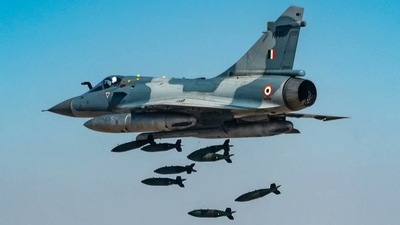
The answer arrived in the form of the Mirage 2000, hastily equipped with laser-guided bombs and paired with a Canberra reconnaissance aircraft flying photo runs to confirm targets and assess damage afterward. The turning point most airwarriors who fought the war still point to came in early July, when Mirages used laser-guided munitions to flatten Pakistani positions on Tiger Hill and to destroy Muntho Dhalo, the enemy’s principal logistics node feeding troops along the ridgeline. Two Mirage squadrons went on to fly 500 plus sorties over the campaign without losing a single aircraft in combat — a striking contrast to the losses of the campaign’s opening days, and a demonstration that precision, not just firepower, was what high-altitude air warfare actually demanded.By early June the IAF had already flown over 1,200 strike sorties; by the war’s end its tally stood at close to 5,000 strike missions and roughly 350 reconnaissance and electronic-intelligence sorties, according to the IAF’s own accounting on the war’s twenty-fifth anniversary. Beyond bombing, the campaign drew on the Air Force in ways less often remembered: Canberra aircraft supplied the first photographic confirmation of the intrusion itself, electronic-intelligence flights mapped Pakistani communications and air-defence positions, and helicopters flew casualty evacuation and, wherever possible, combat search-and-rescue missions for downed airwarriors.
What Air Power Actually Won
India recaptured Tiger Hill and Tololing in early July, and by 26 July — now marked annually as Kargil Vijay Diwas — the last intruders had been pushed back across the Line of Control. Military historians and IAF officers who served in the campaign are consistent in their assessment that air power did not win Kargil alone; the infantry’s assault up near-vertical slopes under fire remains the campaign’s central sacrifice. But the IAF’s own case, made repeatedly in the years since, is that precision air strikes compressed a war that could have dragged through the autumn into one concluded before winter closed the high passes — shortening the fighting by what officers have estimated at several weeks, and doing so without a single Indian aircraft or missile crossing into Pakistani territory proper, a restraint few air campaigns anywhere have managed to sustain under fire.That restraint, as much as the Mirage strikes, is what the IAF now treats as Safed Sagar’s real benchmark. The campaign proved that Indian air power could be applied with real precision and real political discipline simultaneously — hitting hard while staying inside a tightly drawn political boundary — a template India’s political and military leadership have returned to in Operation Sindoor. It also left the IAF with a harder, more permanent lesson: that unguided ordnance and high-altitude combat do not mix, and that the shift toward precision-guided munitions the Mirage crews improvised under fire in 1999 was not a wartime expedient but the shape of every high-altitude campaign since.Twenty-six years on, the peaks above Dras and Batalik are quiet again. But the men who flew Safed Sagar — those who came home, and those like Squadron Leader Ajay Ahuja, Squadron Leader Rajiv Pundir, captain of the downed Mi-17 helicopter ,Flight Lieutenant Subramanian Mulihan his co-pilot and Sergeant PVNR Prasad the flight gunner who did not — fought out a set of lessons about altitude, precision and restraint that continue to shape how the Indian Air Force plans to fight the next war it hopes never comes.