
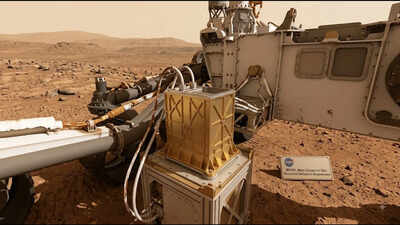
For the first time, a machine made by humans produced oxygen on the surface of another planet. It did not happen inside a futuristic Mars base or through the work of astronauts in bulky spacesuits. Instead, the breakthrough came from a compact instrument tucked inside Nasa’s Perseverance rover, quietly working on Mars between 2021 and 2023. Called the Mars Oxygen In-Situ Resource Utilization Experiment, or MOXIE, the toaster-sized device took carbon dioxide from the thin Martian atmosphere and converted it into molecular oxygen. Its quantities were tiny compared with what a human mission would need, but that was never the point. MOXIE was designed as a technology demonstration for a much larger challenge: learning whether future explorers could make essential resources on Mars rather than carry everything from Earth. Over 16 operating runs, it produced 122 grams of oxygen, exceeding several of its original performance targets. More importantly, it demonstrated a principle that could eventually determine whether astronauts can leave Mars after landing there.
MOXIE turned Mars’ carbon dioxide into oxygen for the first time
When Perseverance landed in Jezero Crater in February 2021, it carried a remarkable collection of scientific instruments, but MOXIE had a particularly unusual assignment. It was not primarily looking for ancient rocks, signs of past water or evidence of possible microbial life. Its job was to test whether humans could one day use Mars itself as a source of something they desperately need: oxygen. On 20 April 2021, MOXIE completed its first successful run, becoming the first technology to produce oxygen from the atmosphere on another planet. The instrument drew in Martian air, which is composed of about 96% carbon dioxide, and used a high-temperature electrochemical process called solid oxide electrolysis to separate oxygen atoms from the carbon dioxide molecules. The resulting oxygen was analysed for purity before being released, while the remaining gases were vented back into the atmosphere.The first demonstration produced only about 5.4 grams of oxygen, roughly enough to provide an astronaut with breathable oxygen for about 10 minutes of normal activity. That may sound insignificant, but MOXIE was never intended to supply Perseverance, let alone a future crew. Its purpose was to prove that the underlying technology could function in the real Martian environment. The instrument was designed to produce up to 10 grams per hour, and over its mission it ultimately surpassed that target. Across 16 oxygen-production runs, MOXIE generated 122 grams of oxygen, reaching a maximum production rate of 12 grams per hour at a purity of at least 98%. Nasa said that was twice the original production goal. The experiment also operated under different Martian conditions, including changing seasons and times of day, giving engineers information that a laboratory demonstration on Earth could never provide.The engineering challenge was considerable because Mars does not offer the convenient conditions available on Earth. Its atmosphere is extremely thin, so MOXIE had to capture and compress enough carbon dioxide to feed its electrolysis system. The process also required temperatures approaching 800°C. To withstand that heat, engineers incorporated heat-resistant nickel-alloy components and specialised insulation into the instrument. Nasa describes MOXIE as roughly the size of a car battery, while its technical specifications list dimensions of about 23.9 by 23.9 by 30.9 centimetres and a mass of 17.1 kilograms on Earth. Despite its modest size, it represented a critical test of whether a much larger system could eventually operate on Mars.The experiment ended in 2023 after its 16th and final oxygen-production run. On 7 August, MOXIE generated another 9.8 grams of oxygen, completing the demonstration after operating across approximately a full Martian year. Nasa concluded that the technology had met its technical requirements and had successfully shown that oxygen could be extracted from the Martian atmosphere under real conditions. The little machine had therefore done something much more important than simply make oxygen: it had demonstrated that a future Mars mission could potentially manufacture a vital resource after arriving on the planet.
The real target was not breathing, it was getting astronauts home
It is easy to imagine MOXIE primarily as a machine that future astronauts would use to breathe. Oxygen for life support is certainly one potential application, but Nasa has emphasised that its most important future role could be far more demanding: producing the oxidiser required for rocket propellant. This distinction changes the scale of the problem completely. An astronaut can survive with a comparatively small quantity of oxygen for breathing. A rocket leaving Mars requires enormous quantities of oxygen to burn its fuel. Nasa estimates that a future crewed Mars mission could need roughly 25 metric tonnes of oxygen simply for the ascent vehicle, alongside about 7 metric tonnes of fuel for launching four astronauts from the Martian surface.That is why producing oxygen locally could become one of the most important technologies for a human Mars expedition. Carrying tens of tonnes of oxygen from Earth would add enormous mass to an already difficult interplanetary mission. Instead, spacecraft could potentially transport a much smaller oxygen-production system to Mars, allow it to manufacture and store oxygen over an extended period, and then use that stored resource when astronauts eventually arrive. Nasa says a future human-scale oxygen generator would need to be around 100 times larger than MOXIE. The experiment was therefore not a miniature life-support system; it was a proof of concept for an industrial-scale resource-production plant that does not yet exist.This approach is part of what scientists call in-situ resource utilisation, or ISRU — essentially using materials already available at the destination instead of transporting every resource from Earth. Mars is particularly suited to this strategy because, although its atmosphere is far too thin and carbon-dioxide-rich for humans to breathe, that carbon dioxide is abundant enough to serve as a raw material. If future engineers can scale up MOXIE’s technology, Mars’ hostile atmosphere could become a source of one of the most valuable materials needed for exploration.
Why 122 grams of oxygen was a much bigger achievement than it sounds
The final amount produced by MOXIE, 122 grams, would be almost laughably small beside the quantities required for a crewed Mars mission. It is roughly equivalent to the amount of oxygen a small dog would breathe in 10 hours. Yet the significance of the experiment lies precisely in what that number represents. Before MOXIE, no machine had demonstrated this process on another planet. Engineers had to prove that the equipment could survive launch, a journey lasting months, landing on Mars and then operating repeatedly in an atmosphere unlike anything found on Earth.MOXIE also demonstrated that production could be maintained under changing environmental conditions. Engineers tested the instrument at different times of day and during different seasons, because a future human-rated system cannot work only when Martian conditions happen to be favourable. The experiment even reached production rates above 10 grams per hour during some runs. In November 2022, Nasa reported a rate of 10.56 grams per hour, while the instrument ultimately reached 12 grams per hour at its best performance. These tests helped establish how the system behaved as the density and conditions of the Martian atmosphere changed.There was another important lesson hidden in MOXIE’s small scale. A successful technology demonstration does not mean the engineering problem is finished. A full-sized system would need to operate much more frequently and at vastly greater production rates. It would also need systems for storing the oxygen, managing power and heat, maintaining equipment and ensuring that the resource remains available when astronauts need it. Nasa’s own estimates show just how large that leap will be. MOXIE proved the chemistry and basic engineering; the next challenge is turning that proof into infrastructure capable of supporting an actual expedition.
A small machine that could change how humans reach Mars and leave it
MOXIE’s most important achievement may therefore have happened without a single astronaut ever touching Mars. The experiment demonstrated a way of making a resource locally that would otherwise have to be launched from Earth. That idea could eventually change the architecture of human Mars missions. Instead of sending every kilogram needed for the return journey from Earth, mission planners could envisage arriving at a planet where critical supplies have already been manufactured from local materials.The timing matters because returning from Mars is not an optional part of a crewed mission. Once humans land there, the spacecraft and resources needed to bring them home must already be accounted for. A dependable supply of oxygen for rocket propellant could provide one of the pieces required to make that return possible. Nasa has described MOXIE as the first-ever demonstration of technology intended to help humans both survive on and leave the Red Planet.The little device inside Perseverance was therefore never meant to solve the entire Mars problem. It was meant to answer one very specific question: can humans make oxygen from Martian air? After two years of intermittent testing, the answer was yes. MOXIE inhaled carbon dioxide from an alien atmosphere and repeatedly produced usable oxygen, proving that a resource once assumed to have to come from Earth could instead be manufactured on Mars. The machine itself has now stopped working, but the idea it tested is likely to remain part of future Mars planning. One day, if astronauts stand on the Red Planet preparing to launch for home, the oxygen in their rocket tanks may have been made from the very atmosphere surrounding them.