
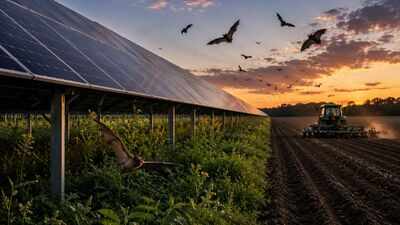
Spring changes the sound of the countryside. Fields that have spent the winter covered in crop residue are opened up, machinery moves across the soil and much of the vegetation disappears within days. For bats hunting after sunset, that seasonal shift can alter where food is easiest to find.That became apparent in a two-year monitoring project at 12 commercial solar facilities in the American Midwest, published in Global Ecology and Conservation by Szoldatits and colleagues in 2025 titled ‘Bat activity at ecovoltaic solar energy developments in the Midwestern United States’. Ultrasonic detectors recorded bat activity around the installations and at nearby agricultural fields during the warmer months of 2023 and 2024. The difference was particularly clear in May and June, when planting was under way. Above the solar arrays, the night air carried considerably more bat activity than it did over neighbouring cropland. The reason appears to have less to do with the panels themselves than with what was growing underneath them.
How solar farms gave bats greener hunting grounds
The solar sites in the project were not simply expanses of panels surrounded by bare ground. They had been designed as ecovoltaic developments, with native prairie vegetation planted beneath and between the infrastructure.Around the neighbouring crop fields, spring preparation could leave large areas of exposed soil. Tilling removes much of the vegetation that has emerged after winter, while subsequent agricultural treatments can further change the conditions for insects. For an insect-eating bat moving through the landscape at dusk, the difference between a recently worked field and an area still carrying flowers and grasses can be substantial.The solar sites offered a rather different setting. Native grasses and wildflowers remained in place beneath the panels, providing vegetation and habitat for insects at a time when the surrounding agricultural landscape was undergoing a major transition.
Bat activity rose 50% over solar farms in May and June
The equipment used in the project did not record ordinary sounds that people would hear from the ground. The detectors were designed to capture the high-frequency echolocation calls produced by bats as they navigate and hunt.Across the 12 solar developments, those recordings revealed that bat activity was generally greater over the solar facilities than over the paired crop fields. During May and June, the difference averaged about 50 per cent when weekly activity was compared between the two types of site. This was not a uniform difference throughout the year. It became especially apparent during the early part of the growing season, when surrounding farmland was being prepared and planted.After sunset, when bats emerged to forage, the airspace over the solar facilities was therefore being used more heavily than the nearby agricultural fields.
Three bat species did not behave in exactly the same way
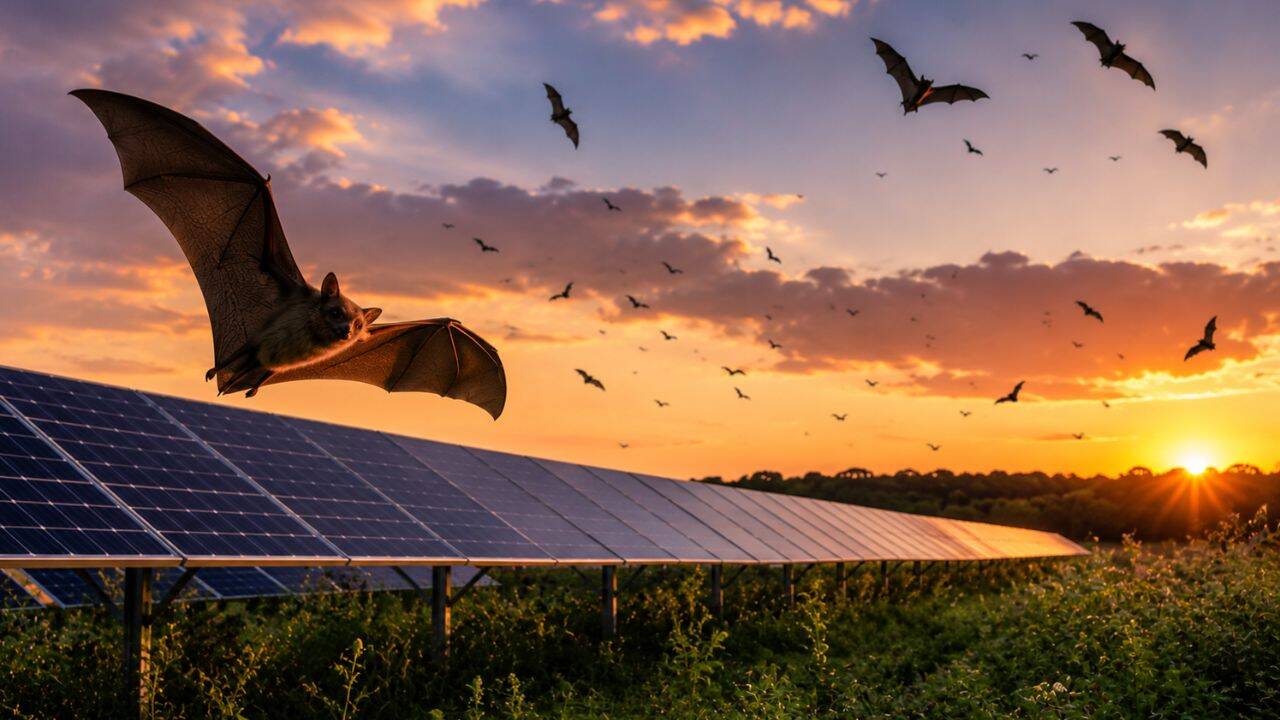
The recordings also showed that the response was not identical among the species detected. Hoary bats tended to produce more calls over the solar facilities for much of the monitoring period. Big brown bats showed a more concentrated seasonal response, with activity rising within the solar sites during roughly the first part of the season before becoming less pronounced later.Silver-haired bats were different again. Their recorded activity was broadly similar between the solar developments and the agricultural comparison sites.Those differences are worth keeping in view. A landscape change does not necessarily produce one universal response from every bat species moving through it. Their diets, movements and preferred hunting conditions can vary, as can the way they use vegetation and open airspace.
What grows beneath the panels may be the important part
It would be easy to look at the result and attribute it to solar panels. The recordings, however, cannot establish that the panels themselves were attracting bats. The vegetation beneath the installations offers another explanation.Native prairie plants can provide flowers, shelter and habitat for insects. During early spring, when nearby fields have been stripped of much of their vegetation for cultivation, those planted areas can remain comparatively productive. Insects associated with the vegetation may then provide bats with a useful source of prey.The solar infrastructure effectively creates a different patch within an agricultural landscape. Panels occupy the upper part of the site, while underneath them is vegetation that is managed for ecological value rather than treated simply as empty space around an energy installation.For bats travelling across a heavily farmed landscape, a patch of native vegetation could become a useful stopping point or hunting area, particularly during a period when suitable insect habitat is less plentiful elsewhere.
What the bat calls can reveal and what they cannot
Acoustic detectors are very good at showing that bats are present and active. They can reveal changes in the frequency and timing of calls, helping researchers understand how animals use different parts of a landscape. But hearing more echolocation calls does not automatically mean that bats are catching more insects.The animals could be travelling through the area, investigating it, hunting unsuccessfully or using the airspace for several different reasons. To establish whether the solar sites actually provide better feeding opportunities, researchers would need to look more closely at the calls associated with prey capture and examine the insect communities at the same time.That next layer of evidence could help separate simple presence from genuine foraging benefit. It would also show whether the effect is strongest during the early planting period or continues after surrounding crops become established.
Solar farms can create habitat as well as energy
The findings add to a growing body of work looking at what happens when renewable energy projects are placed within working landscapes.A solar development does not have to be ecologically empty ground. Where native vegetation is established and maintained, the space beneath the panels can function differently from the surrounding agricultural land. In this case, the contrast was particularly visible during a short period of the year when crop fields were being disturbed and the native plantings remained intact.The distinction matters because solar facilities occupy land for decades in many cases. Decisions about what is planted beneath the panels can therefore influence more than the appearance of the site.For bats, the Midwest study points towards a fairly simple possibility: the most useful feature of an ecovoltaic solar farm may not be the panels overhead, but the living landscape underneath them.The microphones could hear the difference before anyone could say exactly why it was happening. Further work on insects and feeding behaviour should help fill in that missing piece.