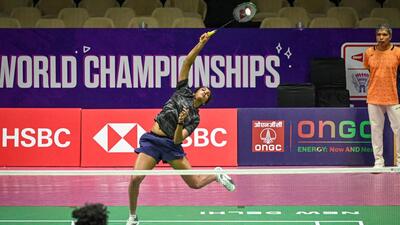
LONDON: As the BWF World Tour approaches its most prestigious week, nostalgia hangs over the courts at New Delhi’s Indira Gandhi Indoor Stadium.
The badminton World Championships starting from Monday will mark the twilight of an era. When the champions are crowned on August 23, it will be the last time the tournament will be played in the traditional 3×21 scoring system. Starting in January, the sport will transition to a faster 3×15 format.
Since 2006, the 21-point system has defined badminton, rewarding tactical adjustments and endurance. The new mandate is a sprint – best of three games, 15 points each. The Badminton World Federation (BWF) argues that this will shorten matches and increase intensity. “More consistent match durations” and “creating tighter scores and more dramatic finishes, the format aims to keep fans engaged from the first rally to the last,” is how BWF put it which making the announcement in April.
Yet, for athletes, it means unlearning decades of muscle memory.
Indian badminton icon PV Sindhu, also the Chair of the BWF Athletes’ Commission, awaits the impending change with anticipation. “It is completely different,” says the former world champion. “Really looking forward to it. The matches might be a little shorter but the intensity is definitely going to be more.”
For Sindhu, the primary challenge is the diminishing margin for error. “In 21 (points system), you actually have time. Even if you’re 5-6 points down, you have time to cover it. In 3×15, you don’t have time. From point No.1, you need to be alert. After seven points, already half the game is over. So, it is very important that you fight for every point from the start. It’s going to be very challenging and exciting.”
Pullela Gopichand, India’s chief national coach, views the scoring change with pragmatism.
“It’s important to accept the reality that it’s a done deal. Let’s accept it and move on,” says the former All England champion. “It’s going to just make the game faster. Scoring points will be important but not giving away points will be even more important. Endurance-wise there might be a bit of a dip. But the speed, power and focus needs to be top notch. The mind will play a much more important role.”
The tactical landscape is set for a major change with rapid-fire sequences, rewarding safe play over expansive shot-making.
“The 11th and 12th points will be a lot more critical. That’s how the game will end up as. In general, it’ll be a lot flatter and faster with players trying to just be a lot safer, and not too much skill. That’s one area which the sport will miss out on because a longer format typically gives you a little more freedom to open up your arms and play a few more strokes,” he said.
However, the Dronacharya awardee remains unconvinced with BWF’s policy. “They cut the game to a shorter format but increased the length of the tournaments (majors and Super 1000s). They should have done one of the two,” said Gopichand.
From next year, major events like the World Championships and team events like Thomas, Uber and Sudirman Cup along with Super 1000 tournaments will be 11-12 days long – the current schedule is 6-7 days. This has been done as from the next season, these tournaments will only have two courts and all matches will be broadcast unlike now where they start with four courts out of which only two are televised.
Gopichand though knows the trauma of such changes. After his All England win in 2001, the format switched from 3×15 (server only scoring) to 5×7 in 2002, derailing him as a stroke player. The return to the earlier format (2002-05) was equally shocking.
“Because you train, you detrain and your endurance drops and then to go back and play the 15, which was impossible for me. These changes definitely make a big impact. A few players the change will wipe off, a few players might benefit. That’s the way it is.”
India is adapting. Sub-junior events in states have already started using 3×15. The shorter games might also offer a lifeline to seasoned players like HS Prannoy and Kidambi Srikanth.
“It will be better for them. We are not very sure how exactly, because when speed goes up, these guys have to move quicker. But if I had a choice, I would pick 3×15 for an older player rather than 3×21,” added Gopichand.
As elite shuttlers descend on New Delhi for the World Championships for one final dance under the 3×21 point system, they carry the weight of history. It will be a tournament of prolonged rallies and tactical patience.
Once the champions lift their trophies, the curtain falls on a format that gave fans two decades of memories. Come January, badminton opens a relentlessly fast and unforgiving chapter. The 3×15 era awaits.