
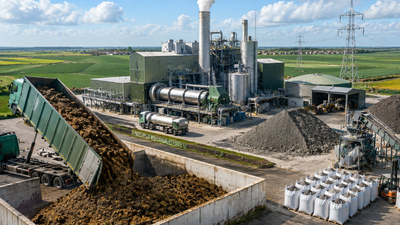
A Dutch plant is turning a huge agricultural waste stream into renewable electricity and fertiliser. BMC Moerdijk in the Netherlands processes around 420,000 tonnes of poultry manure each year, using thermal conversion to generate electricity for the farms supplying the manure and enough additional power for around 45,000 households. The process does not end after the manure is burned. The remaining ash is collected and processed into a phosphate-potassium fertiliser containing nutrients including phosphorus, potassium, calcium and magnesium. The facility has been operating since 2008 and has become an established example of using poultry manure for both energy production and nutrient recovery. The process also gives poultry farmers a way to manage a large volume of manure that would otherwise require disposal or treatment.
Dutch plant processes 420,000 tonnes of poultry manure
BMC Moerdijk processes roughly 420,000 tonnes of poultry manure annually, with around 400 poultry farmers supplying the facility. The manure is transported to the plant and used as fuel in a controlled thermal conversion process. BMC says the facility handles an average of about 1,250 tonnes of manure each day. The scale makes it one of the more significant poultry-manure energy recovery operations in Europe. Some older sources put the annual volume closer to 430,000 or 450,000 tonnes, reflecting figures from different operating periods. The current figure published by BMC is around 420,000 tonnes a year.The manure contains energy that can be recovered through combustion. At BMC Moerdijk, the heat generated during the process is used to produce steam, which drives a turbine connected to an electricity generator. BMC says one tonne of poultry manure produces approximately 600 kWh of net electricity. The electricity generated is used to meet the needs of the poultry farms supplying the manure, with enough additional production to supply the equivalent of around 45,000 households. EU CAP Network reports that the plant produces roughly 292,000 MWh of gross electricity annually, although figures vary according to the period and whether gross or net production is being measured.
The facility has been operating since 2008
This is not a newly proposed waste-to-energy experiment. BMC Moerdijk has been operating since 2008, when it became one of Europe’s first large-scale facilities specifically designed to use poultry manure as a fuel. The plant was developed partly to address the manure surplus faced by Dutch poultry farmers while also producing renewable energy. Over the years, the facility has continued to process hundreds of thousands of tonnes of manure annually. Its long operating history is one reason the project is often cited in discussions about agricultural waste treatment, renewable energy and nutrient recovery.The most unusual part of the process happens after combustion. Rather than treating all the remaining ash as waste, BMC processes it into a phosphate-potassium fertiliser. The company says the product contains around 10% phosphate and 13% potassium, along with calcium, magnesium and several trace elements. EU CAP Network gives a similar nutrient profile, reporting around 10% P₂O₅ and 12% K₂O, as well as calcium, sulphur and magnesium. The recovered minerals can therefore be returned to agriculture instead of being lost as an unusable combustion residue.
The fertiliser contains nutrients needed by crops
The ash-derived fertiliser is designed to supply crops with phosphorus and potassium, two important plant nutrients. BMC says it also contains secondary nutrients and trace elements including sulphur, iron, zinc, manganese and copper. The fertiliser can be used in agriculture on crops including potatoes, maize and cereals. EU CAP Network says its use is based on the phosphorus and potassium requirements of crops and the nutrient condition of the soil. This makes the ash a potential agricultural resource rather than simply another waste product from the energy-generation process.The manure is processed at high temperatures, which changes the composition of the remaining material. BMC says the thermal process takes place at temperatures above 850°C and results in a fertiliser free from pathogens and unwanted organic components. EU CAP Network similarly reports that the resulting fertiliser has low concentrations of contaminants such as cadmium, arsenic and lead and is free of pathogens. The high-temperature treatment is therefore important not only for extracting energy but also for producing a stable mineral fertiliser from the remaining ash.
Research has tested the ash as a fertiliser
The agricultural value of the ash has been examined through research linked to Wageningen Environmental Research. Studies examined the nutrient content and effectiveness of poultry-litter ash and compared the resulting fertiliser with conventional fertiliser products. Research cited by BMC found that the ash-derived product could provide useful phosphorus and potassium to crops. EU CAP Network also reports that the fertiliser has been tested through pot trials, field experiments and practical agricultural applications. These studies provide evidence that the recovered ash can function as an agricultural nutrient source rather than merely being a disposal product.Although the system is often described as circular, there is an important limitation. Not every component of poultry manure survives the thermal conversion process. Nitrogen, for example, is largely lost during combustion, while phosphorus and potassium remain in the ash and can be recovered. A CE Delft life-cycle assessment commissioned for BMC specifically examined the environmental performance of thermal conversion and nutrient recovery. Therefore, the most accurate description is that the plant combines energy recovery with the recovery of important mineral nutrients, rather than claiming that the entire manure stream is recycled without any losses.
The process creates a second use for agricultural waste
The system effectively gives poultry manure two uses. Its energy content is converted into electricity, while minerals remaining in the ash are processed into fertiliser. That means a material that can be difficult for poultry farms to manage becomes an input for both the energy and agricultural sectors. BMC describes this as a circular approach because nutrients such as phosphorus and potassium are returned to agriculture after the energy has been extracted. The model also reduces the need to transport untreated poultry manure for disposal or agricultural application.BMC has also been investigating whether poultry manure could be used to produce biomethane through anaerobic digestion. The company has proposed studying the processing of up to 250,000 tonnes of poultry manure a year, with potential production of around 30 million cubic metres of biomethane. The proposed project could also involve recovering biogenic carbon dioxide and nutrients. However, this is a planned development and should not be confused with the existing thermal-conversion operation at Moerdijk.
A long-running model of waste-to-energy and nutrient recovery
BMC Moerdijk’s operation demonstrates how poultry manure can be treated as a resource rather than simply a waste problem. Around 420,000 tonnes are processed each year to produce renewable electricity, with BMC saying the output is enough for the supplying farms and around 45,000 households. The ash left after combustion is then processed into phosphate-potassium fertiliser containing valuable agricultural nutrients. After operating for nearly two decades, the facility represents a large-scale example of combining renewable energy production, agricultural waste management and nutrient recovery in one system.