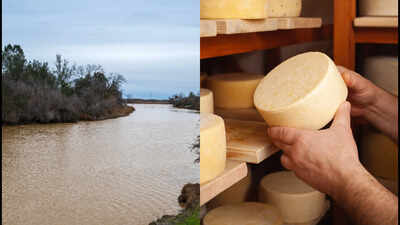
For over 70 years, a section of California’s San Joaquin River was cut off from the land it once naturally fed. Old levees, not built to hold back a river but to hold cattle, had quietly changed the landscape. Then in 2026 crews started to undo that history. Great Valley Grasslands State Park, outside Merced, was the scene of a celebration on June 11, as dozens of scientists, Tribal leaders, state officials, conservationists and community members gathered to mark the completion of a restoration project that took more than 15 years to bring to fruition. The Grasslands Floodplain Restoration Project, finished in February 2026, has reconnected the San Joaquin River to over 220 acres of historic floodplain habitat. The project is returning the river to its natural overflow across the grasslands, by breaching sections of old levees. It’s a remarkable environmental turnaround — and one that began with an unlikely gift from a California dairy farmer and cheesemaker. Scroll down to understand the relation between the project and cheesemaker.
A river at last finds its way home
According to the American Rivers website news report, the June gathering was more than a ceremonial occasion. It was the return of a natural process that had been absent from this landscape for over 75 years. After speeches by state officials, tribal representatives and conservation leaders, attendees walked along the San Joaquin River to the newly breached levee. A red ribbon was draped across the new channel. It is reported that American Rivers led the project’s implementation, in partnership with California State Parks, River Partners and Flow West. The event was one of five spotlight events highlighting conservation efforts across the state as part of California State Parks Week. “Restoration is not a sprint, nor is it a marathon. That’s a relay, a passing of the torch from one generation to the next to care for the land,” said Ann Willis, California regional director for American Rivers.
Why we care about floodplains
The report states that floodplains are much more than a coincidence of flooding. They are some of the most productive ecosystems on earth, providing habitat for plants and animals and performing important functions for people. When rivers can flow over their natural floodplains, water slows, filters through soil and helps recharge underground aquifers. The newly reconnected floodplain along the San Joaquin River is expected to provide a variety of benefits. Also, seasonal flooding can help reduce invasive plants that prefer drier conditions and improve conditions for native grasses and wetland plants. These plants also provide food and shelter for wildlife. It is also believed to benefit threatened and endangered fish species, including Chinook salmon. And, floodplain areas can offer juvenile salmon relatively sheltered waters and access to food during a critical stage of their development.
A home for wildlife and vernal pools
As per the report, seasonal flooding can also create vernal pools, temporary wetlands that form during wet periods and dry up as conditions become drier. These pools may be temporary, but are important habitats for a variety of amphibians, reptiles and invertebrates. Their lives rely on seasonal patterns of water and soil that have been disturbed in many areas of California. So, restoring those rhythms is more than just restoring water to the land. It is about restoring a connected ecosystem in which water, plants, fish and wildlife can respond to seasonal cycles once more.
An improbable beginning: A dairy farm
If we go by the news report by American Rivers, Great Valley Grasslands State Park has a story with a peculiar beginning. Joseph Gallo was a former dairy farmer who built a successful cheese business. In 1982, he donated thousands of acres of Central Valley grasslands to the U.S. Fish and Wildlife Service and the state of California. He requested that the land be preserved as wildlife refuges and parks. Today, Great Valley Grasslands State Park covers nearly 2,826 acres south of Modesto and west of Merced. It includes one of the largest remaining areas of native grassland in California. When Gallo donated the property, old levees, built in the 1950s, still crossed the grasslands. They were not intended to control the San Joaquin River. Instead, they served as a means of corralling cattle within the dairy operation.
A 15-year effort to reverse the past
More than 15 years ago, American Rivers began working with California State Parks, River Partners and other agencies, nonprofit organizations and private partners to learn how to restore the park’s native grasslands and reconnect the river to its floodplain. Permitting problems and the realities of working in an area that nature designed to flood have delayed the project. Weather and flooding could halt construction for months, making work impossible. Some of the State Parks staff and engineers were involved in the project for over 15 years. Funding eventually came from a number of sources, including California Department of Fish and Wildlife funding through Propositions 1 and 68, California State Parks’ Cannabis Watershed Protection Program and support from Cox Enterprises. The result was a restoration project that can re-connect the river to over 220 acres of floodplain.
The work is not done yet
Construction is not the end of the project. This is the start of a new phase: what the ecosystem does Water temperatures, groundwater levels, zooplankton, native vegetation and wildlife activity will be monitored by scientists and restoration teams.The zooplankton are of special importance as they are part of the food web that supports young salmon. When water passes through the recently breached areas, populations of zooplankton on the floodplain and in the river can be compared to determine whether the restored habitat is providing the ecological benefits expected. The information gained here could also help to inform future floodplain restoration efforts along the San Joaquin River and elsewhere.
A new future for the central valley
The restoration comes as California’s Central Valley looks for more ways to provide opportunities for people to experience and protect its natural landscapes. The region has historically been one of the least park-rich in the state, with many of California’s parks situated along the coast or in mountain regions. California State Parks is seeking public input for a General Plan to improve access to Great Valley Grasslands State Park. Meanwhile, State Parks and American Rivers continue to work on plans to restore and reconnect more than 1,000 additional acres north of the San Joaquin River, purchased with funding from the Wildlife Conservation Board.The state is also turning its attention to parks in the Central Valley. In April, Governor Gavin Newsom announced State Parks Forward, a program that includes plans for three new state parks in the region, including the 874-acre San Joaquin River Parkway in Fresno.Images Courtesy: istock