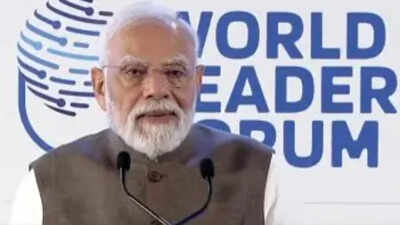
NEW DELHI: PM Narendra Modi said the country has moved from “production-linked punishment” (PLP), where companies were penalised for producing more by the “licence raj govts”, to a regime where higher production is incentivised through schemes such as PLI (I for incentive), and vowed to pursue reforms with greater vigour to realise the goal of ‘Viksit Bharat’.“Our govt will continue working for the youth, women, farmers, the poor and the middle class. Our reform express will move forward at an even greater speed,” he said at Economic Times World Leaders Forum on Friday.Amid growing global challenges, PM said, the world was seeing India as a “bright spot”, where poverty levels have fallen, and with International Monetary Fund forecasting it as the fastest-growing major economy. A developed India will provide stability to a world ridden with distrust, where resources are being weaponised, he said. “For me, if India’s future is secured, it will play a major role in bringing stability to the future of the world.“Slamming Congress-led opposition for mocking Atmanirbhar Bharat initiatives, Modi said they wanted people to remain helpless.
Here’s what PM said
Policies should be tailored for country, not country for policies: Modi
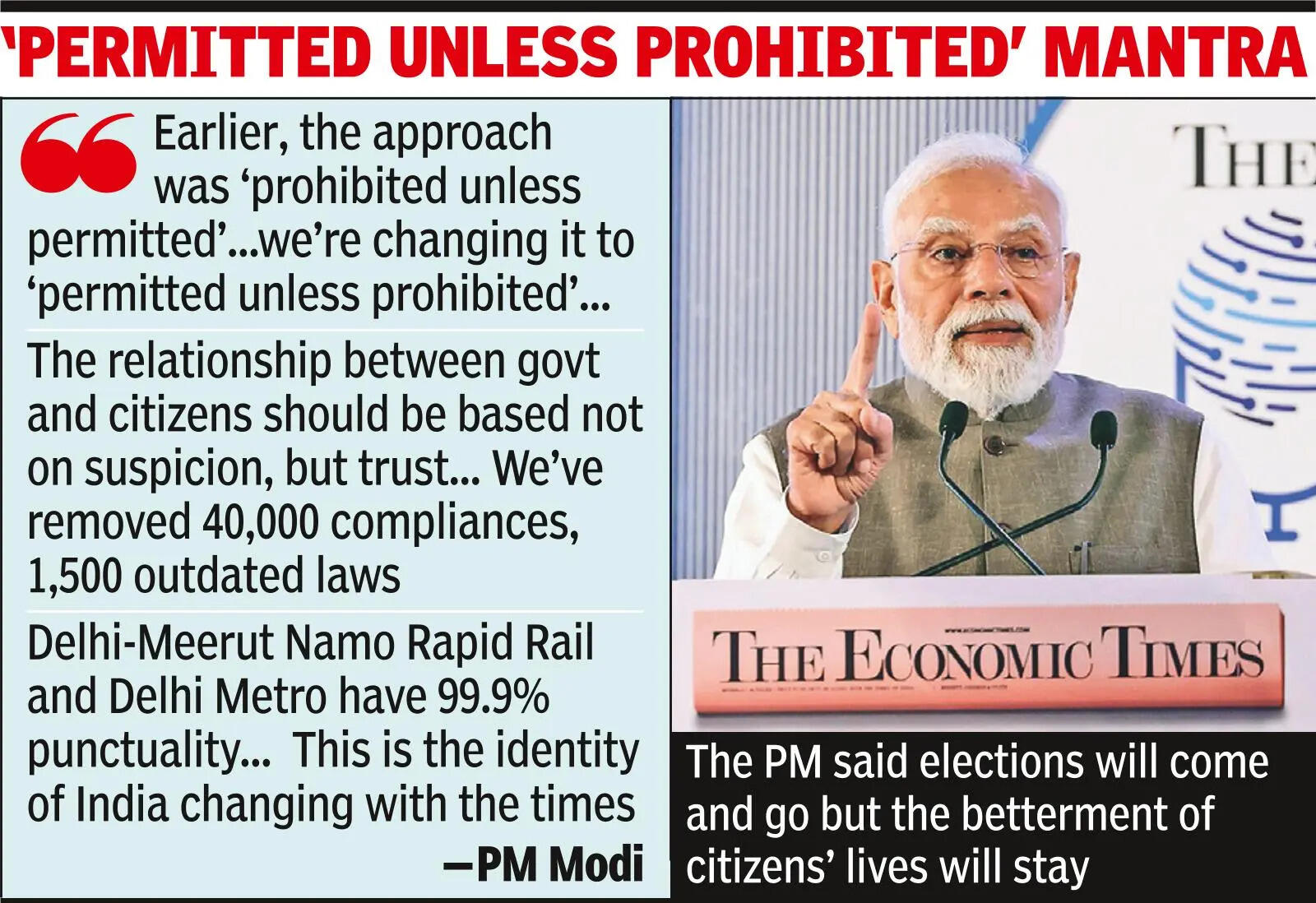
A distorted mentality was at work behind such “production-linked punishment” (PLP) policies. People with that mindset always wanted a shortage of essential goods to persist. Their policy was to keep citizens in a state of scarcity, so that people would remain dependent on them. Their style of governance was to first make people plead before them and then act as if they were granting favours… You can imagine how such an approach strangled the basic principle of employment generation. What is even more surprising is that the courtiers of those govts — I repeat, their courtiers — never raised their voices against it, PM Narendra Modi said at ET World Leaders Forum Friday. He said, in contrast, production-linked incentive (PLI) has generated massive investments, created lakhs of jobs and helped boost exports.Modi said his govt’s approach was never to chase headlines or merely make pre-poll announcements that were never followed up. Instead of announcing free power, he said, NDA opted for the rooftop solar scheme that not only ensured reliable supply of electricity but also allowed individuals to supply to the grid and earn.“Today, we are making policies that are pro-people, pro-growth and pro-development. Policies should be made according to the needs of the country and its people. The country should not be forced to function according to policies.” He pointed out how elimination of railway crossings and interlocking have helped slash the number of rail accidents by over 90% to 15-20 annually. “Governance reform also means building systems that are sensitive to every human life and to people’s time.”Modi highlighted Delhi-Meerut Namo Bharat Rapid Rail and Delhi Metro’s 99.9% punctuality record as a reflection of a change in mindset. “Earlier, if something was delayed, people would simply say, ‘this is Indian time’. Times have changed… Delhi Metro’s punctuality is now almost on a par with metro systems in cities such as New York, Hong Kong and Paris. This is not merely the story of metros and rapid rail running on time. It is the identity of an India that is changing with time.”Citing technological advancements that have made the average Indian’s life easier — from DigiYatra and FasTag to UPI payments and easier I-T return filing — PM said, “The ease-of-living reforms India has undertaken over the past 10-12 years have changed the lives of people, particularly the middle class, in ways that remain a dream even in many developed countries.”Ease of business has improved with compliance burden being lightened, he said, pointing out that outdated laws and compliance requirements have been done away with. Deregulation and reforms have had a major impact in crucial sectors such as drones, geo-spatial mapping, defence production and nuclear energy, he said.
Share your thoughts in the comments
Be respectful · TOI community guidelines
In his special address, Times Internet chairman Satyan Gajwani said Modi is now the longest-serving democratically elected head of govt among G7 and G20 nations. “Stable, long-serving leaders who are able to repeatedly win the trust of their voters do something for a nation. They infuse a nation’s soul with a sense of unity, security and confidence. That no matter what the challenge is, we will deal with it together. And we are in good hands. That we shall overcome. That sense of security and confidence then turns into magical things,” he said.“…A nation’s energy, self-belief, the dreams of its youth, the audacity of its entrepreneurs, the resilience of its farmers and, indeed, its destiny — all essentially flow from stable, long-term leadership,” he added.