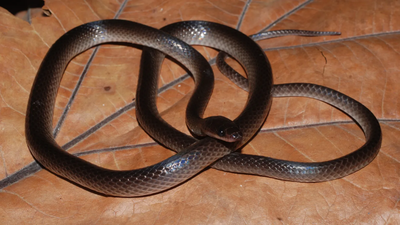
A newly described snake from the forests of New Guinea has been given a name familiar to rock fans around the world. Scientists have named the non-venomous species Lielaphis slashi, or Slash’s groundsnake, after Guns N’ Roses guitarist Slash, whose real name is Saul Hudson. According to the Field Museum, which announced the species’ description, the name was inspired by the guitarist’s long-standing interest in snakes, reptiles and natural history. The small ground-dwelling snake was first encountered during fieldwork in New Guinea years before researchers formally established that it represented a previously unknown species, adding another unusual discovery to the island’s rich biodiversity.
Why Slash was chosen
The decision to name the snake after Slash has a personal connection to Sara Ruane, an associate curator of herpetology at Chicago’s Field Museum and senior author of the study describing the species. According to Ruane, she became interested in both reptiles and Guns N’ Roses when she was young. She told Popular Science that the band had been one of her favourites since childhood and that she had decided by around fifth grade that she wanted to become a herpetologist, a scientist who studies reptiles and amphibians.The connection became stronger when Ruane was 12. She received an issue of Reptiles Magazine featuring Slash holding his pet reticulated python on the cover. According to Ruane, she later read the accompanying interview, in which the guitarist discussed his interest in museums, zoos, natural history and searching for snakes as a child.Those details made Slash a natural choice when Ruane and her colleagues needed a name for the newly recognised species. She told Popular Science that his interest in reptiles made the tribute particularly fitting. Slash welcomed the honour. In a statement reported by the Field Museum, the guitarist said he was “extremely honoured and humbled” to have a snake from New Guinea named after him. The name also has a connection to Slash’s music career. In 1994, he formed the rock band Slash’s Snakepit, giving him another longstanding association with snakes.

Slash and Sara Ruane at the Field Museum (Image Credit: Sara Ruane via Popular Science)
A small snake from New Guinea
The newly described snake comes from New Guinea, a large island north of Australia that is divided between Indonesia and Papua New Guinea. According to the Field Museum, Lielaphis slashi is about 28 inches long and has a reddish-brown appearance. It is non-venomous.Scientists first encountered the snake years before formally recognising it as a new species. According to the Field Museum, Louisiana State University herpetologist Chris Austin first encountered the unfamiliar snake during nighttime fieldwork in New Guinea in 2006.Austin explained that New Guinea groundsnakes are nocturnal and are often found shortly after sunset around the bases of large trees while searching for food. He also noted that researchers working at night need to be cautious because some venomous snakes in the region can resemble harmless groundsnakes.
How scientists identified it
Finding an unfamiliar snake did not immediately prove that it was a new species. Researchers needed to compare it with related snakes using several lines of evidence. Tianqi Huang, the study’s first author and a postdoctoral researcher at the Field Museum, said the researchers conducted multiple genetic analyses and found that L. slashi was genetically distinct from similar snakes.The team also examined physical characteristics, including differences in scale counts, and used ecological modelling to study its habitat. According to Huang, the combined genetic, physical, and ecological evidence showed that the snake represented a previously unrecognised species. This combination of evidence is important in taxonomy. A snake that looks different from a known species is not automatically considered a new species; researchers must establish that it is sufficiently distinct from species already documented.
What does it eat?
Scientists still have much to learn about Slash’s groundsnake and its behaviour in the wild. Ruane told the Field Museum that snakes in this genus have relatively large teeth toward the back of their mouths. Based on their anatomy, researchers believe New Guinea groundsnakes may use those teeth to catch small, slippery-scaled lizards and consume reptile eggs. Unlike boas, these groundsnakes are not thought to subdue their prey using constriction.
Why the discovery matters
The unusual name has attracted attention, but the discovery also highlights New Guinea’s biodiversity and the challenges facing its forests. The habitat where the snake occurs faces pressure from activities including coffee farming and mining. Ruane said formally documenting species is important for conservation because scientists cannot protect or study organisms they do not yet know exist.For Slash, the discovery offers an unexpected scientific honour. For Ruane, it brings together two interests that began in childhood: reptiles and rock music. A magazine cover showing a famous guitarist with his pet snake ultimately became part of the inspiration for a scientific name. Today, Lielaphis slashi carries that connection into the scientific record, linking a newly recognised species from New Guinea with one of rock music’s most recognisable figures.