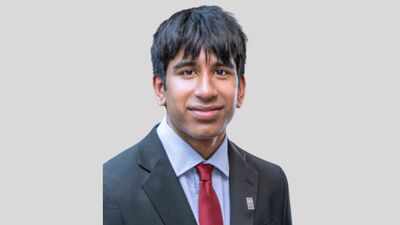
Mythreya Dharani’s achievements in the high school science research arena are few and far between. The Society for Science, which organizes the prestigious Regeneron Science Talent Search, announced that 18-year-old Mythreya from New Jersey developed an AI model to predict how individual tumors would respond to the chemotherapy drug cisplatin. His project placed him among the top 40 finalists in the 2026 Regeneron STS, an important step toward personalized cancer treatment.Mythreya’s research merges machine learning and genomic data to aid doctors in selecting optimal treatments for individual patients. This results in improved outcomes and the prevention of unnecessary side effects. His achievements shows how young individuals can address some of the world’s most critical challenges.A passion for precision medicineMythreya Dharani, a senior at Princeton High School in Princeton, N.J., developed a machine learning algorithm to analyze particle collision data for his Regeneron Science Talent Search physics project. Physicists use computer models to study high-energy particle collisions. When these programs expect symmetrical results, it saves computing time and energy, but can lead to measurement errors being doubled.In his project, Mythreya designed a three-part system to avoid this confusion. The first network is the one that “knows” about symmetry and uses it to find the quickest way to the approximate results of collisions.The second, unconstrained network catches camera and measurement errors, and the third network finds patterns in those errors.He found that, in tests, his combined model was able to navigate the imperfect data without losing the efficiency advantage. His model lets researchers look directly at what “breaks” symmetry, a fundamental problem in physics, especially quantum field theory.Beyond the labMythreya’s achievements extend beyond his research project. The son of Robyn Brook-Nabat and Scott Nabat, he is co-captain of his school’s varsity debate team, where he hones his skills in argumentation and public speaking. As a volunteer instructor with the UCLA Math Circle, Mythreya teaches classrooms of elementary and middle school students college-level mathematics and helps other instructors prepare for their classes. His commitment to education and mentorship reflects his belief in the power of knowledge to transform lives.A prestigious competitionThe Regeneron Science Talent Search is unique among high school competitions. It focuses on identifying, inspiring and engaging the most promising scientists among the nation’s high school seniors. Each year, nearly 1,900 students enter the Regeneron STS, submitting original research in critically important scientific fields of study. The competition culminates in a public exhibition of projects and a formal awards ceremony, where the top ten winners are announced.Looking ahead For Mythreya, winning recognition at the Regeneron STS is more than a personal milestone. It also helps his current research. By studying particle collision he hopes to expand fundamental physics and cosmology’s understanding. But the real value of his work stretches far beyond the lab.Mythreya’s success is an inspiration for young scientists everyplace that big ideas don’t need university credentials. His story shows us the importance of mentorship. It is also a testament to a simple truth: the next breakthrough in science could be a high school science fair project.