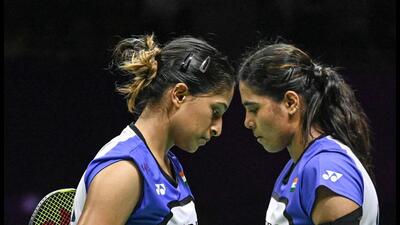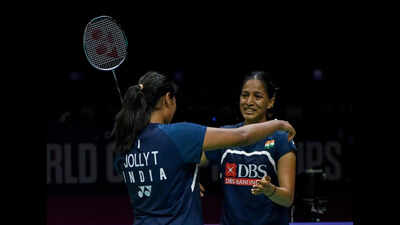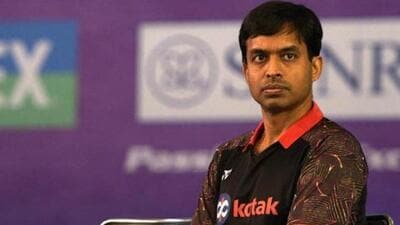
New Delhi: Following a gritty campaign at the BWF World Championships that culminated in a historic women’s doubles bronze for Gayatri Gopichand and Treesa Jolly, chief national coach Pullela Gopichand is planning for the road ahead.
With the Asian Games in Japan looming, Gopichand emphasised on a tailored, highly professional approach for the Indian contingent, backed by specialised coaching units and a renewed focus on squad camaraderie.
As the focus shifts to the Asian Games, to be held in Japan from September 19-October 4, Gopichand revealed a decentralised preparation strategy to cater to the specific needs of an increasingly deep roster.
“As of now, what’s happening is that each one has a dedicated team allotted to them,” said Gopichand, confirming the specialised support for a broad group including Lakshya Sen, Ayush Shetty, Kidambi Srikanth, PV Sindhu, Unnati Hooda, Tanvi Sharma, and Devika Sihag.
“They are all now in a stage of their career where they are professional. They have a team to work with. Some of them are playing tournaments like the China Open… so we get back to work.”
Gopichand also expects the squad’s collective spirit to be a driving force, drawing parallels with recent team successes. “The team is really pumped up. Like the Thomas Cup, the players themselves do a lot of work to get together and build camaraderie. That is what we are hoping for.”
Gayatri and Treesa’s path to the podium was built on clear tactical adjustments, a testament to specific training blocks implemented over the past month-and-a-half.
“Whatever we’ve worked on in the last six weeks has helped, and it’s good to see when the practice you do actually gives you dividends on the court,” Gopichand said.
“It’s a revelation how Treesa kept charging at the net and started taking control. Gayatri’s backcourt has been good, and the rhythm on her serve was very good. These two aspects, at the crucial moments, they were able to pull through.”
Addressing their semi-final defeat against the Chinese world No.1 Liu Sheng Shu and Tan Ning, Gopichand highlighted the heavy influence of the service situation and the difficult conditions.
“They were serving very well because there was a good amount of spin and tumble on the serve. What happens is the moment you push it, the next return is very fast, and then you are engaging in the parallel game,” he said.
“When you are under a three-point deficit, it becomes very difficult to be calm and execute the strategy of lifting the first serve and counter-attacking. But you can’t run away from when people push the pace. You have to get into it.”
Asked about the emotion of watching his daughter, Gayatri, secure a World Championships medal, the coach was stoic as usual.
“I don’t know if I can articulate it in that sense. Whenever my players have played, I’ve always had the same feeling, and there’s no extra for that,” he said, adding he was “very proud of her performance and results, the way she has conducted herself, and the hard work she has done.”
While women’s doubles provided a historic high, the singles campaigns yielded mixed results. Gopichand expressed sympathy for PV Sindhu’s early exit but remained optimistic about her trajectory.
“Sindhu’s match was a bit too close. It’s a bit unfortunate she lost the way she did. But going back to her Japan Open win and her performance here, she’s definitely doing very well,” said the 52-year-old.
He praised rising talent Ayush Shetty. Asked about Lakshya Sen’s struggle, after the India men’s No.1 lost in the second round, he said: “This tournament was bad, unfortunately. I don’t specifically know what the reasons were in that sense.”
With India having now secured World Championship medals in men’s and women’s singles as well as men’s and women’s doubles, mixed doubles remains a glaring omission. Gopichand likened the situation to the step-by-step evolution of Indian badminton over the past 15 years.
“When Saina won for the first time in 2008, the question was ‘Where are the men?’ Then it was ‘Where is men’s doubles?’ and ‘Where is women’s doubles?’ We are ticking one box at a time, and hopefully, mixed doubles will be the next.”