In a shocking move, the government has pruned India’s tennis squad for the upcoming Asian Games, leaving the contingent without its leading singles contenders. The All India Tennis Association (AITA) had originally proposed a 12-member squad, including six women, for the Aichi-Nagoya Games. But that list was slashed to just seven players.
The development came about after the Sports Ministry released the final sanction order, issued on August 22, which cleared 492 athletes for the Asian Games, across 35 disciplines. However, AITA’s request to include all the players it had selected for tennis has not been accepted. The final list for the tennis included just seven players, with only Ankita Raina and Rutuja Bhosale among the women retained.
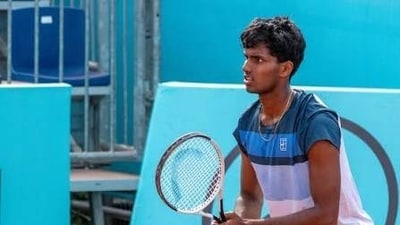
Top women’s singles players Sahaja Yamalapalli, Vaishnavi Adkar and Vaidehee Chaudhari, along with Prarthana Thombare, were omitted for the Games, which will be held from September 19 to October 4, and so was men’s singles prospect Manas Dhamne.
This decision has left India’s India’s women’s singles challenge particularly thin. Sahaja, who is India’s No. 1-ranked player, placed 344 on the WTA ranking chart followed by Vaishnavi (390) and Vaidehee (437), admitted she was “very shocked” at being denied the opportunity.
“I am really shocked and disappointed to hear this. I was very much looking forward to competing in the Asian Games,” Sahaja told PTI from the Netherlands, where she is competing on the WTA circuit.
“There are instances where the underdogs beat the top players and win medals and win tournaments because it is a different set-up. Who knows, this may not be the right thing. If we say that I will compete only when I am a seeded player, then what’s the point of going there? Why play tennis at all?”
AITA had specifically backed the selection of Sahaja when they submitted their list to the Indian Olympic Association on July 3, saying she is the country’s highest-ranked player in singles tennis and citing her deep runs at ITF and WTA events against higher-ranked opposition. Vaishnavi also received backing from AITA, citing her bronze-medal win at the FISU World University Games, while the association highlighted Vaidehee’s consistency on the international circuit.
Why did the government cut the squad?
According to theSports Ministry’s press statement ‘Selection Criteria for participation of Individuals and teams in Asian Games 2026 and other multi-sports events’, released a year back, the government has a defined selection framework for multi-sport events, which ensures that athletes with a realistic medal chance are selected rather than sending players merely for participation. The framework allows the ministry to reject names recommended by national sports federations if they believe the entries do not meet the performance benchmarks.
For individual events, the framework uses recent performances and rankings as benchmarks, while team events and doubles are judged separately. The policy also contains a relaxation clause under which the ministry can approve athletes or teams that fall short of the prescribed benchmark if there are justifiable sport-specific reasons.
AITA interim Secretary General Sunder Iyer told PTI that while the association tried its best to convince the government to approve the 12-member squad, the ministry cited its medal-potential criteria.
“We tried our best to convince the authorities to send all the selected players, but they are citing the criteria of sending only the top-8 players in Asia. It’s disappointing but the criteria is the same for all sports, what to do,” Iyer said.
AITA’s argument was that they had sent the strongest possible squad, arguing that Asian Games tennis offers five separate medal events and selection should take into account the different requirements of singles, doubles and mixed doubles. It also flagged India’s strong mixed doubles prospects, noting that three Indian combinations were among the top eight accepted entries, while India was entitled to field two pairs.
Accordingly, Ankita and Prathana were fielded as doubles specialists. The former had, in fact, won bronze in women’s doubles at the 2018 Games and reached the quarters in singles and mixed doubles at the 2022 edition.
AITA had urged the IOA to urgently review the exclusions and reassess the entries on an event-specific basis, saying the accepted entries offered India legitimate opportunities to compete for medals.
Where does this leave India’s chances at the Asian Games?
The immediate concern for India is the absence of leading women’s singles options. Even though Ankita has entered in singles, her recent struggles to make main draws on the international circuit limits India’s chances.
With limited time left before the Games kick-off, it is unlikely that his disagreement will be solved, but it does expose the larger question on who should have the final say when a national federation believes it has identified its best medal prospects, but the government decides that some of them do not meet its own benchmark?
For Sahaja, the answer is simple.
“Have the belief in players because we have the belief in us,” she said. “Even at Grand Slams now qualifiers are making deep runs and rewriting history. That’s where the fun is.”