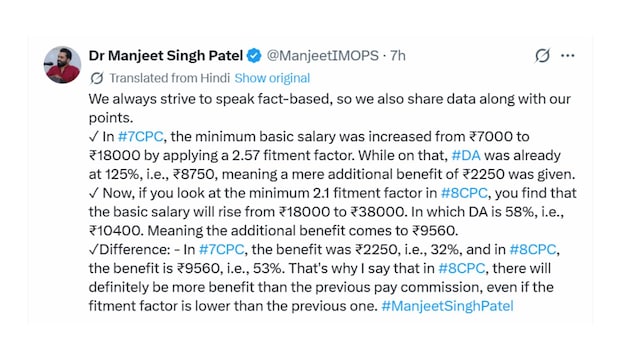
A News18 report, citing All India NPS Employees Federation president Manjeet Singh Patel, explains why employees could potentially receive a bigger effective benefit even with a fitment factor of 2.1, compared with 2.57 under the 7th Pay Commission.
What happened under the 7th Pay Commission?
The 7th Pay Commission raised the minimum basic salary from ₹7,000 to ₹18,000 by applying a fitment factor of 2.57.
However, Patel argues that simply comparing ₹7,000 with ₹18,000 does not show the actual increase employees received because they were already getting dearness allowance (DA) on their old basic pay.
At the time the 7th Pay Commission was implemented, DA stood at 125%. On a basic salary of ₹7,000, this worked out to ₹8,750, taking basic pay plus DA to ₹15,750.
The new basic salary was ₹18,000. Patel therefore puts the additional benefit at about ₹2,250 and estimates the effective benefit at around 32%.
What could happen under the 8th Pay Commission?
Patel uses a possible fitment factor of 2.1 to illustrate what could happen under the 8th Pay Commission.
Applying 2.1 to the current minimum basic salary of ₹18,000 would increase it to ₹37,800, or roughly ₹38,000.
While 2.1 is lower than the 2.57 fitment factor used previously, Patel argues that employees could still end up with a bigger effective increase.
How does the current 58% DA change the calculation?
At a basic salary of ₹18,000, DA of 58% works out to roughly ₹10,400. That puts an employee’s existing basic pay plus DA at around ₹28,400.
If the new basic salary were to rise to about ₹38,000 under a 2.1 fitment factor, Patel estimates the additional benefit at around ₹9,560.
Based on this calculation, he argues that the effective benefit could be around 53%, compared with about 32% when the 7th Pay Commission was implemented.
In other words, his argument is that employees should not look at the fitment factor in isolation. What matters is how the revised basic pay compares with the salary, including DA, that employees are already receiving.
What could basic salaries look like with a 2.1 fitment factor?
If a 2.1 fitment factor were applied across different pay levels, a Level 1 basic salary of ₹18,000 could rise to ₹37,800.
Similarly, a Level 4 basic salary of ₹25,500 could increase to ₹53,550, while a Level 13 basic salary of ₹1,23,100 could rise to ₹2,58,510.
These figures are only illustrative and are based on the 2.1 fitment factor used in Patel’s example.
Fitment factor has not been finalised
The final fitment factor for the 8th Pay Commission has not yet been decided. The eventual salary revision will depend on the commission’s recommendations, the new pay structure and the government’s approval.
Patel’s calculation is therefore not a forecast of what employees will receive. Rather, it illustrates why a lower fitment factor than the 7th Pay Commission’s 2.57 would not automatically translate into a smaller effective salary increase.