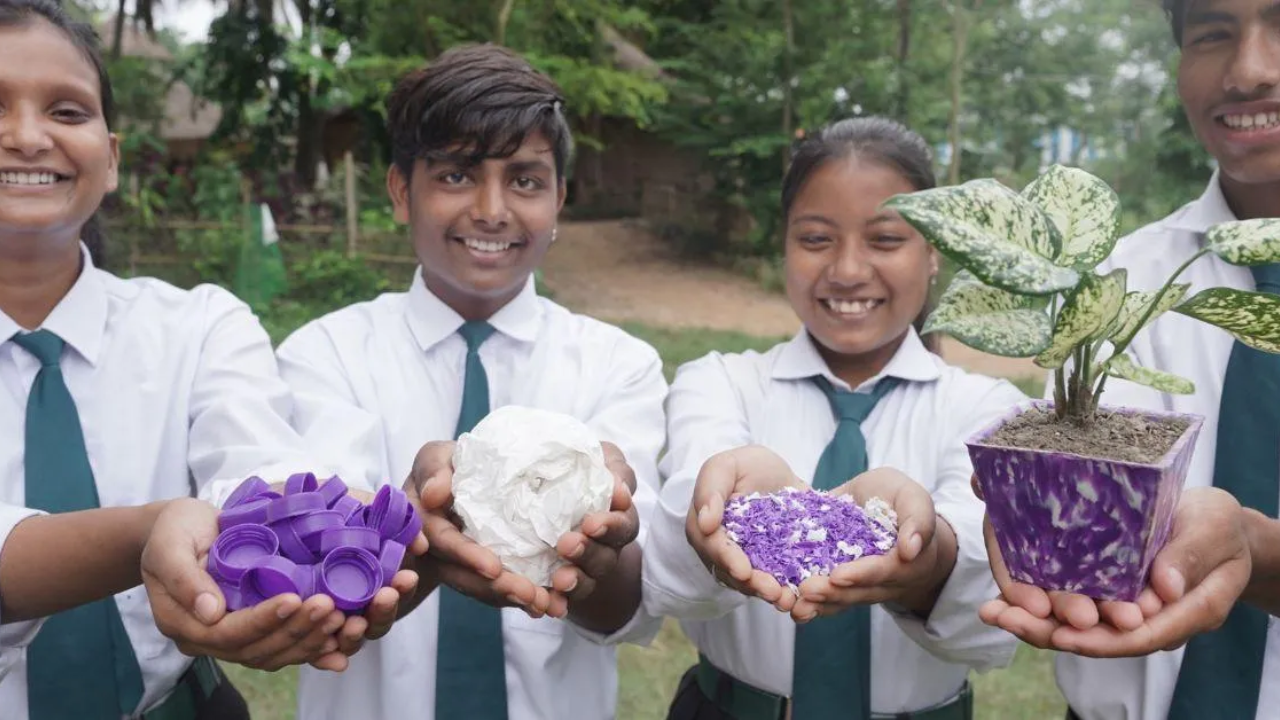
Every morning, children at a school in Assam arrive carrying something unusual in their school bags. Not many would believe plastic waste could be an item used for a barter. But at Akshar School in Pamohi village, students collect plastic from their homes and neighbourhood and bring it to school as part of their fee. The idea was created to solve two problems at once. One, make education accessible to children from low-income families and two, stop people from burning plastic waste.According to The Guardian and various media, the school was founded in 2016 by Mazin Mukhtar and his wife Parmita Sarma. What began with just 20 students has grown into an unconventional education model that combines academics with environmental awareness and vocational training.
How plastic became the school fee
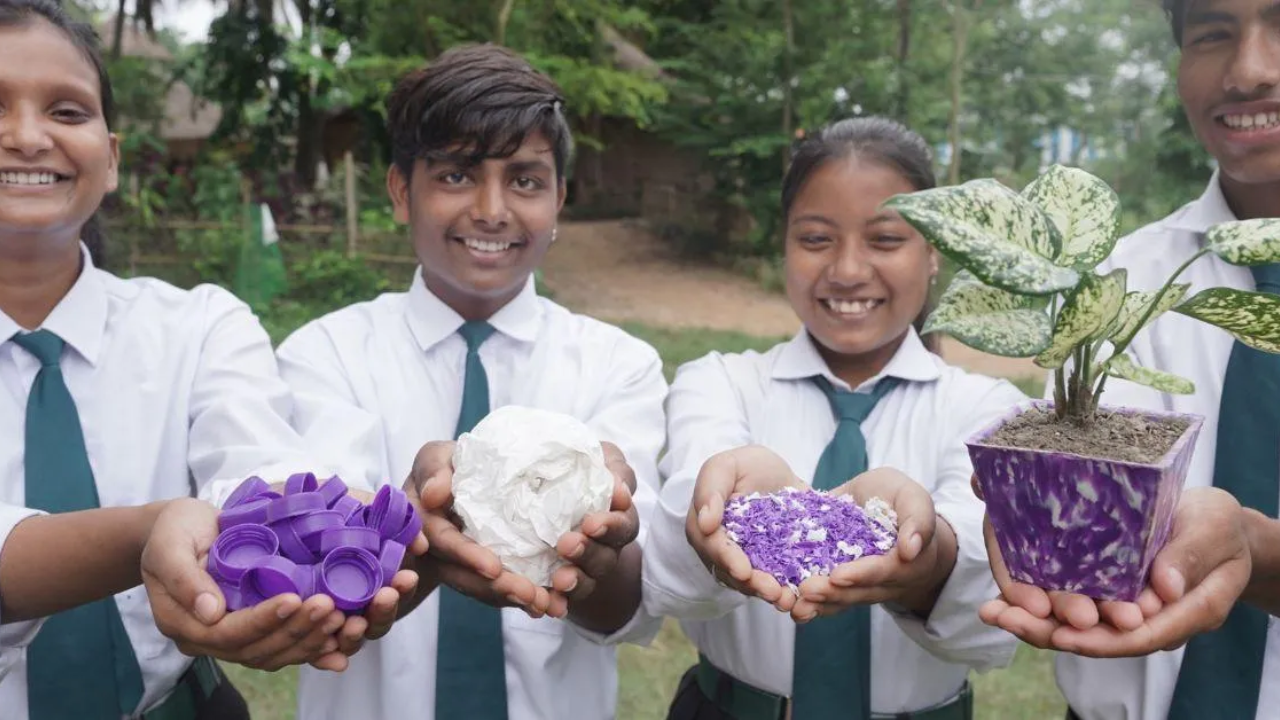
Photo credit: The Better India
The idea came from a problem the founders could see around them. Many children in Pamohi came from families dependent on local stone quarries. Some children themselves were working there, earning money that their families needed. At the same time, plastic waste was being burned as fuel in homes and around the village. The smoke was affecting the children at the school, with students reportedly coughing and wheezing.Initially, Mukhtar and Sarma asked parents to send household plastic with their children. Few did. So the couple changed their approach. Instead of simply asking families to bring plastic, the school introduced it as an alternative to cash fees.As Mukhtar told The Guardian, parents could pay either in cash or with plastic waste from their homes. The change resulted in full compliance, with parents also pledging to stop burning plastic. The students now collect plastic from their homes and the surrounding area and bring it to school.
What happens to the plastic?
The plastic collected by the children does not simply end up in another landfill. The school was collecting at least 25 pieces of plastic from each student every week, adding up to more than 10,000 pieces a month. The material is used to make eco-bricks for construction.Pratha Indic, in a 2024 report on the school, also highlighted its recycling centre, where plastic waste is converted into eco-bricks and other useful materials. The result is a simple cycle: children collect waste, the school puts it to use and families have less reason to burn plastic.We wanted the students to work on the sustainability angle, and we wanted them to work on something that they could relate to. When we had this conversation with them, we learned that they were burning plastic every day because they had no choice. They would gather leaves, plastic, everything, and set it on fire. In the winter months, they would huddle around that for warmth. Even young babies would be taken there and inhale that smoke.So, when we started this, we told the kids, “Instead of burning it, just bring the plastic and we’ll figure out a way to recycle it.” After that, we have had kids bringing in plastic regularly. Then the older students, after school hours, started making eco-bricks. An eco-brick is basically a plastic bottle stuffed with wrappers and plastic, packed tightly. It becomes like a brick that can be used for small constructions. We have made pathways at our school, a planter and benches. You can make small kinds of structures. The kids also learn at the school how to build small structures with eco-bricks. Now we have machines. Now our students operate those machines at the school. They are able to make different products like flower pots, key rings, dog bowls, tables, chairs and everything,” told the co-founder of the school Parmita Sarma.
The school teaches more than textbooks
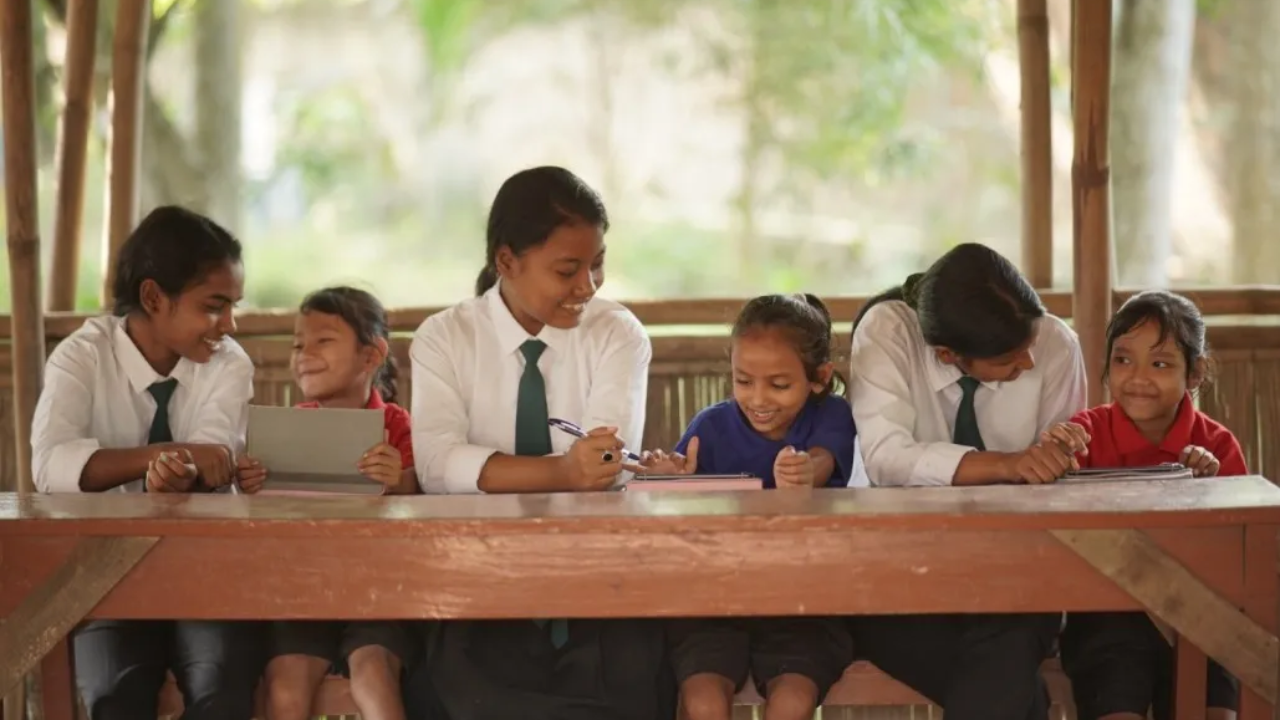
Photo credit: The Better India
Akshar’s model does not stop with regular classroom lessons. Students are also given vocational training in areas such as carpentry, electronics, recycling, first aid and solar-panel installation. The idea is to give children practical skills alongside their formal education.The school also uses a peer-to-peer learning system. Older students tutor younger children and receive toy currency in return. The notes can be used to buy items such as snacks, clothes, toys and shoes at participating local shops.
A chance for children who could not afford school
For some families, Akshar has meant being able to continue their children’s education after money became a barrier. The Guardian spoke to Sompa Boro, whose daughters had earlier attended a private school but had to leave because the family struggled to pay the fees. They later joined Akshar.The school has also reported changes in students’ confidence. Sarma told The Guardian about a 13-year-old girl who could barely speak when she joined the school but later began performing well academically and tutoring two children from a local English-medium school.Pratha Indic reported in 2024 that more than 80% of Akshar’s students came from families living below the poverty line, citing information from the Akshar Foundation. It also featured the case of a 12-year-old student named Reshma, who reportedly contributed around 2kg of plastic waste each month towards her education.
The impact was not limited to the classroom.
During the Covid-19 lockdown, when normal classes were disrupted, Akshar was turned into a food relief centre. According to The Guardian, senior students worked as social workers and helped identify families in need, with the school eventually delivering rations to about 15,000 people in slums and villages around Guwahati.The idea is now moving beyond the original Akshar school. “Currently, we are working with 13,000 students in Assam, 1,500 kids in Mumbai and 800 kids in Jabalpur,” said Parmita.It is not a conventional school model. But in Pamohi, it has created a different idea of what a school fee can be, something that costs a family almost nothing financially, but can still have value for the entire community.