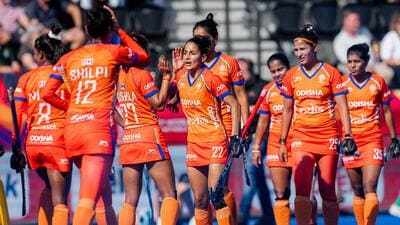
New Delhi: It was a team that had seemingly lost its way. Having failed to qualify for the 2024 Paris Olympics, relegated from the FIH Pro League, and bogged down by internal tensions and rifts over the last couple of years, the Indian women’s hockey team arrived at the World Cup in the Netherlands and Belgium with more questions than answers.
They hadn’t played a top-tier team in a year. Yet, against all odds, they delivered a performance that has reignited hope and proved they can still go toe-to-toe with the sport’s powerhouses.
Returning to the setup in January, after previously guiding the team to a historic fourth-place finish at the Tokyo Olympics in 2021, chief coach Sjoerd Marijne engineered a stunning turnaround. Within months, he helped the squad qualify for the World Cup and secured the Nations Cup title that earned them a ticket back to the elite Pro League.
At the World Cup itself, the team showcased a newfound resilience, finishing the tournament with one win, one loss, and three draws in five matches. Those three draws were not against pushovers, but against true hockey pedigree.
They secured a gritty 2-2 draw against China, the Paris Olympics silver medallists and indisputably the best team in Asia today. They hammered South Africa 6-1, their biggest win in World Cup history.
Salima Tete & Co then held England — a squad built on a system that has medalled at three of the last four Olympics (including gold as Great Britain at Rio 2016) — to eliminate England and progress to the second round, something very few would have bet on.
In Round 2 they fought hard but lost 0-2 to hosts and the world’s best team Netherlands before playing out a 0-0 thriller against Australia, two-time world champions and bronze medallists from four years ago.
“To perform against teams that were much higher ranked was nothing less than commendable,” former India captain Mamta Kharab told HT. “We could have actually won the match against Australia but unfortunately could not convert our chances.”
Addressing the team’s only defeat against the formidable Dutch, Kharab focused on the positives. “Even against the Netherlands, the biggest team in the world, we put up a solid fight. We lost only one game in five. Don’t forget, many of these girls are playing the World Cup for the first time. To perform at that level is not a joke,” added the 44-year-old.
Much of this success was built on the foundation of a rock-solid defence and brilliant goalkeeping. Savita Punia and Bichu Devi Kharibam were sensational under the bar, absorbing relentless pressure from the world’s best attackers. But defensive resilience in modern hockey isn’t just about stick-work, it is driven by elite physical conditioning.
That is where Wayne Lombard, the team’s head of athletic performance, played a transformative role. Moving away from a traditional “one-size-fits-all” conditioning model, the South African and his sports science team utilised advanced data analytics and GPS trackers to individualise training.
“My assessment from afar: simple game plan and role clarity for players,” 1980 Olympic champion MM Somaya, who is also a national selector, told HT.
“Players can defend in numbers and transition into attack quickly due to high fitness levels. For this, Sjoerd’s strengthening and conditioning team led by Wayne Lombard played an important role. Also, he wins the players’ trust by allowing them personal space.”
But as former India women’s coach Neil Hawgood pointed out, the puzzle is not yet complete. While praising Marijne’s rapid turnaround, Hawgood noted the absence of a quintessential match-winner.
“Last night’s game, they were missing a game breaker, which is something they have had for the last 14 years; they had someone who could break the game apart,” Hawgood, who helped India qualify for the Olympics after 36 years at Rio 2016, told HT. “Where are Rani (Rampal), Jaspreet (Kaur), Vandana (Katariya), who score goals? They should have won last night’s game.”
The LA 2028 ticket is now the ultimate prize. Having finished above the Alyson Annan-coached Chinese side at the World Cup, the dynamics in Asian hockey have noticeably spiced up. The 2-2 draw has brought a renewed belief that India can not only compete with but conquer their neighbours at the Asian Games.