He sees the Nifty’s forward price-to-earnings multiple at around 18 times, making India cheaper than the US market, while domestic investors continue to push mid-caps higher.
On US bonds, Matthews is sceptical that efforts to bring down long-term Treasury yields will work, but sees the current 5.3% yield on 30-year Treasuries as attractive for American investors.
He also sees limited impact from the latest Iran sanctions, arguing that heavily sanctioned economies can adapt and become more self-sufficient.
This is an edited transcript of the interview.
Q: What should we expect from the United States Secretary of the Treasury Scott Bessent press conference? He’s described it as the toughest sanctions in history, an economic D-Day. What’s going to be the likely impact, or what’s the market expecting?
A: I don’t think very much because there’s really not much the US can do to stop countries like China from engaging with Iran economically or Russia. So, I think it’s for show. But what’s more important is the fact the US is saying it will engage in economic warfare with Iran. Indirectly, what that means is it will no longer be engaging in real warfare like missiles. And, of course, we would prefer the economic over the hard war. I don’t think the economic war will be particularly more successful than the hard war has been. On the whole, I don’t particularly view this as big news.
Q: Iran’s been pushed into the corner already for the last so many decades now. The rial is at historic lows. Inflation is running at 65%, 70%. Do you think the only way out for Iran economically is going to be via earning some money from the Strait of Hormuz? For example, the Iranian Parliament today approved a draft law, which basically is saying that we’re going to charge a service fee. So, they’re not calling it a toll, which basically then will say that, oh, there’s no freedom of passage, so it’s not a toll, but it’s going to be a service fee. Do you see that going through? What’s going to be the legal, the practical, you know, aspect of this?
A: I think Russia, but you could go back further in history, Iraq. Many countries have proven that they can survive in a heavily sanctioned environment. In some cases, they even become stronger because they become more self-sufficient. I think Russia would be the best analogy.
So, there are some things the Iranians do import they badly need. Medical equipment would be one example. I suspect somehow that kind of thing will still make its way in through Russia.
But as for the Strait of Hormuz, I don’t know if the Americans will let them charge that fee. It’s all very grey what’s happening in the Strait of Hormuz now. But to my understanding, to go through the Panama Canal or the Suez Canal costs about half a million dollars for a ship.
Now, if you figure there’s about $100 million to $200 million, depending on the size of the tanker, of oil on a tanker that goes through the Strait of Hormuz, $500,000 service charge is 0.3% of that. It’s not really a big deal.
Q: The other story which pops up occasionally is this entire bond yield story, which, of course, on the long end is now rising and a lot of debate and discussion around what the Treasury’s trying to do, whether it’ll work, not work, or this is one more instance where everyone panics for a little bit and then forgets about it for the next few months till it comes up again. What’s your sense?
A: My sense is that Donald Trump probably told Scott Bessent to get the long bond yield down before the midterm election because that is the yield off of which mortgage rates are priced, and Scott Bessent knew that he couldn’t really convince Donald Trump, well, the reason why our long bond yields are high is because our debt is high and our deficit to gross domestic product (GDP) is also high.
So, he put on his trader’s hat and intervened in the market. And doesn’t look like it’s going to work. I’d be kind of surprised if it did. This is a market that turns over a trillion dollars a day. It’s the largest market in the world. So that’s where we’re at.
I also have been watching the fund flows into government bond exchange-traded funds (ETFs), and I suppose what is encouraging is they have been very, very strong over the last two weeks. And that is an indication to me that, yes, it’s true, the US deficit to GDP is too high, whatever it is now, 6%. The federal government debt just went over, I think, $40 trillion last week.
But on the other hand, you’re now getting 5.3% for a 30-year Treasury. And now, if you just reckon you’re a retired couple in the United States with, say, $2 million in liquid assets, that gives you a gross income of over $100,000 a year, and then they would be getting maybe about $40,000 in Social Security.
What I’m trying to say is that 5.3% is a very attractive yield on what is essentially risk-free debt. Now, if you’re an overseas investor, you might worry about your currency exposure, but if you’re an American couple and you’re not so worried about what the US dollar is doing.
Q: Let’s focus on the Indian markets then. How do you see things pan out here? Well, we have been thumping the table that earnings have come back, the first quarter wasn’t so bad, valuations are more reasonable than what it was, say, around 18 months or so ago. Your view on the Indian markets and anything in particular you like?
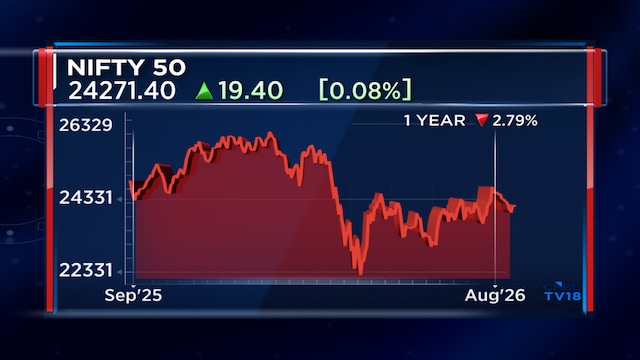
A: India, I think, looks good. The first quarter earnings growth was about 18% and that puts the forward price earnings of the Nifty at around 18 times. So, it’s cheaper than the US market, which it hasn’t been in a long time, and all the foreign selling that we had from the peak of September 2024, some $48 billion of selling, which was pretty much the same amount as what they’d put in over the previous 10 years, it seems to have come to an end.
They are net buyers this month, and when I look at the fact that the mid-caps are about 10% to 15% higher than before the war started, and then the Nifty 50 is about 10% lower. Obviously, the foreigners own the Nifty 50; they don’t really participate in the mid-caps.
Watch the full conversation here

That tells me that if the foreign selling has truly abated, which I think it has, then the market should go up because we have seen in the mid-caps that’s what local investors have been doing. They’ve been pushing the market up. They’re pumping.
Catch all the latest updates from the stock market here