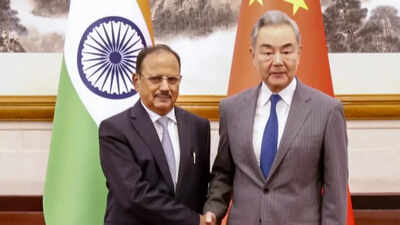
Ahead of Chinese President Xi Jinping’s visit to India next month, India and China held the 25th round of Special Representatives (SR) Dialogue on the Boundary Question, endorsing efforts to formalise the recent turnaround in the relationship on the back of border peace and discussing issues like de-escalation, boundary demarcation and border management.After the talks chaired by Special Representatives Ajit Doval and Wang Yi, while India said both sides agreed to work towards a political settlement of the boundary question in their long-term interests, Beijing also recalled a 2005 bilateral agreement to stress its proposal for a package solution.Doval was quoted as saying by the Chinese side that India and China are partners, not competitors, and developing a stable, predictable, and forward-looking India-China relationship carries great significance also for Asia and the world.“The normalcy we have witnessed in our relationship has been a direct result of both sides maintaining peace and tranquillity in the border areas,” said Doval, stressing the significance of border peace for further progress in bilateral ties. Wang, however, reiterated China’s position that the border issue must be placed in an “appropriate position” in ties.According to a Chinese readout, Doval and Wang held “in-depth communications” on advancing boundary demarcation negotiations, improving border management and control and promoting cross-border cooperation, while reaffirming their commitment to the 2005 agreement on political parameters and guiding principles for a “fair, reasonable, and mutually acceptable package settlement” to the boundary question.China had dropped the mention of package settlement, which seeks a quid-pro-quo approach, in its readout of the last round of talks but had used it regularly for SR meetings earlier. Indian governments in the past, like in 2007 in Parliament, have said that they were exploring a “final package settlement” covering all sectors of the boundary under the 2005 bilateral agreement but India has not used that formulation recently, stressing instead on a fair, reasonable and mutually acceptable settlement framework.On this occasion, the Indian government said in a statement that under the strategic guidance of PM Narendra Modi and President Xi, – in a constructive and forward-looking spirit – Doval and Wang had a candid exchange of views and agreed to continue their work in seeking a “political settlement of the boundary question in the context of their overall and long-term interests”.The SR talks took place ahead of likely back-to-back bilateral meeting between Modi and Xi – first in Kyrgyzstan on the margins of the upcoming SCO summit and second at the BRICS summit that India will host on September 12-13. Xi is expected to arrive in India on September 12 for his first visit to the country in 7 years. While the schedule is yet to be confirmed, official sources said he will have a bilateral meeting with Modi and attend the PM’s welcome dinner for BRICS leaders on September 12, before participating in the BRICS summit the next day.On the boundary issue, the Chinese side further said that both countries agreed to properly handle the boundary question through dialogue and consultation, jointly safeguarding peace and tranquility in the border areas.According to Beijing, Wang said that China-India relations have surpassed the bilateral scope and hold global and strategic significance and pointed to consensus reached in Modi-Xi metings in Kazan and Tianjin.“China is willing to join hands with India to grasp bilateral relations from a strategic height and long-term perspective, strengthen communication, enhance understanding, resolve differences, overcome obstacles, and serve as good neighbors, friends, and mutually enabling partners, thereby realizing the vision of the Dragon-Elephant Tango,” said Wang.
Share your thoughts in the comments
Be respectful · TOI community guidelines
Doval also called on Chinese Vice-President Han Zheng during the visit and discussed ways to strengthen peace and tranquility in the border areas and further improve bilateral relations across economic, political and multilateral forums.