Natural rubber futures have climbed to their highest level in more than a decade, trading at around 235 cents per kg on August 25, close to levels last seen in 2013.
Supply concerns have intensified as adverse weather disrupts tapping operations in Thailand, the world’s largest natural rubber producer. At the same time, the approach of the end of Southeast Asia’s peak tapping season is expected to further tighten supplies, keeping prices elevated.
Also read: Why HAL’s latest SAFHAL pact matters for India’s next-gen helicopters
The surge in rubber prices comes at a challenging time for tyre manufacturers, with crude-linked raw materials also adding to input cost pressures amid continued uncertainty over the conflict in West Asia.
According to Crisil Ratings, tyre makers’ operating margins are likely to moderate to 11.5-12% in FY27 from 14.2% in FY26, as raw material inflation outpaces staggered price hikes.
However, the rating agency expects the pressure to be temporary, with margins recovering to 13-13.5% in FY28, assuming input costs stabilise and higher tyre prices are gradually passed on to customers.
“A sharp 35-40% rise in key input costs is likely to compress tyre makers’ operating margins by 200-250 basis points this fiscal. However, this reflects a lag in cost pass-through rather than a structural reset in profitability,” said Anuj Sethi, Senior Director, Crisil Ratings.
In a March 2026 note, CLSA had estimated that around 45% of the tyre industry’s raw-material basket was linked to crude oil, while another 45% was tied to natural rubber prices. The brokerage had warned that a sustained rise in crude and natural rubber prices could weigh on tyre makers’ gross margins, highlighting the sector’s sensitivity to movements in both key inputs.
Rubber supply faces multiple risks
Natural rubber, which accounts for nearly half of the industry’s raw-material costs, rose to around ₹275 per kg in June 2026 from about ₹220 per kg in FY26, according to Crisil. Unseasonal rainfall and uneven monsoons in Kerala and Southeast Asia have tightened supplies and contributed to a global deficit.
Thailand has also been hit by heavy rainfall and typhoons, disrupting tapping activity and pushing up raw latex prices. Forecasts of further rainfall could prolong the disruption, while the end of Southeast Asia’s peak tapping season in September is expected to tighten supplies as shipments slow.
There is also a weather-related risk emerging later in the year, with the possibility of a strong El Niño in the fourth quarter of 2026 adding to concerns over production and yields across major rubber-producing regions.
On August 20, rubber futures had already moved above 230 cents per kg, with traders anticipating tighter supply after the peak harvesting season ends in September. Elevated oil prices were also making crude-based synthetic rubber less competitive, although lower oil prices subsequently limited some of the upside in rubber.
Can tyre makers pass on the higher costs?
The key question for the sector is how quickly manufacturers can pass higher input costs on to customers.
Crisil expects tyre companies to take a calibrated approach to pricing, with staggered price increases allowing them to absorb part of the cost inflation without sharply raising consumer prices. Sustained replacement and OEM demand, along with GST rationalisation, is providing manufacturers with some room to implement these increases gradually.
Demand itself is expected to remain relatively resilient. Crisil expects overall tyre volumes to grow 4-5% in FY27, after a 7-8% expansion last fiscal. OEM and aftermarket volumes are each expected to grow 4-5%, while exports are seen rising 3-4%.
Aftermarket demand accounts for around half of total industry volumes, with OEMs and exports contributing roughly a quarter each.
That resilience is important because an aggressive increase in tyre prices could potentially affect replacement demand, while delayed pass-through would leave manufacturers carrying the margin burden for longer.
Investment cycle continues despite margin squeeze
The near-term margin pressure has not altered the industry’s longer-term expansion plans.
Crisil expects India’s leading tyre makers to invest around ₹18,000 crore in FY27 and FY28, nearly twice the spending of the previous two fiscals. High capacity utilisation and sustained demand are driving the next capex cycle, with companies focusing on higher-value radial tyres.
The rating agency expects phased commissioning and steady demand to limit the risk of overcapacity, while healthy liquidity and stronger balance sheets should help companies fund the expansion without putting significant pressure on credit profiles.
How tyre stocks have moved
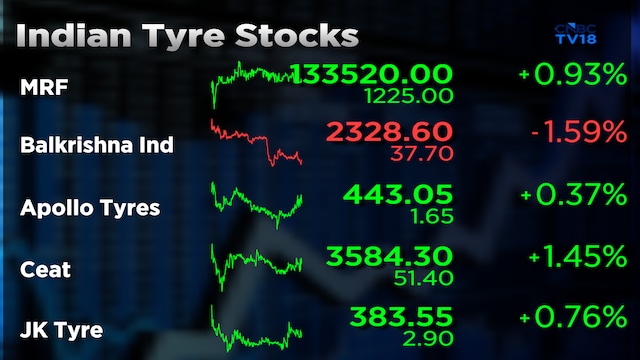
Tyre stocks have delivered a mixed performance over the past month, with most of the key names seeing gains despite remaining in negative territory for the year so far.
| Stock | 1-month performance | 2026 YTD performance |
| Balkrishna Industries | 15% | 0.40% |
| CEAT | 6.50% | -5% |
| Apollo Tyres | 6% | -10% |
| MRF | 1.10% | -12% |
| JK Tyre & Industries | -4% | -26% |
The recent stock performance, however, needs to be viewed against the broader earnings question facing the sector: how long elevated rubber prices persist, how quickly tyre makers can pass on the cost increase, and whether demand remains resilient as prices rise.
For now, Crisil assesses that the margin squeeze should be transitory rather than a structural deterioration in profitability, with raw-material prices, cost pass-through and replacement and OEM demand remaining key variables for tyre companies.