
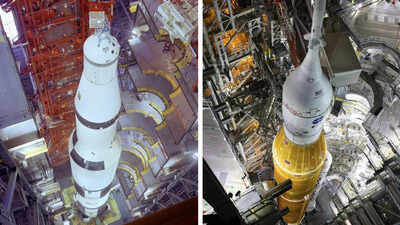
NASA’s Artemis II mission is a key turning point for lunar exploration, moving us from the short-term ‘flags and footprints’ focus of the 1960s to a framework for long-term sustainability. Apollo missions landed on the Moon using the Saturn V rocket and made short-term landings, while Artemis II utilises the most powerful rocket ever built, the Space Launch System (SLS), to launch the Orion spacecraft from a high altitude. Another significant difference with the Artemis II crew is that it includes the first woman and the first person of colour to travel to the Moon, versus only men in the Apollo missions. Artemis II is also a critical mission for testing deep-space life support systems and establishing the ability to sustain a long-term human presence on the Moon.
Artemis II vs Apollo: How SLS power compares to the Saturn V legacy
The rockets represent the biggest physical difference between the Apollo and Artemis programs. The Saturn V remains tall at 363 feet, but the Space Launch System (SLS) is designed to optimise efficiency and meet the needs of modern deep space travel. According to NASA: Space Launch System (SLS) Reference Guide for Artemis II, the SLS produces 8.8 million pounds of thrust – 15 per cent more than Apollo’s Saturn V and will launch the Orion spacecraft with two huge solid rocket boosters and four RS-25 engines, as opposed to three stages of Saturn V, to provide the increased thrust needed to propel the heavier and more advanced Orion capsule and its service module into a lunar trajectory at high altitude.
From Apollo to Artemis: How crew diversity is changing space missions
Apollo mission was all male, all American crews, but Artemis II incorporates a new paradigm for international and social inclusion. Christina Koch will be the first woman to fly to the Moon, and Victor Glover will be the first person of colour to go beyond low Earth orbit. In addition, Jeremy Hansen of the Canadian Space Agency will be the first non-American to fly to the Moon. These changes are part of NASA’s broader goal of making lunar exploration representative of all mankind as we establish a long-term human presence on the Moon.
Artemis II to break Apollo’s deep-space distance records
Unlike Apollo 8’s low lunar orbit (about 70 miles from the surface), Artemis II will follow a path to the Moon that is much further from the Moon than Apollo 8 did. The Orion spacecraft is expected to reach a maximum distance of about 400,000 kilometres (248,655 miles) from Earth. This mission is designed to set a new record for the maximum distance humans have travelled from Earth, officially surpassing the record established by the Apollo 13 crew. According to NASA’s visualisation studio, at the time of the crew’s closest approach to the Moon (about 4,000 to 6,000 miles), they will be able to see the entire Moon and all of its surface features illuminated by sunlight, which was not the case for the Apollo astronauts who orbited the Moon.
Communication evolution: From Apollo’s radio waves to Artemis laser links
The introduction of optical (laser) communications is another major innovation since the Apollo program. The Apollo missions relied exclusively on S-band radio frequencies for communication, whereas Artemis II will test the Orion Artemis II Optical Communications System (O2O) that is laser-based and capable of transmitting data at rates of up to 260 megabits per second. According to NASA, this will allow high-definition (4K) video and very large amounts of data to be transferred to Earth, which was not possible during the 1960s. Like the Apollo missions, Artemis II will be subject to a 41-minute communication blackout when passing behind the Moon and no longer being in sight of Earth-based communication stations.