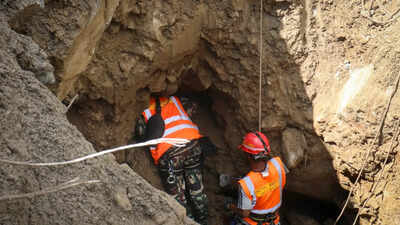
The legal case against Lashkar-e-Taiba founder Hafiz Muhammad Saeed has acquired a fresh dimension in India. In July 2026, the National Investigation Agency named Saeed in a supplementary chargesheet in the Pahalgam terror attack case, charging him in his individual capacity and as the founder and chief of Lashkar-e-Taiba (LeT) and its active proxy, The Resistance Front (TRF). The NIA mentioned a cross-border conspiracy behind the April 22, 2025 attack, which killed 26 civilians. A special NIA court subsequently issued a non-bailable warrant against Saeed.The development came as Mumbai Police separately began proceedings for a trial in absentia against Saeed and five other Pakistan-based accused in the 2008 Mumbai terror attacks. The proclamation covers Saeed, LeT operations chief Zaki-ur-Rehman Lakhvi, Sajid Mir, Abu Alqama, Asim alias Abu Qahafa and Major Abdur Rehman Pasha. The police have also approached the Union home ministry to facilitate service of the proclamation orders through Interpol.The two cases, separated by 17 years, bring together different phases of LeT’s history. One concerns an attack in Kashmir, the region that became the organisation’s principal battlefield in the 1990s. The other concerns the Mumbai attacks, which demonstrated how far LeT’s operational reach had expanded beyond the Kashmir insurgency.But LeT did not begin in Kashmir, nor did Hafiz Saeed first emerge as a militant leader there. The organisation’s institutional roots can be traced to the Afghan jihad of the 1980s, when Pakistan became a major centre for the mobilisation, training and movement of Islamist fighters.
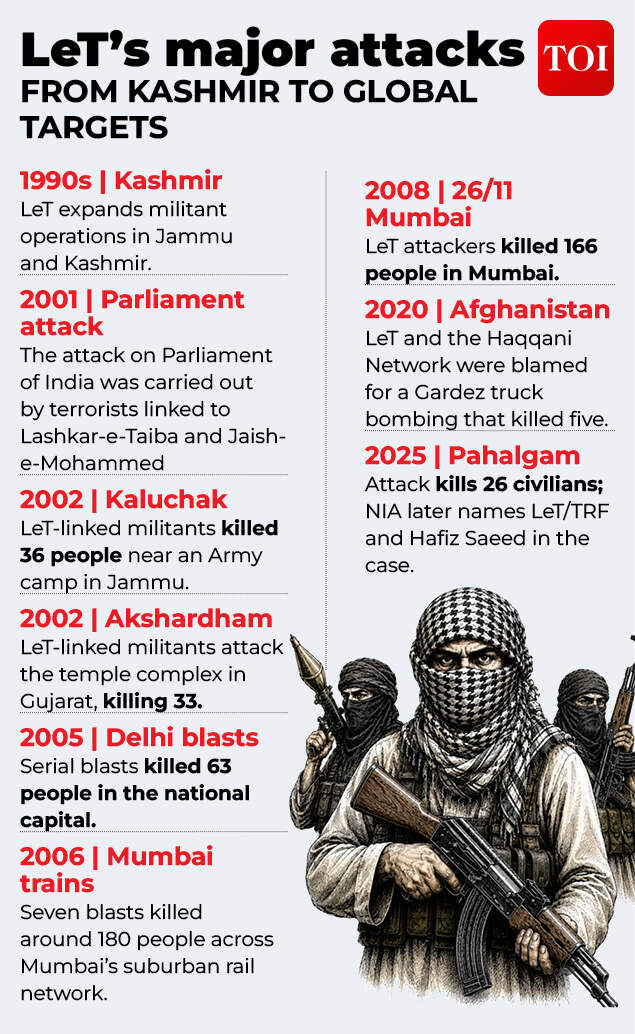
LeT’s major attacks
The Afghan war that created LeT’s foundations
The Soviet invasion of Afghanistan in 1979 created an environment in which Islamist networks from Pakistan and other parts of the Muslim world expanded rapidly. Among the prominent figures associated with this mobilisation was Palestinian scholar Abdullah Azzam, who helped organise foreign volunteers for the Afghan jihad and promoted the idea of jihad as a broader obligation extending beyond a single battlefield.It was in this environment that Azzam worked with Hafiz Saeed, a Pakistani Sunni scholar who had studied in Saudi Arabia. According to Bruce Riedel’s Deadly Embrace: Pakistan, America, and the Future of the Global Jihad, the two were involved in establishing Markaz-ud-Dawa-wal-Irshad (MDI), a religious organisation that combined missionary activity with support for jihad. MDI developed training infrastructure in Afghanistan, including in Kunar province, where recruits could gain battlefield experience. Riedel also records links between the organisation and Pakistan’s Inter-Services Intelligence (ISI).Lashkar-e-Taiba subsequently emerged as the military wing associated with this network. The US state department describes LeT as having formed in the late 1980s as the militant wing of MDI, an organisation originally established in opposition to the Soviet presence in Afghanistan. The Australian government dates LeT’s formation as a military organisation to 1989.The exact formation date therefore varies depending on whether the establishment of MDI, the creation of its military wing or the later formalisation of LeT is being referred to. What is clearer is the sequence: the Afghan jihad provided the organisation’s early ideological, human and training infrastructure, while the end of the Soviet war opened the way for that infrastructure to be redirected towards other conflicts.
Why Lashkar-e-Taiba was established
LeT’s early purpose was shaped by two connected objectives: participation in the Afghan jihad and preparation for jihad in Kashmir and India. Riedel describes MDI’s objective as applying the experience of the Afghan war to Kashmir and India, including training Kashmiris alongside Afghan mujahideen so they could gain combat experience.The changing situation in Afghanistan accelerated that transition. The Soviet withdrawal meant that the battlefield that had brought together thousands of militants was no longer the same. At the same time, violence in Jammu and Kashmir was rising sharply.The Australian government’s account of LeT’s history says the organisation was originally formed to wage militant jihad against the Soviet occupation of Afghanistan and shifted its focus to the insurgency in Indian-administered Kashmir during the 1990s after Soviet troops withdrew. It identifies the organisation’s stated objective as uniting Kashmir with Pakistan, while noting that its broader ideological objectives extended beyond Kashmir.Kashmir thus became the next major theatre in which the organisation could deploy the personnel, training and networks developed during the Afghan war.
From Kunar to Kashmir
The shift towards Kashmir coincided with the rapid growth of the insurgency there. Riedel records that incidents of violence in Kashmir rose from 390 in 1988 to 2,100 in 1989 and nearly 4,000 in 1990. Against this backdrop, Saeed’s organisation began establishing infrastructure in and around Kashmir while maintaining training facilities in Pakistan and Afghanistan.LeT’s emergence also coincided with changes among the various groups fighting in Kashmir. The Jammu and Kashmir Liberation Front advocated an independent Kashmir, while Pakistan’s security establishment increasingly favoured groups committed to the territory’s integration with Pakistan. Riedel describes efforts to strengthen pro-Pakistan organisations and isolate the JKLF, which was regarded as too independent. Hizbul Mujahideen became a major pro-Pakistan militant force, while LeT developed its own network and capabilities.By the 1990s, Kashmir had become LeT’s principal operational theatre. The organisation developed training and recruitment networks and directed fighters towards attacks on Indian security forces. Stephen Tankel, in Lashkar-e-Taiba: From 9/11 to Mumbai, describes Kashmir as the group’s primary objective even as its connections to the wider global jihadist movement expanded.This distinction is important. LeT developed relationships with al Qaida and other jihadist groups, but its core focus remained India and Kashmir. Riedel similarly distinguishes between the different objectives of the groups operating in the region, noting that the Afghan Taliban remained primarily focused on Afghanistan while LeT concentrated on South Asia. At the operational level, however, their cooperation increased.
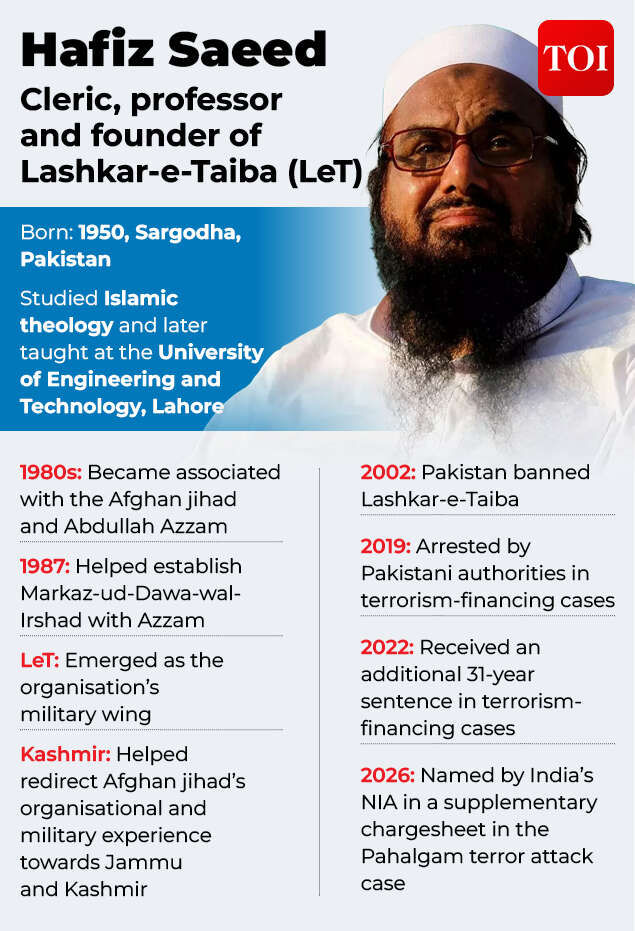
Who is Hafiz Saeed
Hafiz Saeed – From cleric to terrorist
Saeed’s prominence grew alongside the institutional development of MDI and LeT. He was not simply the leader of an armed organisation. The network around him combined religious propagation, education, charity and terror activity.Riedel describes Saeed as a prominent Pakistani Sunni scholar who worked with Azzam in developing MDI. The organisation’s combination of religious activity and military infrastructure provided the foundation for the later growth of LeT.LeT’s recruitment base was also closely connected to Pakistani society. Riedel writes that the organisation was predominantly Punjabi and recruited from many of the same communities and neighbourhoods as the Pakistani army and ISI. He also describes LeT camps located near army bases and the involvement of retired military personnel in training fighters.The nature and extent of state support for LeT has remained a matter of dispute, but the organisation’s relationship with Pakistan’s security establishment became an important part of its history. The United Nations Security Council identifies LeT as a Pakistan-based organisation and records its links with al Qaida and the Taliban, as well as its use of Jamaat-ud-Dawa for financial, logistical and infrastructural support.
LeT survives Pakistani ban after 9/11
The September 11, 2001 attacks changed the environment for militant organisations operating from Pakistan. The United States designated LeT as a Foreign Terrorist Organisation in December 2001, while Pakistan banned the group in January 2002.The ban, however, did not eliminate the network. The US state department says Saeed subsequently changed the group’s name to Jamaat-ud-Dawa and expanded its humanitarian activities, while continuing to disseminate its message through JuD’s media outlets.Riedel similarly writes that although LeT was formally banned, it continued to operate and Saeed remained in charge. He describes the organisation’s large facility at Muridke near Lahore, which included schools, dormitories, a garment factory, an iron foundry and a mosque.This structure helped the network maintain a presence beyond its armed operations. Religious institutions, charitable activity, fundraising and recruitment provided a broader organisational base that could continue even when the LeT name itself faced restrictions.The United Nations says LeT used JuD as a front through which it provided financial, logistical and infrastructural support for terrorist activity. It also records that an al Qaida operative, Abu Zubaydah, was captured in 2002 in a LeT safe house in Faisalabad, illustrating the organisation’s connections to the wider jihadist network.
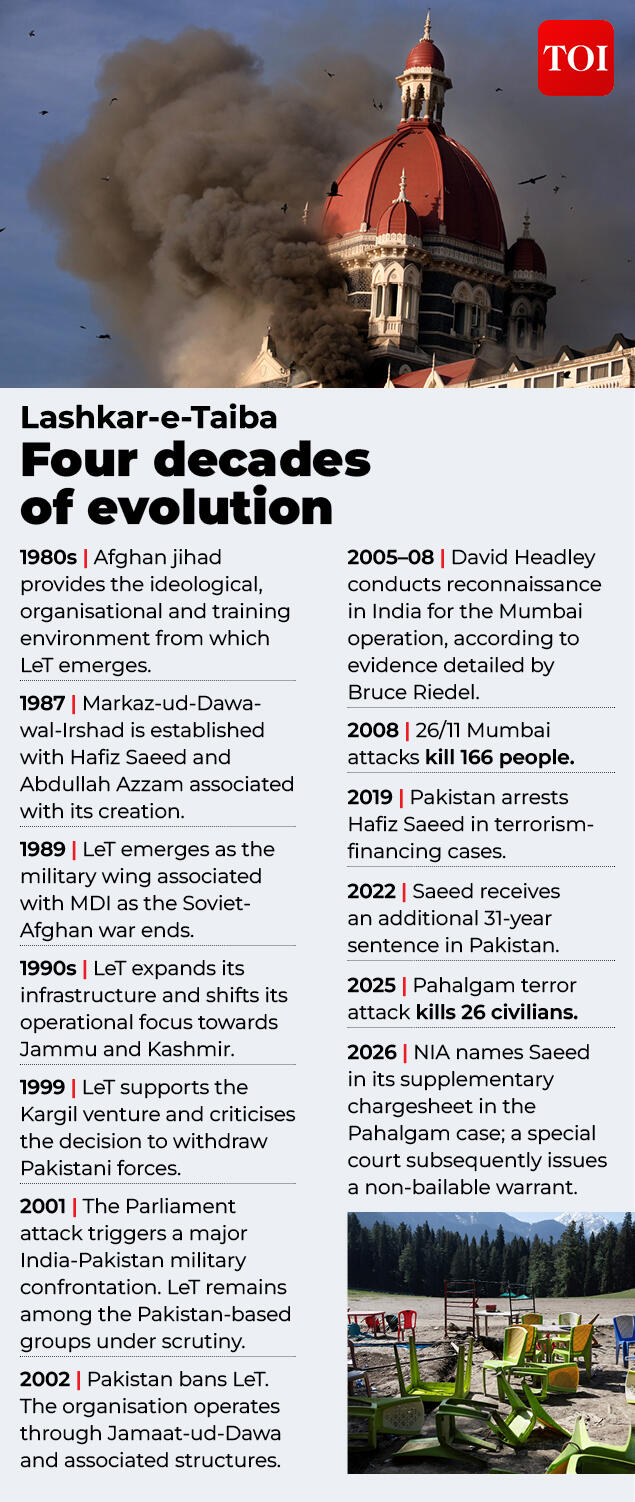
Four decades of evolution
From Kashmir insurgency to Mumbai
The years after 2001 saw LeT’s operational reach extend beyond the traditional Kashmir battlefield. The United Nations records that the organisation conducted terrorist operations against military and civilian targets from the 1990s onwards, including attacks in New Delhi and Mumbai and the December 2001 Parliament attack, in which Jaish-e-Mohammed was also involved.The 2008 Mumbai attacks represented the most significant expansion of that reach. Ten attackers carried out coordinated assaults across Mumbai between November 26 and 29, killing 166 people. The attack targeted several locations, including the Chhatrapati Shivaji Terminus, the Taj Mahal Palace Hotel, the Oberoi-Trident and Nariman House.The operation also demonstrated the organisational depth behind LeT’s attacks. Riedel’s account details the role of David Coleman Headley, who joined LeT in Pakistan and later conducted reconnaissance in Mumbai. Between 2005 and 2008, Headley travelled repeatedly to India, studying targets, recording locations and reporting back to LeT.The Mumbai operation therefore represented more than an extension of the Kashmir insurgency. It demonstrated the organisation’s ability to plan and execute a complex attack far from its traditional theatre while drawing on personnel, training and logistical networks developed over decades.
Why Afghanistan remained part of the network
The shift to Kashmir did not end LeT’s involvement in Afghanistan. Instead, the two theatres became connected through overlapping militant networks.Riedel wrote that LeT became increasingly active in Afghanistan, including operations against Indian interests and clashes with Nato forces. He also described growing operational links between LeT and the Afghan Taliban, particularly the Haqqani network.The United Nations likewise records LeT’s activity in Afghanistan and its links with al Qaida and the Taliban. The Australian government has documented LeT’s continued presence in Afghanistan and reported that the UN estimated the group had close to 1,000 members operating there in May 2020.Afghanistan therefore remained an important part of LeT’s network even after Kashmir became its main operational focus. The relationships, training environments and infrastructure developed during the Afghan jihad continued to provide connections to other militant organisations.
Saeed’s legal history and the Pahalgam case
Saeed’s subsequent legal history illustrates the difference between Pakistan’s formal action against LeT and the organisation’s continued existence through associated structures.Pakistan arrested Saeed in 2019 on terrorism-financing charges. He was convicted in several cases and received additional sentences in subsequent proceedings. The UN Security Council’s current sanctions information says Saeed is in Pakistani custody serving a cumulative 78-year sentence following convictions in seven terrorism-financing cases.India, meanwhile, has continued to pursue him over alleged involvement in major terror attacks attributed to LeT.The latest development is the NIA’s supplementary chargesheet in the Pahalgam case. The agency has named Saeed both individually and as the chief of LeT and TRF, alleging that he was part of the wider conspiracy behind the April 2025 attack.The subsequent non-bailable warrant followed the NIA’s request for Saeed’s arrest and custodial interrogation. Meanwhile, Mumbai Police has begun the process for an in-absentia trial against Saeed and five other Pakistan-based accused in the 26/11 case.
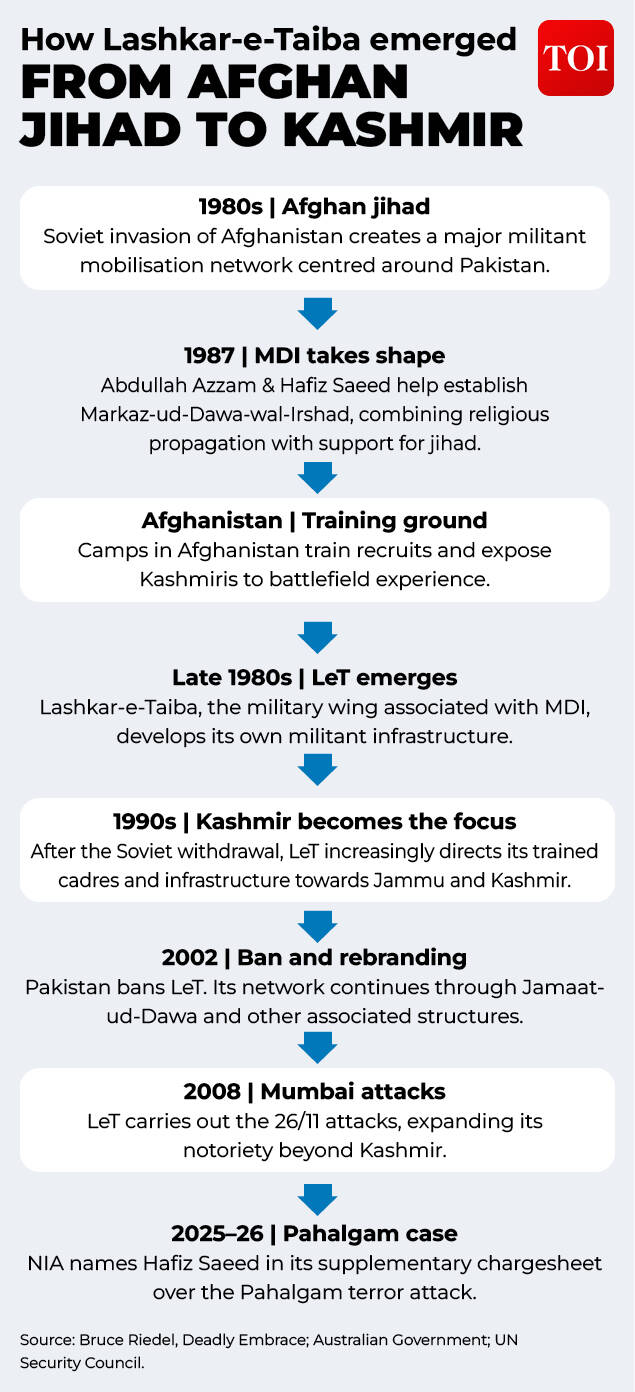
From Afghan jihad to Kashmir
From Afghan jihad to Pahalgam
Lashkar-e-Taiba’s four-decade history can be traced through a sequence of changing battlefields and organisational forms. Its foundations were laid during the Afghan jihad, when Hafiz Saeed and Abdullah Azzam helped build MDI and the networks around it. After the Soviet withdrawal, the organisation redirected much of its experience and infrastructure towards Kashmir, where it became a major Pakistan-based militant group.The 2002 ban did not erase the network. It adapted through Jamaat-ud-Dawa and other associated structures, while maintaining religious, charitable and recruitment networks across Pakistan. Its links with militant groups operating in Afghanistan also survived, even as India and Kashmir remained its central focus.The Mumbai attacks showed how far that network could project violence beyond Kashmir. The Pahalgam investigation has now brought the story back to the same region where LeT established much of its early operational identity.The latest legal proceedings against Saeed therefore sit at the end of a history that began not in Mumbai or Pahalgam, but in the Afghan jihad of the 1980s.