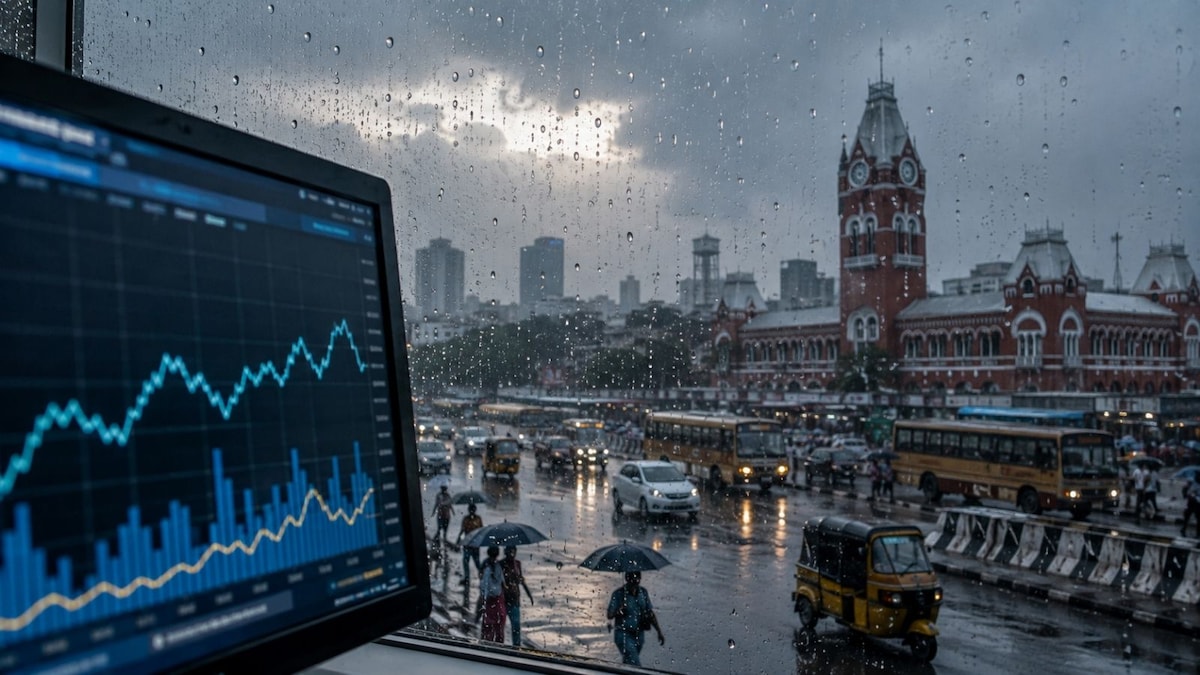
The contract, called RAINCHNNAI, was launched on Monday, August 31, and tracks how much Chennai’s cumulative rainfall deviates from its long-term average.
It covers September to December, a particularly important period for the city because the Northeast Monsoon accounts for nearly 70% of Chennai’s annual rainfall.
Unlike insurance, payouts don’t depend on proving that heavy or deficient rainfall caused a particular loss. The contract is settled according to observed rainfall recorded by India Meteorological Department (IMD) stations at Meenambakkam and Nungambakkam.
Also read: Rupee rises 26 paise to close at 95.17 against US dollar
How does a rainfall futures contract work?
RAINCHNNAI tracks cumulative deviation rainfall (CDR)—essentially the difference between how much rain Chennai actually receives and how much it would normally receive over the period.
NCDEX uses a long-period average (LPA) calculated from the past 50 years of rainfall data as the benchmark.
If rainfall moves significantly above or below that benchmark, the value of the contract changes. A participant whose business is financially exposed to such a change can take a position in the futures contract intended to offset some of that risk.
That could potentially make the contract useful for businesses whose revenues or costs are sensitive to rainfall, without requiring them to demonstrate that a specific weather event caused a specific monetary loss.
No physical delivery — just cash settlement
You aren’t literally buying or selling rainfall.
RAINCHNNAI is cash-settled, meaning positions are ultimately settled in money based on the rainfall index.
The contract has a tick size of 1 millimetre and a lot multiplier of ₹50 per mm. The minimum initial margin is 10%, while the maximum order size is 50 lots.
The final settlement price will be determined using the CDR spot value on the expiry day.
The last trading day will be the business day immediately preceding the final calendar day of the relevant contract month. Trading will be available between 10 am and 11.55 pm on weekdays.
Also read: Eternal to lay off around 250 employees as it shuts Hyderabad customer support centre
From Mumbai’s monsoon to Chennai’s
The Chennai contract expands NCDEX’s experiment with exchange-traded rainfall risk.
Earlier this year, the exchange launched RAINMUMBAI, aimed at managing rainfall risk associated with the Southwest Monsoon.
The two contracts therefore cover India’s two major monsoon patterns: RAINMUMBAI focuses on the June-September Southwest Monsoon, while RAINCHNNAI covers Chennai’s September-December Northeast Monsoon season.
NCDEX said the methodology behind RAINCHNNAI was developed in collaboration with IIT Bombay and relies on official IMD rainfall observations.
The broader idea is to turn rainfall—a factor that businesses can’t control but which can materially affect their finances—into a measurable risk that can potentially be hedged in the derivatives market.