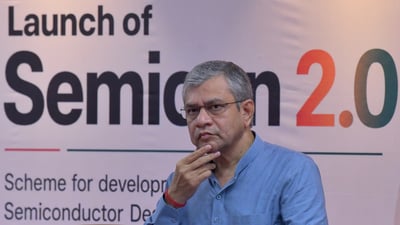
The government on Monday reduced the support for silicon fabs from 50% to 40% while notifying the Semicon 2.0 scheme, with Union minister for IT and electronics Ashwini Vaishnaw calling the renewed support “globally competitive”—neither extraordinarily low nor high. Under the 2022 scheme —Semicon 1.0—eligible silicon fabs could receive 50% of project cost. The second edition of the scheme now provides 40% support on an equivalent basis for eligible capital expenditure.
Also Read I The century will belong to those who command silicon
Speaking to media on Monday, Vaishnaw said lowering the support won’t be a disadvantage to the industry as it is moving at a fast pace, and several factors like ease of doing business and India’s policy certainty added to the government’s decision making.
“When we started Semicon 1.0 in 2022, the global semicon majors had serious doubts about India. That doubt is now replaced by confidence. They now believe India is the right place for making major investments in the coming decades,” said Vaishnaw.
New scheme split into 10 categories
The new scheme, with a total outlay of ₹1.27 lakh crore, approved by the Union Cabinet in July, has been divided into 10 categories of support and six pillars. The pillars include chip design, machines and materials, expanded semiconductor fabs, advanced packaging, research and development, and talent development.
While support for silicon fabs has come down, the government has created dedicated support for display fabs, covering OLED, Micro LED and LCD technologies. OLED and LCD projects require a minimum ₹10,000 crore investment and will get 35% support, while a Micro LED project requires a minimum ₹1,500 crore investment and also gets 35% support.
Packaging is another addition. Semicon 2.0 provides 35% support for advanced packaging, including 2.5D and 3D packaging, wafer-level chip-scale packaging and heterogeneous integration. Legacy packaging projects will get 25% support.
The government is also widening support to the equipment and materials that go into making chips. This includes semiconductor equipment, sub-assemblies and components, as well as wafers, photomasks, photoresists, substrates, chemicals, gases and other semiconductor-grade materials. Equipment manufacturers will also be eligible for a separate production-linked incentive based on the value of components sourced from domestic manufacturers.
Also Read I Apple Mac mini and Mac Studio with M6 and M5 Ultra set new silicon benchmarks
For commercial chip design, startups and MSMEs can receive seed funding of up to ₹15 crore, while equity co-investment will also be available. Larger eligible companies can access royalty financing or equity co-investment.