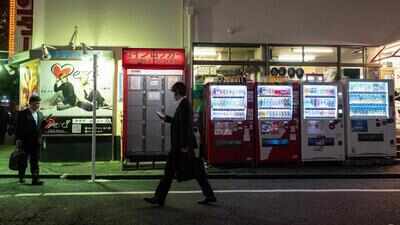
Japan is home to more than 2.6 million vending machines, meaning there’s roughly one machine for every 45-50 residents. These machines sell everything ranging from fresh flowers and hot ramen bowls to umbrellas and even edible grasshoppers. For Japanese consumers, the appeal lies in speed and convenience getting what you need instantly without waiting in line. To understand how the country got here, and how these machines actually work, Popular Science spoke with David Widjaja, a former vending machine industry employee and current owner of Japantogo LLC, an Ishikawa-based company that exports Japanese vending machines internationally.
Japanese vending machines a surprisingly ancient invention
Vending machines are far older than most people assume. The world’s first known vending machine was built by the Greek engineer and inventor Hero of Alexandria in ancient Egypt during the first century AD, originally used to dispense holy water inside temples. Hero’s device relied on a simple counterweight lever system, similar to a set of old-fashioned scales — dropping a coin into the machine caused it to land on one side of a balanced lever, and the added weight triggered a valve that released a measured flow of water.Despite its cleverness, the concept largely disappeared for well over a thousand years. It resurfaced in the late 19th century, when coin-operated machines dispensing postcards, envelopes, and notepaper began appearing on railway platforms across London for travelers in a hurry. The idea soon crossed the Atlantic — by 1888, the Thomas Adams Gum Company was installing machines stocked with Tutti-Frutti chewing gum throughout New York City’s transit system. From there, vending machines gradually expanded to offer everything from cartons of milk to refrigerated sandwiches.
Why vending machines took off in Japan specifically
Vending machines didn’t become deeply embedded in Japanese culture until after World War II, during the country’s rapid postwar economic recovery. Widjaja said their appeal comes down to convenience in a culture that values speed and efficiency. He noted that people in Japan are frequently in a rush and want something immediately, and that stepping into an actual store can easily cost four or five minutes of waiting — a delay a vending machine eliminates entirely.
How vending machines actually work
At their core, vending machines run on what’s known as an embedded computer system — a computer built for one specific, narrow purpose. Inside, that system consists of a microcontroller acting as the machine’s “brain,” along with sensors and actuators, including the gear motors and pusher tracks responsible for physically releasing a snack or drink. Widjaja emphasized that despite appearances, the underlying mechanism is fundamentally simple: the microcontroller receives a customer’s selection, validates their payment, and then sends a command to the correct dispensing motor.
How payment gets verified
When a customer inserts coins, the machine uses electromagnetic sensors to determine whether the payment is legitimate. These sensors identify a coin’s specific metal composition by measuring how it interacts with an electric and magnetic field — different metals respond differently. Cheap iron, for instance, becomes temporarily magnetized as it passes through the machine’s magnetic field, while pure aluminum passes through with comparatively little effect. The machine’s microcontroller compares these readings against a stored database of legitimate currency to confirm authenticity.At the same time, optical sensors measure a coin’s diameter, thickness, and speed as it travels down the machine’s chute, using the shadow the coin casts on a light sensor to calculate its exact size and confirm it isn’t moving abnormally fast or slow — a telltale sign of a counterfeit coin, which triggers an automatic rejection.Paper currency goes through a similar but distinct process, with infrared and UV light sensors reading hidden security markings along with the magnetic ink used in the printing of most banknotes. Credit card payments, meanwhile, are verified by transmitting encrypted data through an attached telemetry gateway device directly to a banking network for real-time confirmation.
How the product actually gets dispensed
Once payment is confirmed and a selection is made, the microcontroller shifts into dispensing mode, sending a signal to the specific motor assigned to that item. Different machines use different mechanical approaches: some rely on spiral coils that rotate a full 360 degrees to slowly push a product off the shelf, others use robotic elevator arms or picker mechanisms that rise to the correct shelf, grab the item, and lower it gently to avoid damage — particularly important for carbonated drinks. Simpler machines rely on straightforward gravity, letting the selected item slide off an angled shelf directly into the retrieval bin.
What makes Japanese vending machines different
Many vending machines worldwide include built-in refrigeration to keep drinks cold, or internal heating elements for warm beverages like coffee and tea. But machines capable of dispensing both hot and cold items from the very same unit remain rare in the United States — a stark contrast to Japan, where Widjaja said efficiency is the whole point of the design, allowing a single machine to sell cold drinks in summer and hot coffee in winter.These dual-temperature machines achieve that using two separate, heavily insulated compartments — one for hot items, one for cold. Many modern versions also incorporate a heat-pump system that recycles thermal energy generated by the machine’s cooling side and redirects it into the heating side, significantly cutting the unit’s overall energy consumption.