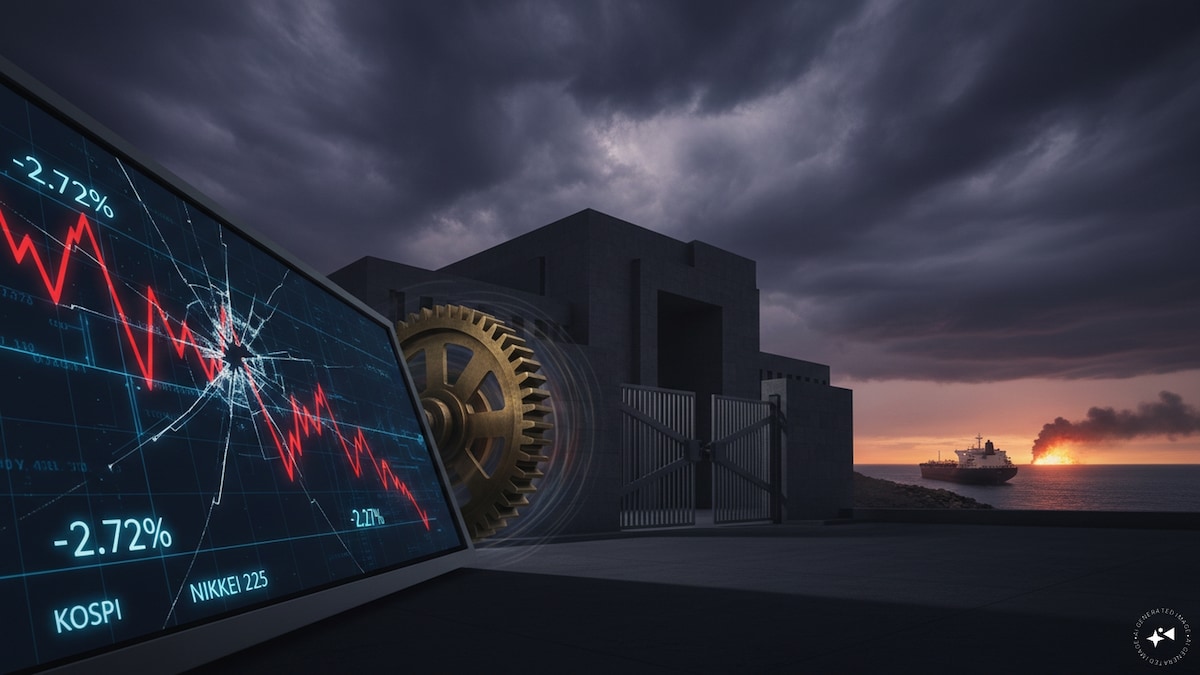
MSCI’s Asia Pacific index dropped 1% as South Korea’s Kospi tumbled 2.72%, while Japan’s Nikkei 225 shed 2.27% and the Topix lost 1.72%. Hang Seng futures barely moved.
The GIFT Nifty traded lower, hinting at a negative start to the Nifty 50 index on Dalal Street.
In currency markets, the Japanese yen held steady at 160.15 per dollar, and the offshore yuan was little changed at 6.7221.
The regional selloff followed a rough session on Wall Street, where the S&P 500 fell for a third straight day and the Nasdaq 100 slid 1.3%.
Crude oil prices edged higher as Brent crude climbed further to around $95 a barrel, while the US West Texas Intermediate (WTI) rose 0.8% to $90.91, as fighting between the US and Iran intensified fears of fresh disruption to oil flows through the Strait of Hormuz.
The jump in global energy costs pushed global bond yields to their highest level since 2008, as traders raised bets that the US Federal Reserve would lift interest rates.
This added to investor concerns that the possibility of inflation was imminent because of heavy government spending and corporate borrowing tied to the artificial-intelligence buildout.US President Donald Trump said that the US strikes came in response to Iran’s attempt to mine the strait and an earlier attack on a military base in Jordan. Iran, in turn, said it had fired a missile at a US air base in Jordan after the American strikes were carried out.
The clash broke weeks of relative calm, during which Washington had leaned towards economic pressure rather than military action against Tehran. Monday also saw Iran’s President signal that the country was willing to reciprocate with the US for a peace deal if the latter returned to the terms of the now-lapsed June memorandum that had earlier this year provided hopes of an end to the conflict that began towards the end of February.
Federal Reserve Chair Kevin Warsh’s Jackson Hole address last week added to expectations of tighter policy, with markets now pricing in roughly a 70% chance of a September rate rise according to a Bloomberg report.
US Fed Governor Michael Barr said the central bank must stand ready to raise rates further if inflation does not ease, cautioning that price pressures risk becoming entrenched after running above target for more than five years, the report said. Friday’s US payrolls report is expected to offer fresh clues on the Fed’s next move, with inflation still sitting above the central bank’s 2% target.
Also Read: Kevin Warsh’s Fed message puts India’s valuation premium to test