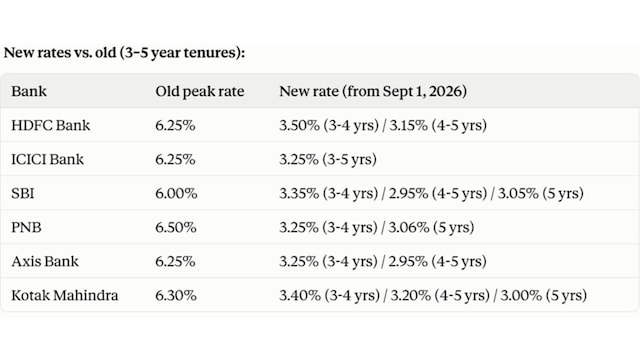
Fixed deposits (FDs) and debt mutual funds are popular options for investors looking for relatively stable returns, but they differ in risk, taxation,…

 1/7
1/7What is a Fixed Deposit? A Fixed Deposit (FD) is a savings instrument offered by banks and NBFCs where you invest a lump sum for a fixed tenure at a predetermined interest rate. The rate stays constant throughout the tenure, regardless of market movements, and you receive your principal along with interest at maturity. FDs are widely used because they are simple to open, easy to understand, and available at almost every bank. (Image: Shutterstock)
 2/7
2/7What is a Debt Mutual Fund? A Debt Mutual Fund pools money from investors and invests it in fixed-income instruments such as government securities, corporate bonds, treasury bills, and money market instruments. Unlike FDs, returns are not fixed — they depend on how the underlying bonds perform and on interest rate movements. Debt funds come in various types, such as liquid funds, short-duration funds, and corporate bond funds, each carrying a different risk-return profile. (Image: Shutterstock)
 3/7
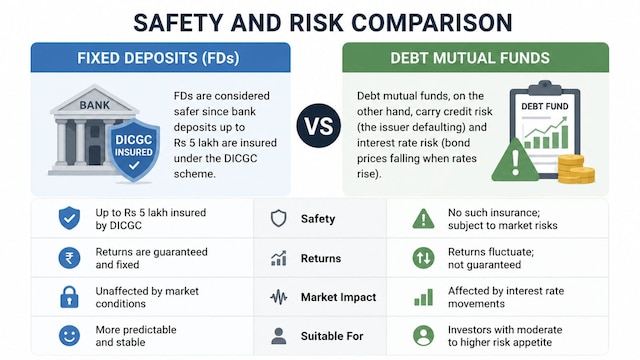
3/7Safety and Risk Comparison: FDs are considered safer since bank deposits up to ₹5 lakh are insured under the DICGC scheme, and the returns are guaranteed regardless of market conditions. Debt mutual funds, on the other hand, carry credit risk (the issuer defaulting) and interest rate risk (bond prices falling when rates rise), meaning returns can fluctuate and are not guaranteed. For risk-averse investors, FDs generally offer more predictability. (Image: AI)
 4/7
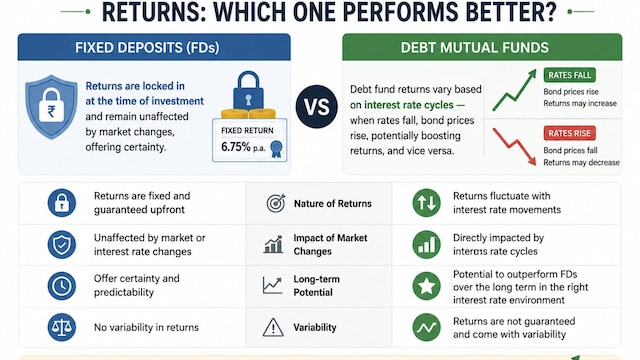
4/7Returns: Which one performs better? FD returns are locked in at the time of investment and remain unaffected by market changes, offering certainty. Debt fund returns vary based on interest rate cycles — when rates fall, bond prices rise, potentially boosting returns, and vice versa. Over the long term, debt funds have the potential to outperform FDs, especially in specific interest rate environments, but this comes with variability that FDs do not have. (Image: AI)
 5/7
5/7Taxation Differences: Interest earned on FDs is added to the investor’s income and taxed as per their income tax slab, with TDS deducted if interest exceeds the specified threshold in a financial year. Debt mutual funds, following recent tax rule changes, are also taxed at the investor’s slab rate on gains, regardless of the holding period, removing the indexation benefit debt funds previously enjoyed. This has narrowed the taxation gap between the two options considerably. (Image: Shutterstock)
 6/7
6/7Liquidity and Flexibility: FDs come with a fixed lock-in, and premature withdrawal usually attracts a penalty along with a reduction in the applicable interest rate. Debt mutual funds, particularly liquid and short-duration funds, generally offer greater flexibility, allowing investors to redeem units within a day or two without steep penalties. This makes debt funds a more convenient option for those who may need access to funds on short notice. (Image: AI)
 7/7
7/7Which One Should You Choose? The right choice depends on individual goals: those prioritising safety, guaranteed returns, and simplicity may find FDs more suitable, especially for short-term goals or emergency funds. Investors comfortable with some market-linked risk, seeking potentially better post-tax returns and liquidity, may lean towards debt mutual funds. A mix of both can also help balance safety and growth, depending on one’s risk appetite and financial timeline. (Image: Shutterstock)