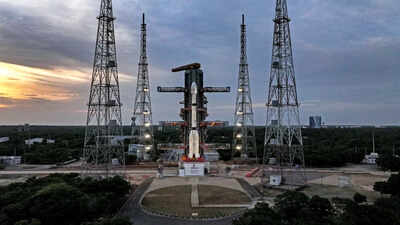
NEW DELHI: India is set to launch its first imaging satellite into geosynchronous orbit on Friday, with the EOS-05 mission expected to significantly strengthen the country’s ability to continuously monitor the same region of the Earth, including its borders and strategic areas.The state-of-the-art Earth observation satellite, also known as Gisat-1A, is scheduled to lift off at 2.55 am on September 4 aboard the GSLV-F17 rocket from the second launch pad at the Satish Dhawan Space Centre in Sriharikota, Andhra Pradesh.ISRO has commenced the 27-hour countdown for the mission, which began at 11.30 pm on Wednesday. The 51.7-metre-tall GSLV-F17 is the 19th flight of India’s Geosynchronous Satellite Launch Vehicle.ISRO Chairman V Narayanan said all arrangements for the launch had been completed and described EOS-05 as a state-of-the-art Earth observation spacecraft that would strengthen India’s Earth observation capabilities and improve the delivery of related services.“Mr Narayanan said EOS-05 is a state-of-the-art Earth observation spacecraft and India’s first imaging satellite to be placed in a geosynchronous orbit. He said the mission will further strengthen India’s Earth observation capabilities and improve the delivery of Earth observation services.”
Satellite to keep constant watch
The key advantage of EOS-05’s geosynchronous orbit is its ability to continuously observe the same region rather than capturing periodic images as satellites in lower orbits do.At an altitude of around 36,000 km, a geosynchronous satellite can match the Earth’s rotation and remain over a fixed region. This enables near-continuous observation of areas of interest and allows rapid monitoring of events such as severe storms, lightning and fires.The capability could also strengthen surveillance of India’s borders and other strategic areas by providing repeated and persistent imagery from space.Most of India’s existing imaging and Earth observation satellites, including those in the Cartosat and RISAT series, operate in low Earth orbit. Such satellites move around the planet and may take days to revisit a location, depending on their orbit.EOS-05 carries two multispectral imagers. One of them has a spatial resolution of 42 metres per pixel, described as the highest resolution camera in a geostationary orbit.The satellite is designed for both civilian and strategic applications, providing detailed imagery and data for monitoring land, the environment and rapidly changing events.
Mission follows 2021 setback
EOS-05 follows the failed launch of Gisat-1 in August 2021. The earlier satellite was lost when a technical anomaly in the cryogenic upper stage of the GSLV-F10 rocket prevented proper ignition.Had that mission succeeded, Gisat-1 would have become India’s first Earth-imaging satellite to operate from geostationary orbit.The upcoming GSLV-F17 mission therefore marks a significant step in India’s efforts to expand persistent Earth observation capabilities from geosynchronous orbit.Before the launch, Narayanan offered prayers at the Sri Venkateswara Swamy Temple in Tirumala and placed models of the GSLV-F17 rocket at the feet of Lord Venkateswara.With the countdown underway, the launch is scheduled for 2.55 am on Friday from Sriharikota.